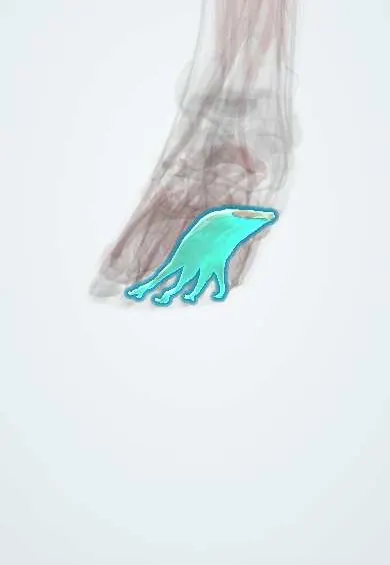
Flexor digitorum brevis !
The flexor digitorum brevis is a sole muscle lying just above the plantar fascia; it bends the four smaller toes.
Opens in the Durgical app, no sign-up needed.
What it is
A muscle in the middle of the sole, just above the plantar fascia, from the heel bone to the four smaller toes.
What it does
Bends the four smaller toes and helps support the arch.
Key facts
- Origin
- Medial process of calcaneal tuberosity; plantar fascia; intermuscular septa
- Insertion
- Both sides of middle phalanges of toes 2–5 (split tendons)
- Action
- Flexes toes 2–5 at PIP and MTP joints
- Nerve
- Medial plantar nerve (S1–S2) (some texts: S2–S3)
- Blood supply
- Medial and lateral plantar arteries; plantar arch
Relations
- Superficial
- Plantar fascia, partly fused with it near the heel
- Deep
- Lateral plantar nerve and vessels, then quadratus plantae and the flexor digitorum longus tendons and lumbricals of the second layer
- Medial
- Abductor hallucis, with the medial plantar nerve and vessels between them
- Lateral
- Abductor digiti minimi
How to find it
It lies in the middle of the sole under the plantar fascia; when the lesser toes are curled it firms under the fingers in the mid-sole.
Examination
- Paper grip test: the person tries to hold a card under the toes while it is pulled away; failure suggests weak toe flexors (short and long)
On imaging
Ultrasound and MRI show it as the central muscle just deep to the plantar fascia. In plantar fasciitis, imaging shows the fascia thickened at its calcaneal origin, with oedema that may extend into this muscle. A lateral foot radiograph may show a plantar calcaneal spur at the shared origin of the muscle and fascia; spurs are also common in people without heel pain.
Common problems
- Like the other small muscles of the foot, it can weaken with age, nerve problems or tight shoes, which can let the arch drop or the toes change shape.
Clinical notes
- Can be turned as a local muscle flap to cover defects of the weight-bearing heel
- Its weakness, with that of the other small foot muscles, contributes to claw toes
- In plantar fascia release the cut stays in the fascia; the muscle just deep to it shields the lateral plantar nerve and vessels, which cross the sole one layer deeper
Anatomical variants
- The tendon to the fifth toe is often small or absent
Test yourself
Think of the answer, then tap the question to see it.
Where does the flexor digitorum brevis insert, and what is special about its tendons?
On both sides of the middle phalanges of toes 2–5; its tendons split to let the flexor digitorum longus tendons through.
In which layer of the sole is the flexor digitorum brevis, and which nerve supplies it?
The central muscle of the first layer, directly under the plantar fascia; medial plantar nerve.
What reconstructive use does the flexor digitorum brevis have?
It can be turned as a local muscle flap to cover defects of the weight-bearing heel.
Educational information, not medical advice. For any symptom, see a health professional.
Its names
- Official Latin (TA2)
- flexor brevis digitorum TA2 2683
- Official Spanish (DeCS)
- Músculo flexor corto de los dedos
- English (TA2)
- Flexor digitorum brevis
- Also called
- flexor digitorum brevis muscle
Related
- Plantar fascia
- Quadratus plantae
- Medial plantar nerve
- Plantar arteries
- Calcaneus
- Fifth metatarsal
- Second toe
- Third toe
Sources: Terminologia Anatomica (TA2); Anatomy, Bony Pelvis and Lower Limb, Foot Muscles.
Spotted a mistake?We are always improving for the community. Tell us what is wrong and our team will review it.Report a mistake
Representative model, for educational purposes only.