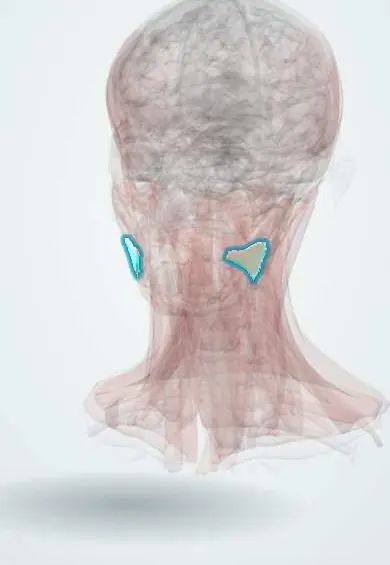
Muscular system · Head and neck
Risorius !
The risorius is a thin strip of facial muscle from the cheek to the corner of the mouth; it pulls the mouth corner sideways.
Official name: Risorius muscle
Opens in the Durgical app, no sign-up needed.
What it is
A thin strip from the cheek to the mouth corner.
What it does
Pulls the mouth corner sideways.
Key facts
- Origin
- Parotid/masseteric fascia
- Insertion
- Angle of the mouth
- Action
- Pulls the mouth corner sideways
- Nerve
- Facial nerve (CN VII): buccal branches
- Blood supply
- Facial artery branches
Relations
- Superficial
- Skin and subcutaneous fat of the cheek
- Deep
- Masseteric and parotid fascia, the masseter, and further forward the buccinator; the facial artery and vein pass deep to it
- Medial
- Modiolus at the angle of the mouth
- Below
- Platysma, whose upper fibres often merge with it
How to find it
Asked to pull the mouth corners straight sideways (a tight, closed-lip grin), a thin horizontal band tightens across the cheek toward the mouth corner.
Examination
- Grinning with the lips closed: the mouth corner does not pull back on the weak side (buccal branch of the facial nerve)
On imaging
Usually not identified on imaging: it is thin, variable and often blends with the platysma and the parotid fascia. Ultrasound or MRI of the cheek may show it as a fine superficial band over the masseter. Imaging of this area is aimed at the parotid gland and masseter beneath it; for a weak smile, MRI follows the course of the facial nerve.
Clinical notes
- Risus sardonicus, the fixed grin of tetanus, is named after it, though it reflects spasm of many facial muscles
- Botulinum toxin injection into the masseter can spread to it and the zygomaticus major, giving an uneven smile
Anatomical variants
- Absent, poorly developed or doubled in many people; it may arise from the platysma rather than the fascia
Development
Second pharyngeal arch muscle; the incomplete splitting of this arch's muscle sheet helps explain why it is so variable and may blend with the platysma.
Memory aid
Risorius, from the Latin risus (laughter): it pulls the mouth corner sideways, as in a grin.
Test yourself
Think of the answer, then tap the question to see it.
What is the action and nerve supply of the risorius?
It pulls the mouth corner sideways; supplied by the buccal branches of the facial nerve.
Which tetanus sign is named after the risorius?
Risus sardonicus, the fixed grin of tetanus, although it reflects spasm of many facial muscles.
Why is the risorius often hard to identify?
It is the most variable facial muscle: thin, sometimes absent or doubled, and may arise from the platysma.
Educational information, not medical advice. For any symptom, see a health professional.
Its names
- Official Latin (TA2)
- musculus risorius TA2 2078
- Official Spanish (DeCS)
- Músculo risorio
- English (TA2)
- Risorius muscle
- Also called
- muscle of Albinus · Santorini's muscle
Related
Sources: Terminologia Anatomica (TA2); Anatomy, Head and Neck, Risorius Muscle; Anatomy of the Human Body (20th ed.): Development of the Muscles (Lea & Febiger (Gray's Anatomy, 1918), 1918) · adapted, Public domain.
Spotted a mistake?We are always improving for the community. Tell us what is wrong and our team will review it.Report a mistake
Representative model, for educational purposes only.