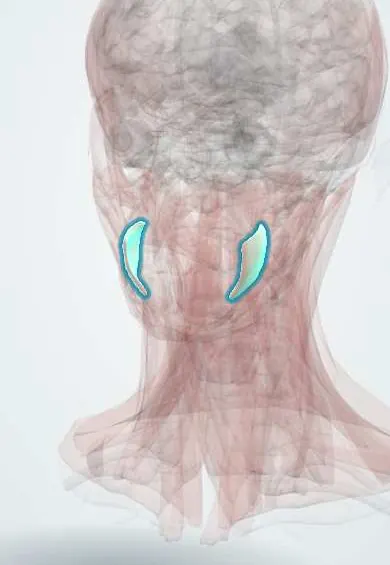
Muscular system · Head and neck
Buccinator !
The buccinator is the muscle of the cheek wall; it keeps food between the teeth while chewing and helps blow air out.
Official name: Bucinator
Opens in the Durgical app, no sign-up needed.
What it is
The muscle of the cheek wall.
What it does
Keeps food between the teeth and blows air out (trumpet muscle).
Key facts
- Origin
- Alveolar processes of maxilla and mandible (molar region), pterygomandibular raphe
- Insertion
- Angle of the mouth (modiolus)
- Action
- Presses the cheek against the teeth; blowing
- Nerve
- Facial nerve (CN VII): buccal branches (the buccal nerve of V3 only gives sensation)
- Blood supply
- Facial artery branches
Relations
- Superficial
- Buccal fat pad, the anterior border of the masseter, the parotid duct, the facial artery and vein, and the zygomaticus major and risorius
- Deep
- Cheek mucosa and the oral vestibule; the buccal nerve (V3) runs on its outer surface and sends branches through it to the mucosa
- In front
- Blends into the orbicularis oris at the modiolus beside the angle of the mouth
- Behind
- Pterygomandibular raphe, behind which the superior pharyngeal constrictor continues
How to find it
With a gloved finger inside the cheek and the thumb outside, the muscle is felt tensing when the person blows out against closed lips. The parotid duct can be rolled over the front edge of the clenched masseter just before it dives through the buccinator.
Examination
- Puffing out the cheeks: on a weak side air leaks from the corner of the mouth and the cheek gives way to a light tap
- In facial nerve palsy food collects between the cheek and the teeth on the affected side, and the person bites the cheek
On imaging
On axial CT or MRI it is the thin muscle deep in the cheek, along the side of the mouth, with the buccal fat pad outside it. The parotid duct pierces it opposite the upper second molar, so ultrasound or sialography follow the duct there to find stones. Contrast CT shows whether a dental infection has spread above or below its attachments, into the buccal space outside it or only into the mouth.
Clinical notes
- Landmark for the inferior alveolar nerve block: the needle enters the mucosa lateral to the pterygomandibular raphe, through the buccinator, into the pterygomandibular space
- The facial artery musculomucosal (FAMM) flap uses buccinator and mucosa to rebuild the lip, palate or floor of mouth
- Infections of the upper and lower molars spread to the buccal space or into the mouth depending on whether they break out above or below its attachments
- Cheek lacerations near the second molar can cut the parotid duct; a probe passed through the duct papilla shows the injury
Development
Second pharyngeal arch muscle, which is why it is supplied by the facial nerve even though it sits among the chewing muscles.
Memory aid
Buccinator comes from the Latin buccina, a trumpet: the trumpeter's muscle that blows air out.
Test yourself
Think of the answer, then tap the question to see it.
Which duct pierces the buccinator, and where does it open?
The parotid duct, opening on the cheek mucosa opposite the upper second molar.
What nerve supplies the buccinator, and what is the buccal nerve that crosses it?
The facial nerve (buccal branches); the buccal nerve is a sensory branch of V3, not its motor supply.
Which raphe does the buccinator share with the superior pharyngeal constrictor?
The pterygomandibular raphe, so the cheek and pharyngeal walls form one continuous muscular tube.
Why does food collect between the cheek and teeth in facial nerve palsy?
The buccinator, which presses the cheek against the teeth, is paralysed.
Educational information, not medical advice. For any symptom, see a health professional.
Its names
- Official Latin (TA2)
- bucinator TA2 2086
- Official Spanish (DeCS)
- Músculo buccinador
- English (TA2)
- Bucinator
- Also called
- bucinator muscle · buccinator muscle · musculus bucinatorius
Related
Sources: Terminologia Anatomica (TA2); Anatomy, Head and Neck: Buccinator Muscle; Anatomy, Head and Neck: Facial Muscles.
Spotted a mistake?We are always improving for the community. Tell us what is wrong and our team will review it.Report a mistake
Representative model, for educational purposes only.