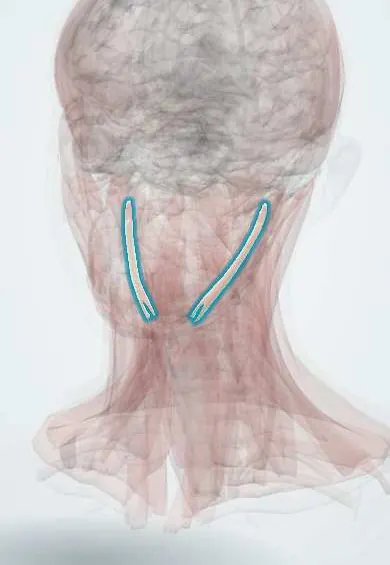
Muscular system · Head and neck
Stylohyoid !
The stylohyoid is a slim neck muscle from a bony spike under the ear (the styloid process) to the hyoid bone; it pulls the hyoid up and back.
Official name: Stylohyoid muscle
Opens in the Durgical app, no sign-up needed.
What it is
A slim muscle from the styloid process to the hyoid.
What it does
Pulls the hyoid up and back.
Key facts
- Origin
- Styloid process
- Insertion
- Body of the hyoid (splits around the digastric tendon)
- Action
- Elevates and retracts the hyoid
- Nerve
- Facial nerve (CN VII)
- Blood supply
- Facial and occipital arteries
Relations
- Course
- From the back of the styloid process it runs down and forward along the posterior belly of the digastric to the junction of the body and greater horn of the hyoid bone
- Superficial
- Parotid gland above; the facial nerve trunk crosses lateral to the styloid process near its origin
- Deep
- External and internal carotid arteries, the internal jugular vein and the hypoglossal nerve
How to find it
It cannot be felt. In parotid and upper neck surgery it is the slim muscle running with the posterior belly of the digastric; the facial nerve trunk lies above and lateral to it, at the styloid process.
On imaging
Too slim to follow on most scans; CT and MRI find it running with the posterior belly of the digastric from the styloid process to the hyoid. The styloid process is the landmark to check: CT with 3D reconstruction shows an elongated styloid or a calcified stylohyoid ligament (Eagle syndrome) in a person with throat or neck pain on turning the head.
Clinical notes
- Eagle syndrome: an elongated styloid process or a calcified stylohyoid ligament causes throat pain, pain on swallowing or turning the head, or a foreign-body feeling; a vascular form presses on the carotid arteries
- Its small branch from the facial nerve, given off just below the stylomastoid foramen, helps the surgeon trace back to the main trunk in parotidectomy
Anatomical variants
- It may be absent or doubled, or pass beside rather than around the intermediate tendon of the digastric
Development
From the second pharyngeal arch (hence the facial nerve), as are the stylohyoid ligament and the lesser horn of the hyoid bone.
Test yourself
Think of the answer, then tap the question to see it.
Which nerve supplies the stylohyoid, and which nerves supply the other two muscles from the styloid process?
Stylohyoid: facial nerve; styloglossus: hypoglossal nerve; stylopharyngeus: glossopharyngeal nerve.
Which muscle does the stylohyoid accompany and split around near the hyoid?
The posterior belly of the digastric: the stylohyoid splits around its intermediate tendon before inserting on the hyoid body.
What is Eagle syndrome?
Throat or swallowing pain, or a foreign-body feeling, from an elongated styloid process or a calcified stylohyoid ligament; a vascular form presses on the carotids.
Educational information, not medical advice. For any symptom, see a health professional.
Its names
- Official Latin (TA2)
- musculus stylohyoideus TA2 2164
- Official Spanish (DeCS)
- Músculo estilohioideo
- English (TA2)
- Stylohyoid muscle
Related
Sources: Terminologia Anatomica (TA2); Anatomy, Head and Neck, Stylohyoid Muscle; Anatomy, Head and Neck: Suprahyoid Muscle.
Spotted a mistake?We are always improving for the community. Tell us what is wrong and our team will review it.Report a mistake
Representative model, for educational purposes only.