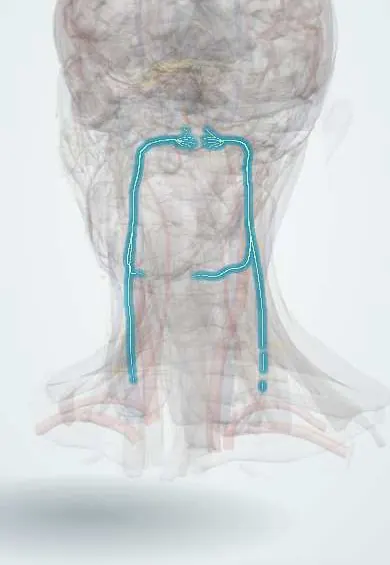
Nervous system · Head and neck
Glossopharyngeal nerve (IX) !
The glossopharyngeal nerve (cranial nerve IX) gives taste and feeling to the back of the tongue and throat, and senses blood pressure in the carotid.
Official name: Glossopharyngeal nerve
Opens in the Durgical app, no sign-up needed.
What it is
A nerve from the medulla through the jugular foramen to the throat and back of the tongue.
What it does
Taste and feeling of the back of the tongue and throat (gag reflex); senses carotid pressure.
Key facts
- Roots
- Nucleus ambiguus, inferior salivatory, solitary nucleus (medulla); jugular foramen
- Moves
- Stylopharyngeus (some texts: also the superior constrictor via the pharyngeal plexus); parotid gland (parasympathetic: tympanic nerve -> lesser petrosal nerve -> otic ganglion -> auriculotemporal nerve)
- Feeling from
- Posterior third of the tongue (taste and touch), pharynx (gag reflex afferent), middle ear, carotid sinus and body; branches: tympanic, carotid sinus, pharyngeal (pharyngeal plexus), tonsillar, lingual
Relations
- Course
- Leaves the medulla oblongata in the groove behind the olive, above the vagus nerve rootlets, exits the jugular foramen in front of X and XI, descends between the internal carotid artery and the internal jugular vein, curves forward around the stylopharyngeus and passes between the superior and middle constrictors to the tonsil bed and the back of the tongue
- Behind
- In the jugular foramen, the vagus nerve (X) and the accessory nerve (XI)
- Deep
- In the tonsil bed it lies deep to the palatine tonsils, separated by the superior constrictor; tonsillectomy can stretch it, with taste loss or pain at the back of the tongue
How to find it
It cannot be felt. In neck surgery it is found passing forward between the internal and external carotid arteries above the carotid bifurcation, winding around the stylopharyngeus.
Examination
- Gag reflex: each side of the back of the throat is touched in turn; a weaker response when one side is touched suggests a IX lesion on that side, while a palate that does not lift from either side suggests X
- Sensation of the back wall of the pharynx and the tonsil area, compared side to side
On imaging
High-resolution heavily T2-weighted MRI shows it leaving the medulla behind the olive, above the vagus, toward the front of the jugular foramen. In glossopharyngeal neuralgia, MRI looks for a vessel pressing on its root entry zone, or a tumour. CT with bone windows shows the jugular foramen; a long calcified styloid process (Eagle syndrome) shows on CT or a panoramic radiograph.
Clinical notes
- Carotid sinus hypersensitivity: pressure over the carotid bifurcation triggers an exaggerated reflex (IX in, X out) with a slow heart rate and fainting
- Jugular foramen tumours (paraganglioma, schwannoma) affect IX, X and XI together: hoarseness, swallowing difficulty, a lost gag on that side and shoulder weakness
- Its tympanic branch supplies the middle ear, so pain from the throat or tonsils, for example after tonsillectomy, can be felt in the ear
- Eagle syndrome: a long styloid process or a calcified stylohyoid ligament can irritate the nerve, with throat pain or a feeling of something stuck on swallowing; the tip may be felt in the tonsil bed
Development
Nerve of the third pharyngeal arch; its only muscle, the stylopharyngeus, comes from that arch.
Test yourself
Think of the answer, then tap the question to see it.
What role does the glossopharyngeal nerve (IX) play in the gag reflex?
It is the afferent limb (sensation of the pharynx); the vagus nerve (X) is the efferent limb.
Which branch of the glossopharyngeal nerve carries the afferent limb of the baroreceptor reflex?
The carotid sinus branch, from the carotid sinus (blood pressure) and carotid body (blood oxygen).
Through which foramen does the glossopharyngeal nerve leave the skull, and what syndrome follows a lesion there?
The jugular foramen, with X and XI; a lesion there affects IX, X and XI together (Vernet syndrome).
What is glossopharyngeal neuralgia?
Brief stabbing pain in the throat, tonsil area, back of the tongue or ear, triggered by swallowing, talking or yawning.
Educational information, not medical advice. For any symptom, see a health professional.
Its names
- Official Latin (TA2)
- nervus glossopharyngeus TA2 6320
- Official Spanish (DeCS)
- Nervio Glosofaríngeo DeCS D005930
- English (TA2)
- Glossopharyngeal nerve
- Also called
- cranial nerve IX
Related
Sources: Terminologia Anatomica (TA2); DeCS; Neuroanatomy, Cranial Nerve 9 (Glossopharyngeal).
Spotted a mistake?We are always improving for the community. Tell us what is wrong and our team will review it.Report a mistake
Representative model, for educational purposes only.