Reproductive system · Pelvis · Female
Suspensory ligament of ovary !
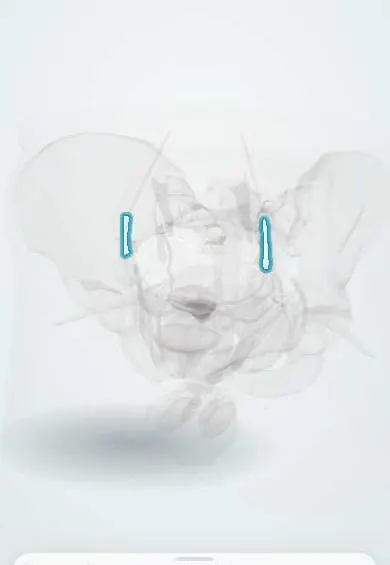
The suspensory ligament of the ovary is a fold from the pelvic side wall to the ovary that carries its artery and veins; it is divided to remove the ovary.
Opens in the Durgical app, no sign-up needed.
What it is
A fold from the ovary up to the pelvic side wall that carries the ovarian artery and vein (infundibulopelvic ligament).
What it does
Holds the ovary in place; it is clamped to remove the ovary, taking care of the ureter nearby.
Key facts
- Attaches
- Tubal pole of the ovary to the lateral pelvic wall over the external iliac vessels
- Function
- Carries the ovarian artery, vein, lymphatics and nerves (infundibulopelvic ligament); the ureter crosses close to it at the pelvic brim
Relations
- Course
- From the upper (tubal) pole of the ovary, up and outward over the external iliac vessels, to the peritoneum of the lateral pelvic wall at the pelvic brim
- Contents
- Ovarian artery, ovarian veins (the pampiniform plexus), lymphatics and the ovarian nerve plexus
- Medial
- Ureters, entering the pelvis close to it
- Below
- Ovaries and the infundibulum and fimbriae of the tube
How to find it
At laparoscopy, lifting the ovary tents up a peritoneal fold running to the pelvic brim; the ureter is identified through the nearby peritoneum before the fold is sealed or tied.
On imaging
On CT or MRI the ovarian vein can be followed down to a pelvic mass: if it leads into the mass, the mass is most likely ovarian (ovarian vascular pedicle sign).
Common problems
- Weakened supports allow prolapse.
- Endometriosis often grows on the uterosacral ligaments.
How it is diagnosed
Examination and ultrasound; seen directly in laparoscopy.
Treatment
- They are divided step by step in a hysterectomy.
Clinical notes
- In torsion the vessels in this ligament are twisted, which is why the ovary becomes congested before it loses its arterial supply
- Postpartum ovarian vein thrombosis, usually on the right, causes fever and flank or lower abdominal pain
- Ovarian remnant syndrome: if the ligament is cut too close to the ovary, functioning tissue left behind can cause pain or a mass
Development
The ovary begins high on the posterior abdominal wall; as it moves down into the pelvis its vessels trail behind it, still arising from the aorta and draining near the kidneys, and the peritoneal fold over them becomes this ligament.
Related conditions
Test yourself
Think of the answer, then tap the question to see it.
What does the suspensory ligament of the ovary contain?
The ovarian artery, ovarian veins (pampiniform plexus), lymphatics and the ovarian nerve plexus.
Why is tying the suspensory ligament of the ovary a classic moment of ureteric injury?
The ureter crosses the pelvic brim right beside it, near the bifurcation of the common iliac arteries.
What is ovarian remnant syndrome?
If the suspensory ligament is cut too close to the ovary, functioning tissue left behind can cause pain or a mass.
Which side is usually affected by postpartum ovarian vein thrombosis, and how does it present?
Usually the right; fever with flank or lower abdominal pain.
Educational information, not medical advice. For any symptom, see a health professional.
Its names
- Official Latin (TA2)
- ligamentum suspensorium ovarii TA2 3805
- Official Spanish (DeCS)
- Ligamento suspensorio del ovario
- English (TA2)
- Suspensory ligament of ovary
- Also called
- infundibulopelvic ligament · plica suspensoria ovarii
Related
Sources: Terminologia Anatomica (TA2); Anatomy, Abdomen and Pelvis, Ovary; 27.2 Anatomy and Physiology of the Ovarian Reproductive System (OpenStax (Rice University), 2022) · adapted, CC BY 4.0.
Spotted a mistake?We are always improving for the community. Tell us what is wrong and our team will review it.Report a mistake
Representative model, for educational purposes only.