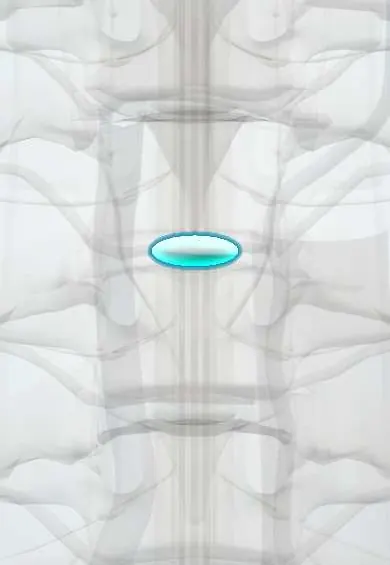
T4–T5 nucleus !
The nucleus pulposus is the soft, gel-like centre of the T4-T5 disc in the mid-back; it works like a water cushion that spreads the load.
Official name: T4-T5
Opens in the Durgical app, no sign-up needed.
What it is
The soft, gel-like centre (nucleus pulposus) of the T4–T5 disc.
What it does
Works like a water cushion: it turns pressure from above into outward push on the fibre ring, spreading the load. It is under the most pressure when you bend forward and lift.
Key facts
- Where
- Centre of the T4–T5 disc, slightly toward the back, inside the annulus fibrosus
- Function
- Notochord-derived gel (about 70–90% water, proteoglycans); turns axial load into annulus tension; small in thin thoracic discs, herniation rare
Relations
- Behind
- Back of the annulus fibrosus and the posterior longitudinal ligament, then the spinal cord
On imaging
Axial MRI at this level also shows the carina and the azygos arch in front of the spine, a useful check that the level is right.
Common problems
- Squeezes out through a tear in the ring (herniation), usually backward and to one side, toward a nerve root.
- Loses water with age, so the disc gets thinner and stiffer.
How it is diagnosed
On MRI a healthy nucleus is bright on T2 images; a worn one turns dark ('black disc').
Treatment
- In a microdiscectomy only the loose piece that has pushed out is removed; most of the disc stays.
Clinical notes
- Pain between the shoulder blades with no clear band is a common first symptom of mid-thoracic disc disease and is easily blamed on the muscles
- Mid-thoracic pain with weight loss or night pain in an older adult suggests a metastasis rather than a disc; on imaging, tumour tends to spare the disc space while infection destroys it
Development
The thoracic curve is a primary curve kept from the flexed fetal posture. Unlike the neck and low back, where wedge-shaped discs build the curve, the thoracic discs are of fairly even height and the curve comes mainly from the bodies.
Test yourself
Think of the answer, then tap the question to see it.
Which surface landmark lies at the level of the T4–T5 nucleus?
The sternal angle.
Which root and dermatome can a posterolateral fragment of the T4–T5 nucleus reach?
The T4 root, the nipple band.
On axial MRI, which structures in front of the spine confirm the T4–T5 level?
The carina and the azygos arch, a useful check that the level is right.
Educational information, not medical advice. For any symptom, see a health professional.
Its names
- Official Latin (TA2)
- nucleus pulposus T4-T5 TA2 1686
- Official Spanish (DeCS)
- Núcleo pulposo T4-T5 DeCS D000070614
- English (TA2)
- T4-T5
Related
Sources: Terminologia Anatomica (TA2); DeCS; Anatomy, Back, Nucleus Pulposus; Anatomy, Back, Intervertebral Discs; 7.3 The Vertebral Column (OpenStax (Rice University), 2022) · adapted, CC BY 4.0; Anatomy of the Human Body (20th ed.): Articulations of the Vertebral Column (Lea & Febiger (Gray's Anatomy, 1918), 1918) · adapted, Public domain.
Spotted a mistake?We are always improving for the community. Tell us what is wrong and our team will review it.Report a mistake
Representative model, for educational purposes only.