Digestive system · Head and neck
Upper left second molar !
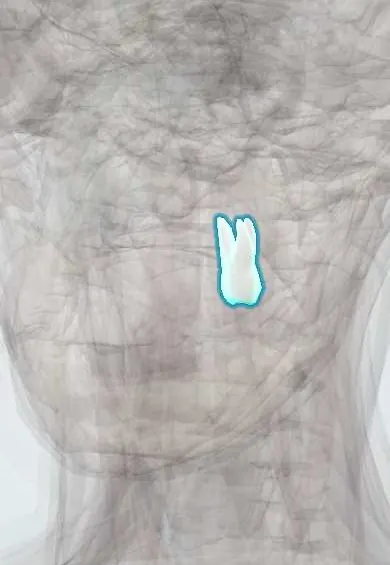
The upper left second molar (tooth 27) is the back tooth behind the first molar that comes in around age 12; it grinds food.
Opens in the Durgical app, no sign-up needed.
What it is
A large back tooth behind the first molar, with three roots.
What it does
Grinds food before swallowing.
Key facts
- Joints with
- Alveolar socket of the maxilla (gomphosis held by the periodontal ligament); bites against the opposing teeth
- Landmarks
- FDI 27, upper left second molar: 3 roots; erupts behind the first molar around age 12; erupts at about 12–13 years; nerve: posterior superior alveolar nerve (V2); roots near the floor of the maxillary sinus
Relations
- In front
- The upper left first molar
- Behind
- The upper left third molar, or the maxillary tuberosity when that tooth is missing
- Above
- Maxillary sinus floor
- Below
- Meets the lower left second molar and the lower left third molar
How to find it
Seventh from the midline on the upper left, behind the first molar; the parotid duct opens on the inner cheek right beside it.
On imaging
A panoramic film shows its roots against the maxillary sinus floor; a periapical or CBCT clarifies whether infection at the apex has reached the sinus.
Common problems
- Tooth decay (caries) in the grooves of the chewing surface.
Clinical notes
- Supplied by the posterior superior alveolar nerve, which enters the maxillary tuberosity just above and behind it; the palatal gum depends on the greater palatine nerve
- Infection or extraction here can involve the maxillary sinus: odontogenic sinusitis or an oroantral communication
Anatomical variants
- The crown may have 3 cusps instead of 4, and the roots are fused more often than in the first molar
Development
Like the other permanent molars it comes from the backward-growing dental lamina and has no primary predecessor; it erupts at about 12 years, the '12-year molar'.
Related conditions
Test yourself
Think of the answer, then tap the question to see it.
Which duct opens on the cheek opposite the upper left second molar?
The parotid duct, which opens on the cheek mucosa opposite the crown of the upper second molar.
Which nerves supply the upper left second molar and its palatal gum?
The posterior superior alveolar nerve supplies the tooth; the greater palatine nerve supplies the palatal gum.
What sinus complications can follow infection or extraction of the upper left second molar?
Odontogenic sinusitis or an oroantral communication, because its roots often lie right against the maxillary sinus floor.
Why is the upper left second molar called the 12-year molar?
It erupts at about 12 years, behind the first molar, without replacing a primary tooth.
Educational information, not medical advice. For any symptom, see a health professional.
Related
Sources: Anatomy, Head and Neck, Teeth; Anatomy, Permanent Dentition; Anatomy, Head and Neck, Tooth Eruption; Anatomy, Head and Neck: Alveolar Nerve; 23.3 The Mouth, Pharynx, and Esophagus (OpenStax (Rice University), 2022) · adapted, CC BY 4.0.
Spotted a mistake?We are always improving for the community. Tell us what is wrong and our team will review it.Report a mistake
Representative model, for educational purposes only.