Digestive system · Head and neck
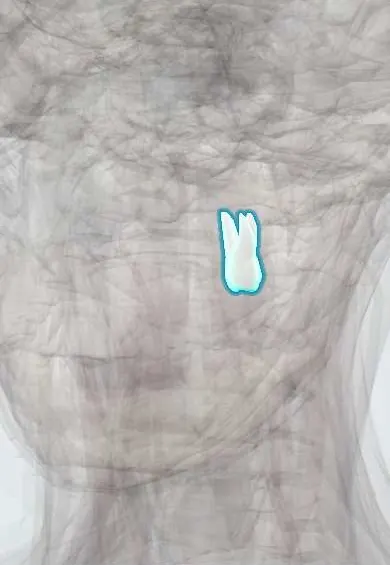
Upper left third molar !
The upper left third molar (tooth 28) is the wisdom tooth, last at the back; it often lacks room to come in and stays stuck (impacted).
Opens in the Durgical app, no sign-up needed.
What it is
The wisdom tooth: the last molar, usually coming in between the ages of 17 and 25.
What it does
Grinds food when it erupts fully; often it does not.
Key facts
- Joints with
- Alveolar socket of the maxilla (gomphosis held by the periodontal ligament); bites against the opposing teeth
- Landmarks
- FDI 28, upper left third molar (wisdom tooth): roots often fused or variable; often impacted or missing; erupts at about 17–25 years; nerve: posterior superior alveolar nerve (V2); roots near the floor of the maxillary sinus
Relations
- In front
- The upper left second molar
- Behind
- Maxillary tuberosity and, beyond it, the infratemporal fossa
- Above
- Maxillary sinus floor
- Below
- Opposes only the lower left third molar
How to find it
Eighth and last tooth on the upper left, tucked against the maxillary tuberosity behind the second molar; frequently missing or still buried in bone.
On imaging
A panoramic radiograph shows its angle, its depth in the tuberosity and the sinus floor above it; CBCT is added when the relation to the sinus is unclear.
Common problems
- Impacted wisdom tooth: stuck under the gum or against the second molar, with pain, swelling or infection (pericoronitis).
Clinical notes
- Supplied by the posterior superior alveolar nerve; the buccal gum around it is shared with the buccal nerve and the palatal gum with the greater palatine nerve
- Without a lower tooth to bite against it tends to over-erupt (extrude), which can catch food and disturb the bite
- It is hard to clean, so decay is common on it and on the back of the second molar in front
Anatomical variants
- A small extra tooth can sit behind it (distomolar, a fourth molar) or on its cheek side (paramolar)
Development
Its germ is one of the last to form, starting to calcify at about 9–10 years; the roots are complete in the early twenties. Absence of one or more third molars is common, at rates that vary by population.
Memory aid
FDI 28 = quadrant 2, tooth 8. In the US Universal system it is #16, the last tooth of the upper count.
Test yourself
Think of the answer, then tap the question to see it.
What are the risks of removing an impacted upper left third molar?
An oroantral communication, displacement into the maxillary sinus or infratemporal fossa, and fracture of the maxillary tuberosity.
What are a distomolar and a paramolar?
Small extra teeth near the upper third molar: a distomolar (fourth molar) sits behind it, a paramolar on its cheek side.
What is the US Universal number of the upper left third molar (FDI 28)?
#16, the last tooth of the upper count.
When does the germ of the upper left third molar begin to calcify?
At about 9–10 years; its roots are complete in the early twenties.
Educational information, not medical advice. For any symptom, see a health professional.
Related
Sources: Anatomy, Head and Neck, Teeth; Anatomy, Permanent Dentition; Anatomy, Head and Neck, Tooth Eruption; Anatomy, Head and Neck: Alveolar Nerve; 23.3 The Mouth, Pharynx, and Esophagus (OpenStax (Rice University), 2022) · adapted, CC BY 4.0.
Spotted a mistake?We are always improving for the community. Tell us what is wrong and our team will review it.Report a mistake
Representative model, for educational purposes only.