Cutaneous larva migrans !
Cutaneous larva migrans is an itchy, winding red track in the skin caused by dog or cat hookworm larvae, caught by walking barefoot on sand or soil.
Updated 2026-11-01
Structures involved
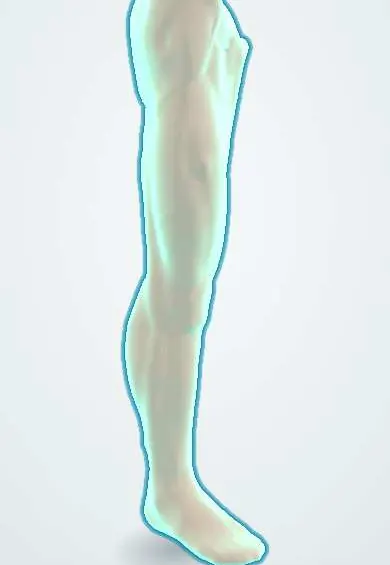
Tap one to see what it is and open it in 3D.
Microorganisms that cause it
Why it happens
What it is
A parasitic skin infection caused by larvae of animal hookworms that penetrate human skin but cannot complete their life cycle, so they wander in the epidermis and create intensely itchy, raised, serpiginous tracks. It is self-limiting but very uncomfortable. Also called creeping eruption.
Who gets it
Common in warm, humid tropical and subtropical areas, including Colombia's Caribbean and Pacific coasts and other beaches of Latin America where stray dogs and cats defecate on sand. Affects children in poor communities and tourists who walk or lie barefoot on contaminated sand or soil.
Causes
- Larvae of dog and cat hookworms, mainly Ancylostoma braziliense, also A. caninum and Uncinaria stenocephala
- Infective third-stage larvae in sand or soil contaminated with animal faeces
- Direct penetration of intact skin
Risk factors
- Walking barefoot or lying on beaches and shaded sandy soil
- Stray dogs and cats in the area
- Warm, humid climate
- Children's play in sandpits
- Occupations in contact with soil (farmers, gardeners, plumbers)
Pathophysiology
Animal hookworm larvae penetrate the skin using proteases but lack the enzymes needed to cross the basement membrane in humans. Trapped in the epidermis, they migrate a few millimetres to a few centimetres per day. The immune response to the larva and its secretions causes inflammation, eosinophilic infiltrate and severe itch. Because humans are dead-end hosts, the larvae die within weeks to months.
Symptoms and signs
- Itching or tingling at the entry site within hours, then an intensely itchy track
- Raised, red, thread-like, serpiginous (snake-like) track, a few millimetres wide, advancing daily
- Typical sites: feet, toes, soles, buttocks and hands
- Sometimes blisters, scratch marks and secondary infection
- Folliculitis-like form with many itchy papules on the buttocks
Diagnosis
- Clinical
- Clinical: typical serpiginous, migrating, itchy track with a history of barefoot exposure to sand or soil in a warm area.
- Tests
- No serological test. Blood count may show mild eosinophilia. Biopsy is not useful because the larva lies ahead of the visible track.
- Imaging
- Not needed; dermoscopy may show translucent segmental structures corresponding to the larva.
Differential diagnosis
- Larva currens (Strongyloides; very fast track around the buttocks)
- Tinea corporis (annular, scaly lesions)
- Scabies (burrows, nocturnal itch, family members)
- Contact dermatitis and phytophotodermatitis
- Migratory myiasis and gnathostomiasis
Goal of treatment
Kill the larva to relieve itch quickly, prevent secondary infection and teach prevention; although self-limiting, treatment is recommended because of the severe itch.
Treatment
- Medical
- Oral anthelmintics: ivermectin as a single dose, or albendazole for several days, are first-line. Topical thiabendazole can be used for few, early lesions.
- Conservative
- Antihistamines and cool compresses for itch; topical or oral antibiotics only for secondary bacterial infection.
- Lifestyle
- Wear footwear on beaches and soil, lie on towels or mats rather than directly on sand, and deworm pets.
Complications
- Secondary bacterial infection (impetigo, cellulitis) from scratching
- Sleep disruption from itch
- Eczematous reaction and blistering
- Rarely, Löffler-like pulmonary infiltrates with eosinophilia
Prognosis
Excellent. Untreated lesions resolve over weeks to months as larvae die; with treatment, itch improves within days.
Prevention
- Footwear on beaches and soil; lie on towels rather than bare sand
- Keep dogs and cats off beaches and play areas
- Regular deworming of pets and proper disposal of animal faeces
Test yourself
Think of the answer, then tap the question to see it.
Which parasite most often causes cutaneous larva migrans?
Larvae of the dog and cat hookworm Ancylostoma braziliense.
Why do the larvae stay in the epidermis?
Humans are dead-end hosts; the larvae cannot cross the basement membrane to complete their life cycle.
What is the typical lesion?
An intensely itchy, raised, serpiginous track that advances daily, usually on the feet.
What are the first-line treatments?
Oral ivermectin or albendazole (topical thiabendazole for limited early lesions).
How does larva currens differ?
It is caused by Strongyloides, moves much faster (centimetres per hour) and appears around the buttocks and perineum.
Related conditions
- Soil-transmitted helminthiasis (ascariasis, hookworm, trichuriasis)
- Strongyloidiasis
- Toxocariasis (visceral and ocular larva migrans)
- Tungiasis and furuncular myiasis
- Scabies
- Dermatophytosis (tinea) and onychomycosis
- Impetigo
Educational information, not medical advice. For any symptom, see a health professional.
Sources: Hookworm (Extraintestinal) (Centers for Disease Control and Prevention (CDC), 2026); Cutaneous larva migrans (DermNet, 2026).
Spotted a mistake?We are always improving for the community. Tell us what is wrong and our team will review it.Report a mistake
Representative model, for educational purposes only.