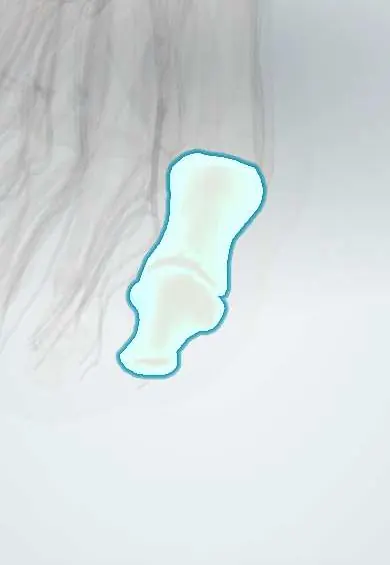
Big toe !
The big toe has two small bones (phalanges); it does most of the pushing off when walking.
Official name: Great toe
Opens in the Durgical app, no sign-up needed.
What it is
The big toe (hallux), made of two small bones called phalanges.
What it does
Takes most of the push-off force when you walk and run, and helps with balance.
Key facts
- Joints with
- First metatarsal (MTP joint, with sesamoids); one interphalangeal joint
- Landmarks
- Two phalanges; flexor and extensor hallucis longus to distal phalanx; abductor, adductor and flexor hallucis brevis to proximal phalanx
Relations
- Behind
- First metatarsal head and the two sesamoids at the MTP joint
- Above
- Extensor hallucis longus to the distal phalanx; extensor hallucis brevis to the proximal phalanx
- Below
- Flexor hallucis longus to the distal phalanx, running between the sesamoids; plantar plate; flexor hallucis brevis through the sesamoids
- Medial
- Abductor hallucis to the base of the proximal phalanx; the dorsomedial cutaneous nerve and the medial plantar digital nerve of the big toe
- Lateral
- Adductor hallucis through the lateral sesamoid; the first web space, supplied by the deep fibular nerve
How to find it
The MTP joint line is felt on the dorsomedial side while the toe is moved up and down; the single interphalangeal joint lies under the toe's crease. A large range of passive dorsiflexion at the MTP joint is normal and is needed for push-off.
Examination
- Grind test: axial compression with rotation of the first MTP joint is painful in hallux rigidus and arthritis
- Jack test: passive dorsiflexion of the big toe should raise the medial arch through the plantar fascia; failure suggests a rigid flatfoot
On imaging
Standing AP view for hallux valgus and interphalangeal angles; lateral view for the dorsal spurs of hallux rigidus. In chronic gout, punched-out erosions with overhanging edges appear near the first MTP joint.
Common problems
- Bunion (hallux valgus): the big toe leans toward the second toe.
- Turf toe: a sprain of the big toe joint when it is bent up too far, common on artificial turf.
- Stiffness from arthritis (hallux rigidus), ingrown toenails and fractures.
How it is diagnosed
A physical exam; X-rays taken standing; MRI for turf toe.
Treatment
- Proper shoes, taping, stiff inserts and rest.
- Physical therapy for turf toe, with a gradual return to sport.
- Surgery for severe bunions, arthritis or torn ligaments under the joint.
Clinical notes
- Hallux valgus interphalangeus: the lateral deviation lies at the interphalangeal joint rather than the MTP joint
- The big toe can be transferred to the hand to rebuild a lost thumb (toe-to-thumb transfer)
Anatomical variants
- A small sesamoid under the interphalangeal joint of the big toe is a frequent normal finding and should not be mistaken for a fracture fragment
- The medial (tibial) sesamoid under the first metatarsal head is often in two pieces (bipartite), frequently in both feet; its smooth, rounded edges set it apart from a fracture
Development
Each phalanx has a primary centre in the shaft and a secondary centre at its base; a split or cone-shaped epiphysis can mimic a fracture.
Related conditions
- Diabetic foot
- Hallux valgus (bunion)
- Gout
- Dermatophytosis (tinea) and onychomycosis
- Cutaneous larva migrans
- Tungiasis and furuncular myiasis
Test yourself
Think of the answer, then tap the question to see it.
Which dermatome and which motor test are classically linked to the big toe?
L5: the skin over the dorsum of the big toe, and extensor hallucis longus strength.
Which joint is classically affected first in acute gout?
The first metatarsophalangeal joint of the big toe (podagra).
How is turf toe graded?
I–III: from a stretched plantar plate to a complete tear with sesamoid displacement.
Educational information, not medical advice. For any symptom, see a health professional.
Its names
- Official Latin (TA2)
- hallux; phalanges pedis TA2 171
- Official Spanish (DeCS)
- Hallux (primer dedo del pie) DeCS D014034
- English (TA2)
- Great toe
- Also called
- first toe · first digit of foot · digit 1 of foot · phalangeal bones of foot
Related
- First metatarsal
- Sesamoids
- Toe arteries
- Abductor hallucis
- Extensor hallucis brevis
- Flexor hallucis brevis
- Big toe flexor tendon
- MTP ligaments and plantar plate
Sources: Terminologia Anatomica (TA2); DeCS; Anatomy, Bony Pelvis and Lower Limb: Foot and Ankle.
Spotted a mistake?We are always improving for the community. Tell us what is wrong and our team will review it.Report a mistake
Representative model, for educational purposes only.