Migraine !
Migraine is a common headache disorder with repeated attacks of throbbing, often one-sided pain, nausea and sensitivity to light and sound.
Updated 2026-10-30
Structures involved
Tap one to see what it is and open it in 3D.
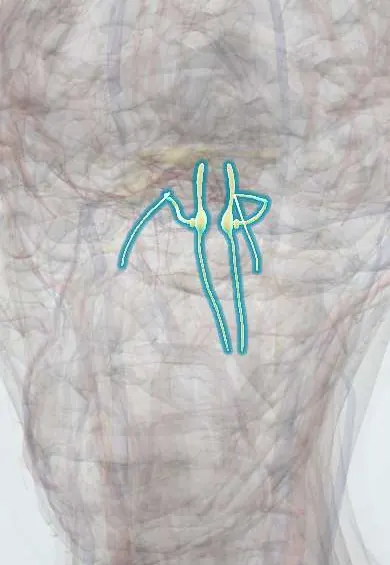
- Trigeminal nerve (V)
- Dura mater
- Visual cortex
- V1 ophthalmic
- Trigeminal ganglion
- Hypothalamus
- Midbrain
- Middle meningeal artery
In biochemistry
In physiology
What it is
A common primary headache disorder with recurrent attacks of usually one-sided, throbbing headache with nausea and sensitivity to light and sound, sometimes preceded by an aura.
Who gets it
One of the commonest neurological disorders and a major cause of disability in young and middle-aged adults. It is about three times more common in women and often starts around puberty. In a Colombian health-insurer cohort (2018–2022, 89,227 patients), recorded prevalence was 1.69–2.42 per 100 affiliates, lower than earlier Colombian studies, and 84.9% were women.
Causes
- Genetic predisposition (strong family history)
- Familial hemiplegic migraine is a rare monogenic form
Risk factors
- Female sex and hormonal changes (menstruation)
- Family history
- Triggers: stress, poor sleep, skipped meals, alcohol, some foods
- Overuse of acute headache medicines (medication-overuse headache)
- Obesity
Pathophysiology
A hyperexcitable brain activates the trigeminovascular system, releasing neuropeptides such as CGRP that cause neurogenic inflammation of the meninges and sensitisation of pain pathways. Aura is linked to cortical spreading depression, a slow wave of neuronal depolarisation, often across the occipital cortex.
Classification
- Migraine without aura
- Migraine with aura: visual, sensory or speech symptoms that develop gradually and reverse
- Chronic migraine: headache on 15 or more days a month
- Menstrual migraine
- Rare types: hemiplegic, brainstem aura
Symptoms and signs
- Moderate–severe, often unilateral, pulsating headache lasting hours to a few days
- Worse with routine physical activity
- Nausea or vomiting
- Photophobia and phonophobia
- Aura: zigzag lines, scotoma or spreading tingling, usually lasting minutes
- Prodrome (yawning, mood change) and postdrome (fatigue)
Diagnosis
- Clinical
- Clinical diagnosis using International Classification of Headache Disorders (ICHD-3) criteria, with a normal neurological examination. A headache diary helps.
- Tests
- No routine tests; targeted tests only when another cause is suspected.
- Imaging
- Not needed in typical migraine with a normal examination. CT or MRI when red flags suggest a secondary headache.
Differential diagnosis
- Tension-type headache
- Cluster headache
- Medication-overuse headache
- Subarachnoid haemorrhage or other secondary headache
- Transient ischaemic attack or seizure (for aura)
Goal of treatment
Stop attacks quickly, reduce their frequency and disability, and avoid medication-overuse headache.
Treatment
- Acute
- Acute treatment early in the attack: simple analgesics or NSAIDs, triptans, antiemetics; newer gepants or ditans in some settings. Opioids are avoided.
- Medical
- Prevention for frequent or disabling attacks: beta-blockers, some antiepileptics, tricyclic antidepressants, calcium channel blockers; CGRP-targeting antibodies or botulinum toxin for chronic migraine in specialist care.
- Lifestyle
- Regular sleep and meals, exercise, stress management, identifying triggers and limiting acute medicine use.
Drugs for this condition
Complications
- Medication-overuse headache
- Chronic migraine
- Status migrainosus (attack lasting over 72 hours)
- Rarely migrainous infarction
- Anxiety and depression
Prognosis
Often improves with age and, for many women, after menopause. Good acute and preventive care greatly reduces disability.
Prevention
- Trigger management and regular routines
- Preventive medicines when attacks are frequent
- Limiting acute medicines to a few days a month
Test yourself
Think of the answer, then tap the question to see it.
Which features favour migraine over tension-type headache?
Pulsating, often one-sided pain worsened by activity, with nausea and photophobia or phonophobia.
What phenomenon is thought to underlie migraine aura?
Cortical spreading depression, a slow wave of neuronal depolarisation across the cortex.
What is a key risk of frequent use of acute migraine medicines?
Medication-overuse headache.
Which headache features need urgent investigation?
Thunderclap onset, new headache after 50, fever or neck stiffness, focal deficit, seizure, or a progressive or changed pattern.
Related conditions
- Subarachnoid haemorrhage
- Ischaemic stroke
- Epilepsy and seizures
- Bacterial meningitis
- Tension-type headache
- Transient ischaemic attack
- Acute rhinosinusitis
- Benign paroxysmal positional vertigo (BPPV)
Educational information, not medical advice. For any symptom, see a health professional.
Sources: Migraine Headache (StatPearls (NCBI Bookshelf), 2024); Epidemiological, clinical characterization and treatment patterns of migraine patients in a Colombian cohort from 2018 to 2022 (The journal of headache and pain, 2024) · adapted, CC BY 4.0.
Spotted a mistake?We are always improving for the community. Tell us what is wrong and our team will review it.Report a mistake
Representative model, for educational purposes only.