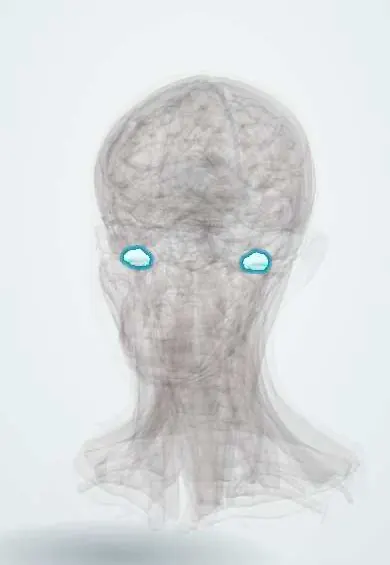
Joints and ligaments · Head and neck
TMJ disc !
The disc of the temporomandibular (jaw) joint is a small cushion between the jaw and the skull; if it slips, the jaw can click or lock.
Official name: Articular disc of temporomandibular joint
Opens in the Durgical app, no sign-up needed.
What it is
A small oval cushion between the jaw's condyle and the skull.
What it does
Slides forward with the condyle when the mouth opens; when it slips, the jaw clicks or locks.
Key facts
- Where
- Between the mandibular condyle and the articular fossa/eminence
- Attaches
- Medial and lateral poles of the condyle; front to the lateral pterygoid; back to the retrodiscal tissue
- Function
- Splits the joint into an upper (gliding) and lower (hinge) compartment; moves forward with the condyle on wide opening; displacement causes clicking
Relations
- Above
- Articular fossa and eminence of the temporal bone, across the upper (gliding) compartment
- Below
- Condyle of the mandible, across the lower (hinge) compartment
- In front
- Superior head of the lateral pterygoid, attached to the disc and capsule
- Behind
- Retrodiscal tissue (bilaminar zone), with an elastic upper lamina and a collagen lower lamina
How to find it
The disc itself cannot be felt; the click of a displaced disc can be felt with a fingertip in front of the tragus as the mouth opens and closes.
Examination
- Reciprocal click: a click on opening and another, often softer, on closing suggests disc displacement with reduction
- Opening with deflection: limited opening with the jaw swinging to one side and not returning to midline suggests displacement without reduction on that side
On imaging
MRI with closed- and open-mouth views is the reference for disc position and shape; on proton density images the disc is a dark bow tie between the condyle and the eminence.
Common problems
- Clicking or popping when the disc slips forward and back.
- Locking (the jaw cannot open fully).
- Jaw pain linked to clenching or grinding (bruxism).
How it is diagnosed
Exam of jaw opening and the joint; MRI for the disc in persistent cases.
Treatment
- Soft diet, heat, jaw exercises and pain relief.
- A night guard (splint) for grinding.
- Joint washing (arthrocentesis) or surgery only rarely.
Clinical notes
- Long-standing displacement can deform the disc and lead to degenerative joint disease (osteoarthritis) of the condyle
- A closed lock that does not settle is sometimes treated by arthrocentesis (washing out the upper compartment) or arthroscopy
- A painless click with normal opening is common in the general population and is not a disease by itself
Development
Like other articular discs, it is mesenchyme left between the developing condyle and the temporal bone when the joint spaces open, which is why the joint has separate upper and lower compartments.
Related conditions
Test yourself
Think of the answer, then tap the question to see it.
What is the shape of the TMJ disc, and where does the condyle normally sit on it?
Biconcave, with thick anterior and posterior bands; the condyle sits on the thin, avascular intermediate zone.
How do anterior TMJ disc displacement with and without reduction differ?
With reduction: a reciprocal click on opening and closing. Without reduction: a closed lock with limited opening.
Why does a forward-slipped TMJ disc cause pain?
The condyle loads the retrodiscal tissue (bilaminar zone), which is vascular and innervated.
Which muscle attaches to the front of the TMJ disc?
The superior head of the lateral pterygoid.
Educational information, not medical advice. For any symptom, see a health professional.
Its names
- Official Latin (TA2)
- discus articulationis temporomandibularis TA2 1623
- Official Spanish (DeCS)
- Disco de la Articulación Temporomandibular DeCS D019224
- English (TA2)
- Articular disc of temporomandibular joint
Related
Sources: Terminologia Anatomica (TA2); DeCS; Anatomy, Head and Neck, Temporomandibular Joint; Anatomy of the Human Body (20th ed.): Development of the Joints (Lea & Febiger (Gray's Anatomy, 1918), 1918) · adapted, Public domain.
Spotted a mistake?We are always improving for the community. Tell us what is wrong and our team will review it.Report a mistake
Representative model, for educational purposes only.