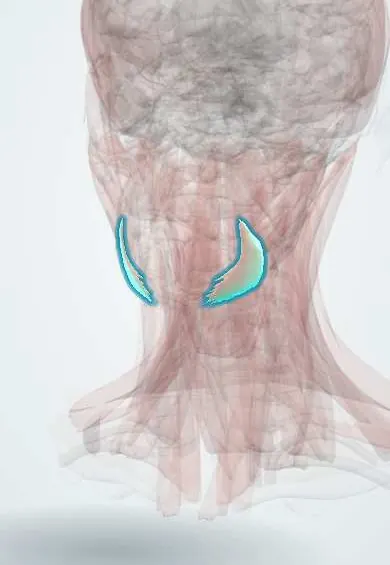
Muscular system · Head and neck
Depressor anguli oris !
The depressor anguli oris is a triangular muscle from the jaw to the corner of the mouth; it pulls the corner down when frowning.
Opens in the Durgical app, no sign-up needed.
What it is
A triangular muscle from the jaw to the mouth corner.
What it does
Pulls the mouth corner down (frown); weak on one side in facial palsy.
Key facts
- Origin
- Oblique line of the mandible
- Insertion
- Angle of the mouth
- Action
- Pulls the mouth corner down
- Nerve
- Facial nerve (CN VII): marginal mandibular branch
- Blood supply
- Facial artery branches
Relations
- Superficial
- Skin and subcutaneous fat of the chin and lower cheek; the platysma blends into its lower fibres
- Deep
- Depressor labii inferioris and the mental foramen with the mental nerve and vessels
- Above
- Modiolus at the angle of the mouth, where it meets the orbicularis oris, risorius and zygomaticus major
- Below
- Oblique line of the mandible, close to the platysma
How to find it
Asked to pull the corners of the mouth down hard (a sad face), a triangular band tightens from the jaw below the canine and premolars up to the mouth corner.
Examination
- Frowning or pulling the mouth corners down: the corner stays up on the weak side
- In a crying newborn the lower lip pulls down on one side only; the forehead and eye closure stay normal, which separates it from facial nerve palsy
On imaging
Not usually imaged; its function is tested by asking the person to show the lower teeth. High-resolution ultrasound shows it as a triangle of muscle from the lower border of the mandible up to the corner of the mouth, and can guide botulinum toxin injection. In a newborn with asymmetric crying facies, an echocardiogram looks for associated heart defects; facial imaging is not needed.
Clinical notes
- Marginal mandibular branch injury in neck and jaw surgery leaves this muscle weak: the danger zone runs along the lower border of the mandible, where the branch crosses the facial artery and vein
- Its pull deepens the «marionette» lines from the mouth corners in ageing faces
- Asymmetric crying facies is linked in some children to cardiac anomalies, including the 22q11.2 deletion syndrome
Development
Second pharyngeal arch muscle; hypoplasia is present at birth and does not recover, unlike birth-trauma facial palsy.
Test yourself
Think of the answer, then tap the question to see it.
Which facial nerve branch mainly supplies the depressor anguli oris, and what does its loss show?
The marginal mandibular branch (with buccal branches); its loss gives a lopsided frown and lower lip.
What is asymmetric crying facies in a newborn?
Congenital absence or underdevelopment of the depressor anguli oris: the lower lip pulls down on one side when crying, sometimes with heart defects such as 22q11.2 deletion.
How is asymmetric crying facies told apart from facial nerve palsy?
The forehead and eye closure stay normal; only the depressor anguli oris is affected.
Educational information, not medical advice. For any symptom, see a health professional.
Its names
- Official Latin (TA2)
- depressor anguli oris TA2 2076
- Official Spanish (DeCS)
- Músculo depresor del ángulo de la boca
- English (TA2)
- Depressor anguli oris
- Also called
- depressor anguli oris muscle · triangularis muscle · musculus triangularis
Related
Sources: Terminologia Anatomica (TA2); Anatomy, Head and Neck: Facial Muscles; Anatomy, Head and Neck: Face.
Spotted a mistake?We are always improving for the community. Tell us what is wrong and our team will review it.Report a mistake
Representative model, for educational purposes only.