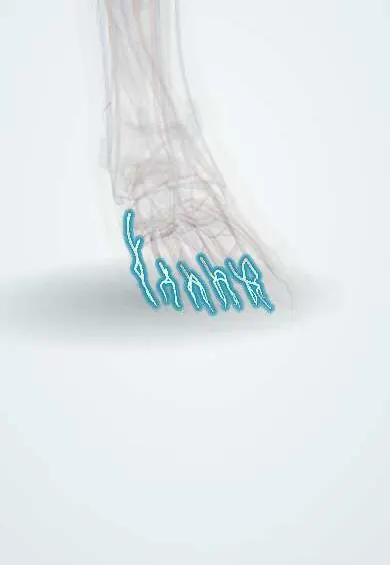
Cardiovascular system · Lower limb
Toe arteries !
The toe arteries are small arteries running along the sides of each toe, two on the sole side and two on top.
Official name: Dorsal digital arteries of foot
Opens in the Durgical app, no sign-up needed.
What it is
Small arteries that run along both sides of each toe, from the arteries on the top and in the sole of the foot.
What it does
Supply the toes.
Key facts
- Origin
- Plantar metatarsal arteries (plantar arch) and dorsal metatarsal arteries
- Branches
- Common then proper plantar digital arteries; dorsal digital arteries
- Supplies
- Toes, including nail beds and pulp
Relations
- Course
- Plantar metatarsal arteries from the deep arch become common plantar digital arteries and split at the webs into proper digital arteries for adjacent toes; the dorsal metatarsal arteries do the same on top; the medial side of the big toe and the lateral side of the little toe get their own branches
How to find it
The plantar digital arteries lie with the nerves at the plantar corners of each toe; a pencil Doppler placed on the side of the toe pad picks up their signal, and toe pressures are taken with a small cuff around the base of the big toe.
Examination
- Toe–brachial index: toe pressure divided by arm pressure; used when stiff, calcified ankle arteries make the ankle–brachial index falsely high; below about 0.7 is abnormal
- Capillary refill at the toe pulp: slow return of colour after pressure suggests poor perfusion
On imaging
Too small to assess directly on routine imaging. In blue toe syndrome, Doppler ultrasound and CT angiography look upstream for the embolic source, such as aortic or popliteal plaque or an aneurysm. Toe pressures and pulse-volume recordings measure toe perfusion, and catheter angiography can show digital artery occlusions before revascularization.
Common problems
- Narrowing in diabetes or peripheral artery disease can slow healing of toe wounds.
Clinical notes
- A digital nerve block at the base of a toe places the anesthetic near the four neurovascular bundles at the corners of the proximal phalanx
- In toe-to-hand transfer, whether the dorsal or plantar system dominates for the big or second toe is mapped beforehand
- Vasospasm (Raynaud phenomenon) and cold injury affect the toes as well as the fingers
Anatomical variants
- When the dorsalis pedis ends early and gives no branches to the toes, the dorsal digital arteries come from the plantar side, through the medial plantar artery and the perforating branches
Related conditions
- Atheroembolic renal disease (cholesterol crystal embolism)
- Thromboangiitis obliterans (Buerger disease)
Test yourself
Think of the answer, then tap the question to see it.
How many digital arteries supply each toe, and which are usually larger?
Four: two plantar and two dorsal; the plantar ones are usually larger.
What does blue toe syndrome with good foot pulses suggest?
Small emboli from atheroma or an aneurysm higher up.
When is the toe–brachial index used instead of the ankle–brachial index?
When stiff, calcified ankle arteries make the ankle–brachial index falsely high; below about 0.7 is abnormal.
Educational information, not medical advice. For any symptom, see a health professional.
Its names
- Official Latin (TA2)
- arteriae digitales dorsales pedis; arteriae digitales plantares communes; arteriae digitales plantares propriae TA2 4719
- Official Spanish (DeCS)
- Arterias digitales dorsales y plantares del pie
- English (TA2)
- Dorsal digital arteries of foot
- Also called
- plantar digital arteries proper
Related
Sources: Terminologia Anatomica (TA2); Anatomy, Bony Pelvis and Lower Limb: Foot Arteries; Anatomy of the Human Body (20th ed.): The Arteria Dorsalis Pedis (Lea & Febiger (Gray's Anatomy, 1918), 1918) · adapted, Public domain.
Spotted a mistake?We are always improving for the community. Tell us what is wrong and our team will review it.Report a mistake
Representative model, for educational purposes only.