Conditions · Surgery and trauma
Thromboangiitis obliterans (Buerger disease) !
An inflammatory blockage of small arteries and veins of the hands and feet, almost only in young smokers. Stopping tobacco completely is the key treatment.
Updated 2026-11-01
Structures involved
Tap one to see what it is and open it in 3D.
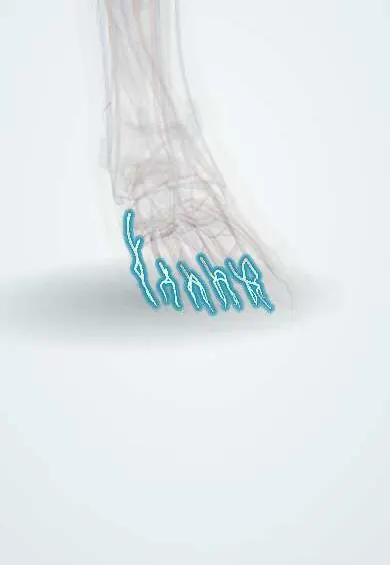
- Toe arteries
- Digital arteries
- Plantar arteries
- Dorsalis pedis artery
- Posterior tibial artery
- Anterior tibial artery
- Radial artery
- Ulnar artery
- Superficial palmar arch
- Great saphenous vein
- Popliteal artery
Why it happens
What it is
A non-atherosclerotic, segmental inflammatory disease of small and medium-sized arteries and veins of the distal limbs. Inflammatory thrombi block the vessels of the fingers, toes, feet and forearms, causing ischaemia, ulcers and gangrene. It is tightly linked to tobacco use.
Who gets it
Rare in most Western countries and more frequent in Asia, the Middle East and parts of Eastern Europe. It mainly affects men aged about 20–45 who smoke heavily, although the share of women has risen as more women smoke. In Colombia and Latin America it is uncommon, but it is a classic exam item for young smokers with digital ischaemia.
Causes
- Tobacco exposure in any form (cigarettes, cigars, chewing tobacco, heavy second-hand smoke) is almost always present
- Cannabis smoking has also been associated
- Immune-mediated vessel inflammation of uncertain cause, triggered by tobacco
- Probable genetic susceptibility (certain HLA types are more frequent)
Risk factors
- Heavy smoking or other tobacco use
- Male sex
- Age under 45 at onset
- Low socioeconomic status and poor access to health care in some series
- Cold exposure and minor limb trauma as triggers of ulcers
Pathophysiology
Tobacco components appear to trigger an immune reaction in the vessel wall. In the acute phase, a highly cellular inflammatory thrombus fills the lumen of small and medium arteries and veins, while the internal elastic lamina and wall structure are largely preserved (unlike true vasculitis). Over time the thrombus organises and partly recanalises, and fibrosis can bind the artery, vein and nerve together. Occlusions start distally (digital, palmar, plantar, tibial and radial or ulnar arteries) and spread proximally; the result is distal ischaemia with tortuous collateral vessels.
Classification
- Acute phase: inflammatory thrombus with intense cellular infiltrate
- Subacute phase: progressive organisation of the thrombus
- Chronic phase: organised thrombus, recanalisation and perivascular fibrosis
- Clinical criteria sets (for example Shionoya or Olin criteria) combine age, tobacco use, distal occlusions and exclusion of other causes
Symptoms and signs
- Coldness, numbness or tingling of the fingers and toes
- Raynaud phenomenon
- Claudication of the foot arch (instep) or calf, progressing to pain at rest
- Painful ulcers at the fingertips or toes and dry gangrene
- Migratory superficial thrombophlebitis (tender red cords along veins)
- Weak or absent pulses at the wrists and ankles with normal proximal pulses
Diagnosis
- Clinical
- A clinical diagnosis of exclusion: a young smoker with distal ischaemia of the hands and/or feet, often with superficial phlebitis, and no other cause such as atherosclerosis, diabetes, emboli or autoimmune disease. The Allen test is often abnormal, showing hand artery involvement.
- Tests
- Ankle-brachial index and digital pressures show distal reduced flow. Blood tests exclude other causes: glucose and lipids, inflammatory markers, antinuclear antibodies and other autoantibodies, antiphospholipid antibodies, cryoglobulins and thrombophilia studies. There is no specific laboratory marker.
- Imaging
- Arterial Doppler ultrasound maps occlusions. Echocardiography excludes a cardiac source of emboli. Angiography (CT, MR or catheter) shows smooth segmental occlusions of small distal arteries with corkscrew-shaped collateral vessels and normal proximal arteries without atheroma. Biopsy is rarely needed.
Differential diagnosis
- Peripheral artery disease from atherosclerosis
- Embolism from the heart or an aneurysm
- Systemic sclerosis and other connective tissue diseases
- Antiphospholipid syndrome
- Diabetic foot with small-vessel disease
- Frostbite or vibration injury
Goal of treatment
Stop the disease from progressing by complete and permanent abstinence from all tobacco, relieve ischaemic pain, heal ulcers and avoid amputation.
Treatment
- Lifestyle
- Complete abstinence from every form of tobacco, including second-hand smoke; this is the only measure proven to halt the disease. Support with counselling and cessation medicines; nicotine replacement may keep the disease active, so non-nicotine options are preferred.
- Conservative
- Protect the limbs from cold and trauma, careful foot and nail care, well-fitting footwear, and avoiding vasoconstrictor drugs.
- Medical
- Analgesia for ischaemic pain; intravenous prostacyclin analogues may help ulcer healing in critical ischaemia. Calcium channel blockers or other vasodilators may be tried with limited evidence. Antibiotics for infected ulcers.
- Surgical
- Debridement and limited amputation for gangrene; sympathectomy in selected cases. Bypass is rarely possible because of the distal pattern; endovascular treatment is an option in selected patients.
- Follow-up
- Nursing priorities: daily inspection of hands and feet, wound care, pain control, warmth, and repeated tobacco-cessation support at every contact.
Complications
- Chronic ischaemic ulcers
- Wet or dry gangrene of fingers or toes
- Minor and major amputations
- Infection of ulcers and osteomyelitis
- Chronic pain and reduced quality of life
Prognosis
Life expectancy is near normal because the disease does not affect coronary or cerebral arteries much. Limb prognosis depends on tobacco: patients who stop completely rarely need major amputation, whereas those who keep smoking have a high risk of progressive amputations.
Prevention
- Avoiding tobacco in any form
- Tobacco-cessation programmes for young smokers
- Early care of minor foot and hand wounds in known patients
Test yourself
Think of the answer, then tap the question to see it.
What is the typical patient profile in thromboangiitis obliterans?
A young man (under about 45) who smokes heavily, with ischaemia of the fingers and/or toes.
What is the single most effective treatment for Buerger disease?
Complete and permanent cessation of all tobacco use; continued smoking leads to progression and amputation.
What angiographic finding is characteristic of Buerger disease?
Segmental occlusions of small distal arteries with corkscrew collaterals and normal proximal arteries without atheroma.
Which venous finding can accompany Buerger disease?
Migratory superficial thrombophlebitis.
Related conditions
- Peripheral artery disease
- Acute limb ischaemia
- Raynaud phenomenon
- Tobacco use disorder
- Superficial thrombophlebitis (superficial vein thrombosis)
- Systemic sclerosis (scleroderma, including CREST)
- Antiphospholipid syndrome
- Diabetic foot
- Atherosclerosis and dyslipidaemia
Educational information, not medical advice. For any symptom, see a health professional.
Sources: Thromboangiitis Obliterans - Cardiology - Merck Manual Professional Edition (Merck Manual Professional Edition, 2025); Thromboangiitis obliterans: MedlinePlus Medical Encyclopedia (MedlinePlus (U.S. National Library of Medicine), 2024).
Spotted a mistake?We are always improving for the community. Tell us what is wrong and our team will review it.Report a mistake
Representative model, for educational purposes only.