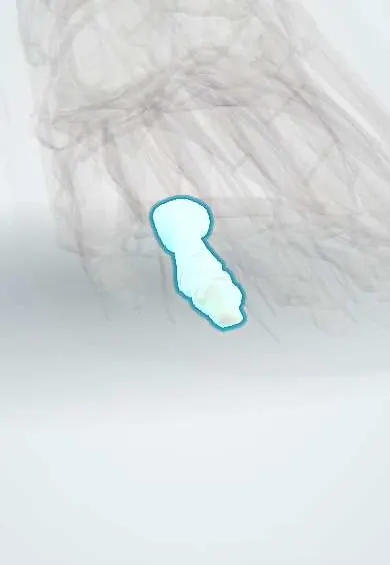
Fourth toe !
The fourth toe, next to the little toe, has three small bones (phalanges) and helps with balance and grip.
Opens in the Durgical app, no sign-up needed.
What it is
The fourth toe, made of three small bones (phalanges).
What it does
The smaller toes help with balance and grip when you stand and walk.
Key facts
- Joints with
- Fourth metatarsal (MTP joint); proximal and distal interphalangeal joints
- Landmarks
- Three phalanges; FDL to distal, FDB to middle phalanx; extensor expansion; fourth dorsal interosseous (lateral), second plantar interosseous (medial); lumbrical
Relations
- Behind
- Fourth metatarsal head and the plantar plate
- Medial
- Third toe; the third web space with its digital nerve; the second plantar interosseous
- Lateral
- Little toe; the fourth dorsal interosseous
- Above
- Extensor digitorum longus and extensor digitorum brevis tendons
- Below
- Flexor digitorum longus and flexor digitorum brevis tendons; plantar digital nerves and arteries
How to find it
Its MTP joint lies just behind the web on the dorsum; a soft corn is looked for in the web between the fourth and fifth toes, where it stays moist and white.
On imaging
Dorsoplantar and oblique foot views. A short fourth metatarsal (brachymetatarsia) is obvious on the dorsoplantar view, with the toe set back. Radiographs show phalangeal fractures and the bony prominences of the facing condyles behind a soft corn between the fourth and fifth toes; the corn itself is a clinical diagnosis. Ultrasound or MRI is kept for a suspected neuroma or mass.
Common problems
- Hammer toe or claw toe: the toe bends up at the base and down at the middle joint, often with corns.
- Fractures from stubbing or dropping something on the toe.
Clinical notes
- Interdigital soft corns can ulcerate and become infected, especially with diabetes
- Morton neuroma symptoms reach its medial side through the third web space
Anatomical variants
- Congenital curly toe: a flexed, underlapping toe, typically one of the third to fifth toes, often on both feet
Development
Congenital curly toe, common in young children, most often affects the third and fourth toes: the toe bends and rotates to tuck under its medial neighbour, and many improve as the child grows.
Related conditions
Test yourself
Think of the answer, then tap the question to see it.
Which nerves supply the plantar skin of the fourth toe?
The medial half from the medial plantar nerve, the lateral half from the lateral plantar nerve.
Where do soft corns (heloma molle) form and why?
Between the fourth and fifth toes, where the bones press against each other.
Why does the fourth toe sit back and ride up in brachymetatarsia?
Its metatarsal, the fourth, is congenitally short.
Educational information, not medical advice. For any symptom, see a health professional.
Its names
- Official Latin (TA2)
- digitus quartus pedis; phalanges pedis TA2 174
- Official Spanish (DeCS)
- Cuarto dedo del pie DeCS D014034
- English (TA2)
- Fourth toe
- Also called
- fourth digit of foot · digit 4 of foot · phalangeal bones of foot
Related
- Fourth metatarsal
- Toe arteries
- Crural fascia
- Dorsal interossei
- Toe extensor tendons
- Extensor digitorum brevis
- Flexor digitorum brevis
- Toe flexor tendon
Sources: Terminologia Anatomica (TA2); DeCS; Anatomy, Bony Pelvis and Lower Limb: Foot and Ankle.
Spotted a mistake?We are always improving for the community. Tell us what is wrong and our team will review it.Report a mistake
Representative model, for educational purposes only.