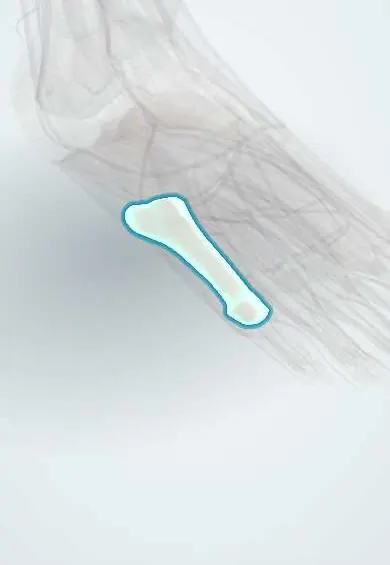
Fifth metatarsal !
The fifth metatarsal is the outer long bone of the forefoot, behind the little toe; a tendon attaches to the bump at its base.
Official name: Fifth
Opens in the Durgical app, no sign-up needed.
What it is
The outer long bone of the forefoot, behind the little toe. Its base has a bump (tuberosity) where the fibularis brevis tendon attaches.
What it does
Forms the outer edge of the foot and helps with balance when standing and walking.
Key facts
- Joints with
- Cuboid; fourth metatarsal; proximal phalanx of little toe
- Landmarks
- Tuberosity on base (fibularis brevis); fibularis tertius on dorsal base; Jones fracture at metaphyseal–diaphyseal junction
Relations
- Behind
- Cuboid at the fifth tarsometatarsal joint
- In front
- Proximal phalanx of the little toe
- Medial
- Fourth metatarsal at the intermetatarsal joint; fourth dorsal and third plantar interossei
- Lateral
- Subcutaneous outer border; the sural nerve runs along the lateral foot near the base and is at risk in surgery
- Below
- Abductor digiti minimi and flexor digiti minimi brevis; the lateral band of the plantar fascia to the tuberosity
- Above
- Fibularis tertius on the dorsal base; extensor digitorum longus tendon to the little toe
How to find it
The tuberosity at the base is the most prominent point of the outer border of the foot, about halfway between the heel and the little toe; the shaft is followed along the outer edge to the head.
Examination
- Ottawa foot rules: tenderness at the base of the fifth metatarsal or at the navicular, or inability to bear weight, indicates foot X-rays
On imaging
AP, oblique and lateral foot views: the zone is set by where the line runs. In children the apophysis is a thin flake parallel to the shaft, whereas a fracture line runs across the bone. Os vesalianum and os peroneum are smooth corticated ossicles nearby.
Common problems
- Avulsion fracture: the tip of the base breaks off when the ankle rolls. It usually heals well.
- Jones fracture: a break a little further along, where the blood supply is poor, so it often heals slowly.
- Stress fractures of the shaft in athletes.
How it is diagnosed
A physical exam; X-rays show where the break is. CT or MRI for slow-healing or stress fractures.
Treatment
- Avulsion fractures: a stiff shoe or boot and gradual walking.
- Jones fractures: a cast or boot with no weight on the foot for several weeks, or surgery with a screw, often chosen for athletes.
- Fractures that do not heal: surgery with a screw, sometimes with a bone graft from the patient or a donor.
Clinical notes
- Jones fractures have high rates of delayed union and refracture; athletes are often treated with an intramedullary screw
- Dancer's fracture: a spiral fracture of the distal shaft from rolling over a plantarflexed foot
- A cavovarus foot overloads the lateral border and predisposes to fifth metatarsal stress fractures
Anatomical variants
- Os vesalianum: an accessory ossicle beside the tuberosity, near the fibularis brevis insertion; its smooth, corticated edges tell it apart from an avulsion fracture
Development
The tuberosity apophysis appears around the start of adolescence and fuses a few years later; traction apophysitis here is Iselin disease.
Related conditions
Test yourself
Think of the answer, then tap the question to see it.
Which tendon inserts on the tuberosity of the fifth metatarsal base?
The fibularis brevis tendon; the lateral band of the plantar fascia also pulls here.
What is a Jones fracture and why does it heal poorly?
A fracture at the metaphyseal–diaphyseal junction of the fifth metatarsal (zone 2), a watershed area with poor blood supply.
How does a tuberosity avulsion (zone 1) differ from a Jones fracture in which joint the line enters?
Zone 1 enters the joint with the cuboid; a Jones (zone 2) fracture enters the joint between the fourth and fifth metatarsal bases.
What is Iselin disease?
Traction apophysitis at the tuberosity apophysis of the fifth metatarsal in adolescents.
Educational information, not medical advice. For any symptom, see a health professional.
Its names
- Official Latin (TA2)
- os metatarsi V TA2 1496
- Official Spanish (DeCS)
- Quinto metatarsiano DeCS D008682
- English (TA2)
- Fifth
Related
- Cuboid
- Little toe
- Fibularis brevis tendon
- Fibularis tertius
- Abductor digiti minimi
- Adductor hallucis
- Dorsal interossei
- Fibular retinacula
Sources: Terminologia Anatomica (TA2); DeCS; Anatomy, Bony Pelvis and Lower Limb: Metatarsal Bones.
Spotted a mistake?We are always improving for the community. Tell us what is wrong and our team will review it.Report a mistake
Representative model, for educational purposes only.