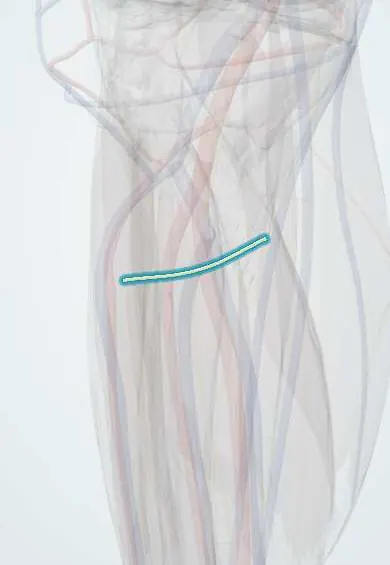
Infrapatellar nerve !
The infrapatellar nerve is a small skin nerve below the kneecap; it is often cut in knee surgery, leaving a numb patch.
Official name: Infrapatellar branch of saphenous nerve
Opens in the Durgical app, no sign-up needed.
What it is
A small skin branch of the saphenous nerve below the kneecap.
What it does
Carries feeling from the skin below the kneecap; it can be irritated after knee surgery.
Key facts
- Roots
- L3–L4 (branch of saphenous nerve)
- Moves
- None (purely sensory, cutaneous)
- Feeling from
- Skin in front of knee below patella and over patellar ligament; often cut in medial knee incisions
Relations
- Course
- Leaves the saphenous nerve at the medial knee, pierces the sartorius and the fascia lata, then runs obliquely downward and laterally below the patella to the skin over the patellar ligament and the tibial tuberosity
- Superficial
- Subcutaneous fat and skin only
- Deep
- The medial patellar retinaculum and the patellar ligament
- Above
- The patella and the patellar plexus, which it forms with the anterior cutaneous nerves of the thigh
How to find it
It cannot be felt. It crosses the anteromedial knee as an oblique band running from upper-medial to lower-lateral, between the lower pole of the patella and the tibial tuberosity; surgeons look for it in the fat when making medial knee and hamstring harvest incisions.
Examination
- Light touch below and lateral to a knee scar maps the numb area; Tinel's sign over the scar reproduces tingling when a neuroma has formed
On imaging
Usually not seen on routine imaging. High-resolution ultrasound can trace it from the sartorius, which it pierces or winds around, across the anteromedial knee between the lower pole of the patella and the tibial tuberosity. This view is used to block it or to find a painful neuroma after knee surgery; MRI mainly rules out other causes of anterior knee pain.
Clinical notes
- Oblique or horizontal incisions for hamstring graft harvest run along its branches and are used to lower the risk of cutting them
- Numbness after knee replacement or ACL reconstruction usually comes from this nerve and often shrinks over the following months
- A painful neuroma is confirmed by a tender spot with tingling on tapping and relief after a local nerve block
Anatomical variants
- Its relation to the sartorius varies (through, in front of or behind the muscle), as does the number of branches it gives
Test yourself
Think of the answer, then tap the question to see it.
Which nerve is most often injured in knee surgery?
The infrapatellar branch of the saphenous nerve, cut by medial parapatellar incisions, arthroscopy portals and hamstring graft harvest.
What does injury to the infrapatellar branch of the saphenous nerve cause?
A numb patch beside and below the scar, usually on its lateral side; a painful neuroma can make kneeling uncomfortable.
Which skin does the infrapatellar branch of the saphenous nerve supply?
The skin in front of the knee below the patella and over the patellar ligament.
Educational information, not medical advice. For any symptom, see a health professional.
Its names
- Official Latin (TA2)
- ramus infrapatellaris nervi sapheni TA2 6526
- Official Spanish (DeCS)
- Ramo infrarrotuliano del nervio safeno
- English (TA2)
- Infrapatellar branch of saphenous nerve
Related
Sources: Terminologia Anatomica (TA2); Anatomy, Bony Pelvis and Lower Limb: Saphenous Nerve, Artery, and Vein.
Spotted a mistake?We are always improving for the community. Tell us what is wrong and our team will review it.Report a mistake
Representative model, for educational purposes only.