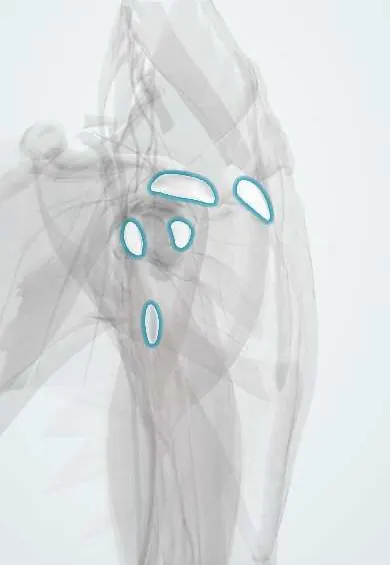
Other shoulder bursae !
The other shoulder bursae are small fluid sacs around the shoulder, such as the one under the subscapularis; they cut friction where tendons slide over bone.
Opens in the Durgical app, no sign-up needed.
What it is
Small sacs under the tendons around the shoulder.
What it does
Reduce friction where tendons slide over bone.
Key facts
- Where
- Subscapular (opens into the joint), subcoracoid and coracobrachial bursae
- Function
- Reduce friction where tendons slide over bone
Relations
- Superficial
- Subcutaneous acromial bursa: between the skin and the acromion
- In front
- Subcoracoid and coracobrachial bursae: under the coracoid and the conjoint tendon of coracobrachialis and the short head of biceps, in front of the subscapularis
- Deep
- Subscapular bursa: between the subscapularis tendon, the scapular neck and the shoulder capsule
- Behind
- Infraspinatus bursa: between the infraspinatus tendon and the capsule
How to find it
They cannot be felt. They are found on ultrasound or MRI, or at surgery when the subscapularis is reached through the deltopectoral interval.
Examination
- Coracoid impingement test: pain over the coracoid with the arm flexed forward, adducted and turned inward suggests subcoracoid impingement
On imaging
MRI or MR arthrography: the subscapular recess fills with joint fluid and is the commonest site of loose bodies; a fluid-filled subcoracoid bursa should not be mistaken for a subscapularis tear.
Clinical notes
- Subcoracoid impingement: the subscapularis is pinched between the coracoid and the lesser tuberosity, causing anterior shoulder pain
- A narrow coracohumeral interval on imaging supports subcoracoid impingement
Test yourself
Think of the answer, then tap the question to see it.
Which shoulder bursa usually opens into the glenohumeral joint, and where?
The subscapular bursa, between the superior and middle glenohumeral ligaments (foramen of Weitbrecht).
Why are loose bodies of the shoulder often found in the subscapular bursa?
Because it opens into the joint, it fills with joint fluid and is a favourite hiding place for loose bodies.
What is subcoracoid impingement, and which test suggests it?
The subscapularis is pinched between the coracoid and the lesser tuberosity; pain over the coracoid with the arm flexed, adducted and turned inward (coracoid impingement test).
Educational information, not medical advice. For any symptom, see a health professional.
Its names
- Official Latin (TA2)
- bursa subcutanea acromialis TA2 2556
- Official Spanish (DeCS)
- Bolsas sinoviales del hombro (subcutánea acromial, subtendinosas, coracobraquial)
- English (TA2)
- Other shoulder bursae
Related
Sources: Terminologia Anatomica (TA2); Anatomy, Shoulder and Upper Limb, Shoulder; Anatomy, Rotator Cuff.
Spotted a mistake?We are always improving for the community. Tell us what is wrong and our team will review it.Report a mistake
Representative model, for educational purposes only.