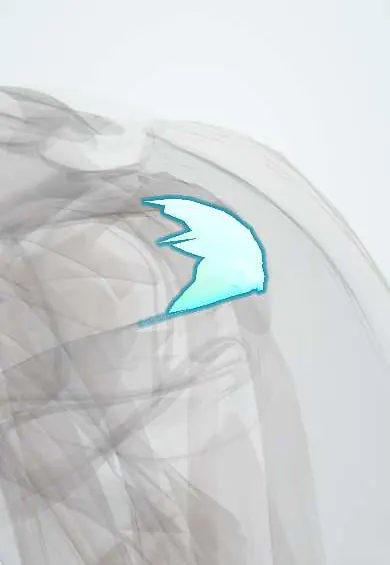
Infraspinatus tendon !
The infraspinatus tendon crosses the back of the shoulder to the humerus; it turns the arm outward and holds the ball back in the socket.
Opens in the Durgical app, no sign-up needed.
What it is
The rotator cuff tendon at the back of the shoulder; large cuff tears often extend into it, weakening outward rotation.
What it does
Turns the arm outward and holds the ball back in the socket.
Key facts
- Attaches
- Infraspinatus to the middle facet of the greater tubercle, between the supraspinatus and teres minor tendons
- Function
- Main lateral rotator; holds the humeral head back in the glenoid; tested by resisted lateral rotation with the arm at the side
- Tight in
- Medial rotation with horizontal adduction
Relations
- Course
- From the infraspinous fossa it runs laterally across the back of the shoulder joint, behind the humeral head, to the greater tubercle
- Superficial
- Posterior deltoid and the back of the subacromial–subdeltoid bursa; the posterior edge of the acromion above
- Deep
- Posterior shoulder capsule, which it reinforces, and the back of the humeral head
- Above
- Supraspinatus tendon, with interlacing fibres near the insertion
- Below
- Teres minor tendon, often hard to separate from it
- Medial
- Spinoglenoid notch at the lateral edge of the scapular spine, where the suprascapular nerve and vessels curve round under the spinoglenoid ligament to reach the muscle
How to find it
Seated, with the arm flexed forward and brought across the chest, the tendon is drawn out from under the acromion and is felt just below the posterolateral corner of the acromion. Resisted lateral rotation tightens it under the posterior deltoid.
Examination
- Resisted lateral rotation with the elbow at the side and bent to 90°: weakness points to a tear or a suprascapular nerve palsy; pain alone suggests tendinopathy
- External rotation lag sign: the examiner turns the forearm outward almost fully and lets go; if it drifts back inward, the posterosuperior cuff is torn
On imaging
MRI and ultrasound show whether a superior cuff tear extends back into it. On sagittal MRI, wasting and fatty change of the muscle (Goutallier grading) help predict whether a tear can be repaired. Muscle wasting with an intact tendon points to a nerve cause.
Common problems
- Rotator cuff tear, partial or full, from wear with age or from a fall; the most common cause of shoulder weakness.
- Tendinopathy and impingement: pain lifting the arm and at night.
- Calcific tendinitis: calcium deposits that cause sudden severe pain.
How it is diagnosed
Weakness and pain on cuff tests (for example the empty-can test). Ultrasound or MRI shows the tear size and muscle quality.
Treatment
- Physical therapy, pain medicines and sometimes injections, especially for partial and age-related tears.
- Arthroscopic rotator cuff repair with suture anchors for many full-thickness tears, especially recent ones in active people.
- Reverse shoulder replacement for large, irreparable tears with arthritis.
Clinical notes
- Suprascapular nerve compression at the spinoglenoid notch, often by a ganglion linked to a labral tear, weakens the infraspinatus alone; seen in overhead athletes such as volleyball players
- With the subscapularis in front it forms the transverse force couple that centres the humeral head; losing both sides of the couple lets the head ride up
- The interval between it (suprascapular nerve) and the teres minor (axillary nerve) is the internervous plane of the posterior approach to the shoulder joint
Anatomical variants
- Its muscle may be fused with the teres minor
Test yourself
Think of the answer, then tap the question to see it.
Where does the infraspinatus tendon insert, and what is its main action?
On the middle facet of the greater tubercle; it is the main lateral rotator and holds the humeral head back in the glenoid.
What does a positive external rotation lag sign mean for the infraspinatus tendon?
The tendon is torn, not just painful: the forearm drifts back inward after being released in near-full lateral rotation.
What does infraspinatus wasting with an intact infraspinatus tendon suggest?
Suprascapular nerve compression at the spinoglenoid notch, often by a paralabral cyst.
What internervous plane lies beside the infraspinatus tendon in the posterior shoulder approach?
Between the infraspinatus (suprascapular nerve) and the teres minor (axillary nerve).
Educational information, not medical advice. For any symptom, see a health professional.
Its names
- Official Latin (TA2)
- tendo musculi infraspinati TA2 2458
- Official Spanish (DeCS)
- Tendón del músculo infraespinoso
- English (TA2)
- Infraspinatus tendon
Related
Sources: Terminologia Anatomica (TA2); Anatomy, Shoulder and Upper Limb, Infraspinatus Muscle; Anatomy, Rotator Cuff.
Spotted a mistake?We are always improving for the community. Tell us what is wrong and our team will review it.Report a mistake
Representative model, for educational purposes only.