Muscular system · Head and neck
Procerus !
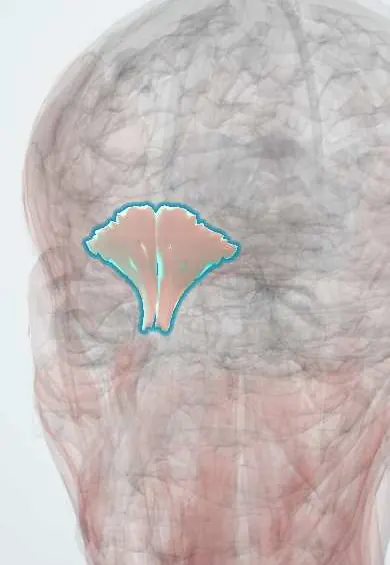
The procerus is a small muscle over the bridge of the nose; it pulls the skin between the eyebrows down, making horizontal lines there.
Official name: Procerus muscle
Opens in the Durgical app, no sign-up needed.
What it is
A small muscle over the bridge of the nose.
What it does
Makes the horizontal lines between the eyebrows.
Key facts
- Origin
- Nasal bone and upper lateral nasal cartilage
- Insertion
- Skin between the eyebrows
- Action
- Pulls the eyebrows down (horizontal lines at the root of the nose)
- Nerve
- Facial nerve (CN VII): temporal and zygomatic branches (some texts: zygomatic and buccal)
- Blood supply
- Facial artery branches
Relations
- Superficial
- Skin of the glabella between the eyebrows
- Deep
- Nasal bones and the upper lateral nasal cartilages
- Above
- Medial fibres of the frontalis
- Lateral
- Corrugator supercilii and the medial part of the orbicularis oculi
- Below
- Transverse part of the nasalis on the nasal bridge
How to find it
Asked to frown or wrinkle the top of the nose (as at a bad smell), horizontal lines form across the bridge of the nose between the eyes.
Examination
- Frowning or wrinkling the nasal root: absent creases on one side fit a weak upper facial nerve on that side
On imaging
Not usually imaged: on CT or MRI it is a thin soft-tissue layer over the nasal bones at the glabella, continuous above with the frontalis. Imaging here looks at what lies beneath: CT shows frontal sinus and nasal bone fractures after a blow to the glabella, and CT or MRI studies a midline lump at the root of the nose in a child, such as a dermoid, for a tract toward the skull base.
Clinical notes
- Botulinum toxin injection for the glabellar lines treats procerus and corrugator together; spread can cause temporary eyelid drooping
- Brow-lift surgery weakens or divides it to reduce downward pull on the medial brow
Development
Second pharyngeal arch muscle; it is continuous with the frontalis because both come from the same sheet of second-arch muscle.
Memory aid
Procerus «pulls the brow down»: horizontal lines; corrugator «crinkles» the brow: vertical lines.
Test yourself
Think of the answer, then tap the question to see it.
Which skin creases does the procerus produce, and how does it move the brow?
Horizontal creases at the root of the nose; it pulls the medial brow down, forming the glabellar complex with the corrugator.
Which muscle is continuous with the procerus above and acts as its antagonist?
The frontalis: the procerus lowers the brow and the frontalis raises it.
Which nerve supplies the procerus?
The facial nerve (CN VII), by its upper branches; texts differ on whether these are temporal, zygomatic or buccal.
Educational information, not medical advice. For any symptom, see a health professional.
Its names
- Official Latin (TA2)
- musculus procerus TA2 2061
- Official Spanish (DeCS)
- Músculo prócer
- English (TA2)
- Procerus muscle
- Also called
- Santorini's muscle · depressor glabellae · musculus depressor glabellae
Related
Sources: Terminologia Anatomica (TA2); Anatomy, Head and Neck, Procerus Muscle; Anatomy of the Human Body (20th ed.): Development of the Muscles (Lea & Febiger (Gray's Anatomy, 1918), 1918) · adapted, Public domain.
Spotted a mistake?We are always improving for the community. Tell us what is wrong and our team will review it.Report a mistake
Representative model, for educational purposes only.