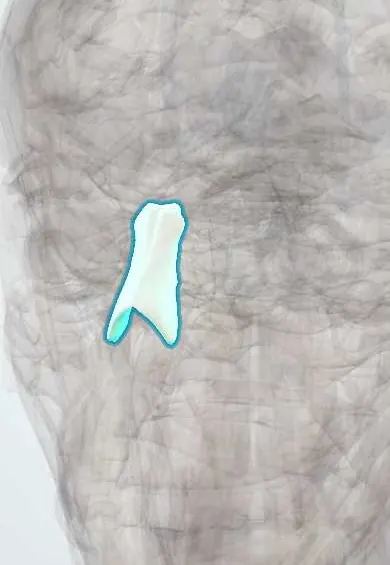
Skeletal system · Head and neck
Nasal bones !
The nasal bones are two small bones that form the bridge of the nose; they support its upper part, while the lower nose is made of cartilage.
Official name: Nasal bone
Opens in the Durgical app, no sign-up needed.
What it is
Two small bones that form the bridge of the nose.
What it does
Support the upper nose; the lower nose is cartilage.
Key facts
- Joints with
- Opposite nasal, frontal, maxilla, ethmoid
- Landmarks
- Bridge of the nose (most fractured facial bone)
Relations
- Above
- Nasal part of the frontal bone at the nasion
- Lateral
- Frontal processes of the maxillae at the nasomaxillary sutures
- Deep
- Nasal septum (perpendicular plate of the ethmoid bone and septal cartilage) in the midline; the external nasal branch of the anterior ethmoidal nerve runs in a groove on the deep surface
- Below
- Upper lateral nasal cartilages, overlapped by the lower edge of the bones
- Superficial
- Procerus, nasalis and the thin skin of the nasal dorsum
How to find it
The bony bridge is felt from between the eyes down to about the upper third of the nose, where it gives way to softer cartilage; crepitus, a step or local tenderness here suggests a fracture.
On imaging
Diagnosis is mostly clinical; plain nasal radiographs add little to management. CT is used when other facial fractures (naso-orbito-ethmoid, orbital) are suspected.
Clinical notes
- Displaced fractures are reduced either soon after injury or once swelling settles, before the fragments set (commonly within about two weeks)
- A wide, flat nasal bridge with widened distance between the inner corners of the eyes (telecanthus) after a central midface blow suggests a naso-orbito-ethmoid fracture, not a simple nasal fracture
- In rhinoplasty, controlled osteotomies of the nasal bones and the frontal process of the maxilla narrow or straighten the bony vault
Development
Each ossifies in membrane from a single centre. In children the bones are small and more of the nose is cartilage, so injury more often damages the septum, which can affect later midface growth.
Related conditions
Test yourself
Think of the answer, then tap the question to see it.
Why do most nasal bone fractures pass through their lower part?
The nasal bones are thick and narrow above at the frontal bone but thin and wide below, where they support the upper lateral cartilages.
What must always be checked inside the nose after a nasal bone fracture, and why?
A septal haematoma: it must be drained to prevent cartilage necrosis and a saddle nose.
What does a wide, flat nasal bridge with telecanthus after a central midface blow suggest?
A naso-orbito-ethmoid fracture, not a simple fracture of the nasal bones.
Educational information, not medical advice. For any symptom, see a health professional.
Its names
- Official Latin (TA2)
- os nasale TA2 748
- Official Spanish (DeCS)
- Hueso Nasal DeCS D009295
- English (TA2)
- Nasal bone
Sources: Terminologia Anatomica (TA2); DeCS; Anatomy, Head and Neck, Nose Bones; Anatomy, Head and Neck, Nose.
Spotted a mistake?We are always improving for the community. Tell us what is wrong and our team will review it.Report a mistake
Representative model, for educational purposes only.