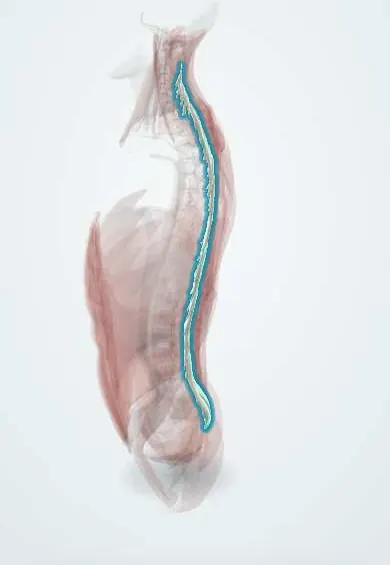
Rotatores !
The rotatores are the smallest, deepest back muscles, best developed in the mid-back; they steady the spine and sense its position.
Opens in the Durgical app, no sign-up needed.
What it is
The smallest and deepest back muscles, from each transverse process to the lamina above, best developed in the mid-back.
What it does
Steady and slightly twist the spine; they are rich in sensors that tell the brain where each vertebra is.
Key facts
- Origin
- Transverse processes; best developed in the thoracic region
- Insertion
- Lamina and base of spinous process 1 (brevis) or 2 (longus) segments above
- Action
- Stabilise vertebrae; assist extension and rotation to the opposite side; proprioception
- Nerve
- Medial branches of dorsal rami (segmental)
- Blood supply
- Dorsal branches of posterior intercostal arteries (and lumbar, deep cervical)
Relations
- Superficial
- Multifidus, then semispinalis
- Deep
- Laminae, transverse processes and facet joint capsules
- Medial
- Bases of the spinous processes
How to find it
They cannot be felt. In a posterior approach they are the last thin fibres cleared from the laminae and transverse processes before the facet joints are exposed.
On imaging
Not seen separately on routine imaging; on axial MRI they are part of the deep layer on the laminae and transverse processes, clearest in the thoracic spine. What is assessed instead is the whole transversospinal group: oedema after injury, or fatty change after posterior surgery or denervation. In facet procedures under fluoroscopy or CT, bony landmarks guide the needle.
Common problems
- Shrinks and fills with fat in chronic low back pain, sometimes only at the painful level.
- Is stripped or split from the bone in open posterior spine surgery; muscle-sparing approaches try to protect it.
How it is diagnosed
MRI or ultrasound shows its size and fat content.
Treatment
- Targeted exercise (motor control training) to retrain the deep stabilisers.
Clinical notes
- Removed in laminectomy and facet exposure; their loss is thought to blunt the segmental position sense of the spine
- Supplied by the medial branches of the dorsal rami, the nerves targeted in facet joint denervation
Test yourself
Think of the answer, then tap the question to see it.
How do rotatores breves differ from rotatores longi?
Rotatores breves span one segment, rotatores longi two; both run from a transverse process to the lamina above.
In which part of the spine are the rotatores best developed?
The thoracic spine; in the neck and lower back they are small and irregular.
Why are the rotatores thought of mainly as position sensors?
They are very rich in muscle spindles, giving segmental proprioception more than movement.
Educational information, not medical advice. For any symptom, see a health professional.
Its names
- Official Latin (TA2)
- rotatores TA2 2284
- Official Spanish (DeCS)
- Músculos rotadores DeCS D064170
- English (TA2)
- Rotatores
- Also called
- rotator muscles
Related
Sources: Terminologia Anatomica (TA2); DeCS; Anatomy, Back.
Spotted a mistake?We are always improving for the community. Tell us what is wrong and our team will review it.Report a mistake
Representative model, for educational purposes only.