Digestive system · Head and neck
Upper right third molar !
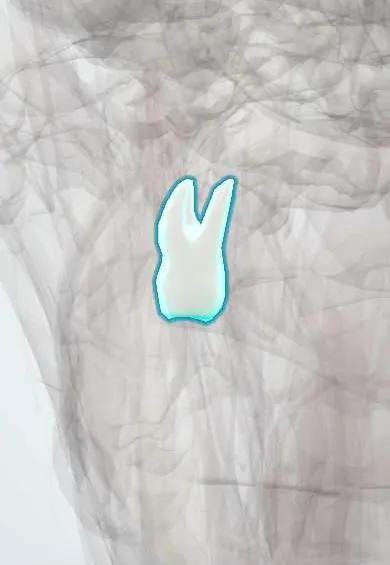
The upper right third molar (tooth 18) is the wisdom tooth, last at the back; it often lacks room to come in and stays stuck (impacted).
Opens in the Durgical app, no sign-up needed.
What it is
The wisdom tooth: the last molar, usually coming in between the ages of 17 and 25.
What it does
Grinds food when it erupts fully; often it does not.
Key facts
- Joints with
- Alveolar socket of the maxilla (gomphosis held by the periodontal ligament); bites against the opposing teeth
- Landmarks
- FDI 18, upper right third molar (wisdom tooth): roots often fused or variable; often impacted or missing; erupts at about 17–25 years; nerve: posterior superior alveolar nerve (V2); roots near the floor of the maxillary sinus
Relations
- In front
- The upper right second molar
- Behind
- Maxillary tuberosity; behind it, the pterygoid plates and the infratemporal fossa
- Above
- Floor of the maxillary sinus, often very close
- Below
- In a normal bite it meets only one tooth, the lower right third molar
How to find it
The last tooth on the upper right, eighth from the midline, against the maxillary tuberosity; often absent, unerupted or only partly visible.
On imaging
A panoramic film is the first study: it shows its depth in the tuberosity and how close it lies to the sinus floor; CBCT helps when it sits high or inside the sinus wall.
Common problems
- Impacted wisdom tooth: stuck under the gum or against the second molar, with pain, swelling or infection (pericoronitis).
Clinical notes
- Posterior superior alveolar nerve, entering the tuberosity just above and behind it; the pterygoid venous plexus and branches of the maxillary artery lie close behind
- When it erupts tilted toward the cheek it can rub or be bitten against the buccal mucosa
- Hard to reach with a toothbrush, so it decays easily and can trap plaque against the back of the second molar
Anatomical variants
- Its crown is the most variable of the upper teeth: often 3 cusps or a small peg, with roots that are frequently fused into one
- A small extra molar can sit behind it (distomolar) or on its cheek side (paramolar)
Development
Among the last tooth germs to form: calcification starts at about 9–10 years and the roots finish in the early twenties, which is why third-molar stage is used to estimate age.
Memory aid
FDI 18 = quadrant 1, tooth 8. In the US Universal system it is #1: the count starts here and runs across the upper arch to #16.
Test yourself
Think of the answer, then tap the question to see it.
How is an impacted upper right third molar usually positioned?
Upright or tilted backward (distoangular) in the maxillary tuberosity.
Where can the upper right third molar be displaced during removal?
Into the maxillary sinus or back into the infratemporal fossa; the maxillary tuberosity can also fracture.
What are the FDI and US Universal numbers of the upper right third molar?
FDI 18 (quadrant 1, tooth 8) and Universal #1, where the count begins.
At what age does the upper right third molar usually erupt?
Between about 17 and 21 years, if it erupts at all.
Educational information, not medical advice. For any symptom, see a health professional.
Related
Sources: Anatomy, Head and Neck, Teeth; Anatomy, Permanent Dentition; Anatomy, Head and Neck, Tooth Eruption; Anatomy, Head and Neck: Alveolar Nerve; 23.3 The Mouth, Pharynx, and Esophagus (OpenStax (Rice University), 2022) · adapted, CC BY 4.0.
Spotted a mistake?We are always improving for the community. Tell us what is wrong and our team will review it.Report a mistake
Representative model, for educational purposes only.