
Blepharospasm and hemifacial spasm
Involuntary eyelid squeezing: both eyes in blepharospasm (a dystonia), one side of the face in hemifacial spasm. Both respond to botulinum toxin.
What it is
Two disorders of involuntary eyelid closure. Benign essential blepharospasm is a focal dystonia with bilateral forceful closure that can cause functional blindness. Hemifacial spasm is one-sided, usually from a blood vessel compressing the facial nerve at the brainstem, with lid twitching spreading to the cheek and mouth.
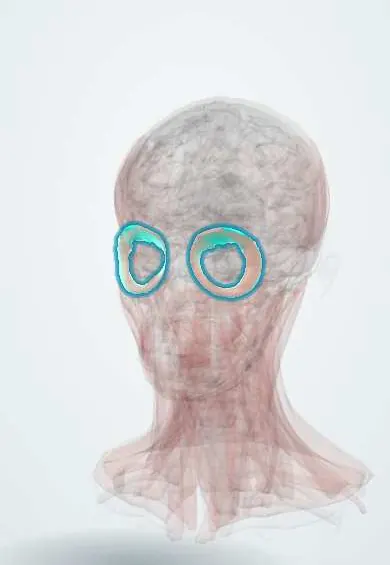
See it in 3D
Who gets it
Blepharospasm mostly affects women aged 50 to 70; hemifacial spasm affects middle-aged adults, more often women.
Causes
- Blepharospasm: dystonia of the basal ganglia circuits; sometimes drug-induced or with Parkinsonism
- Hemifacial spasm: vascular compression of the facial nerve root; rarely a tumour; after Bell palsy (synkinesis)
Risk factors
- Dry eye and light sensitivity (blepharospasm triggers)
- Hypertension (hemifacial spasm)
- Family history of dystonia
Pathophysiology
In blepharospasm, abnormal central motor control causes sustained contraction of the orbicularis muscles on both sides. In hemifacial spasm, pulsatile compression of the facial nerve near the brainstem causes ectopic firing in all its branches on one side.
Symptoms and signs
- Increased blinking and involuntary closure of both eyes (blepharospasm)
- Worse with bright light, stress and reading; better with talking or touching the face
- One-sided lid twitching spreading to the cheek and mouth (hemifacial spasm)
Diagnosis
- Clinical
- Bilateral (blepharospasm) or unilateral (hemifacial spasm) involuntary contractions; examination for dry eye and other movement disorders.
- Tests
- Review of medications that can cause dystonia.
- Imaging
- MRI of the brain and posterior fossa in hemifacial spasm to show vascular compression and exclude a tumour.
Differential diagnosis
- Eyelid myokymia (benign twitching of one lid)
- Tics
- Apraxia of lid opening
- Ocular surface irritation causing reflex blinking
Involuntary eyelid closure
| Feature | Benign essential blepharospasm | Hemifacial spasm | Eyelid myokymia | Apraxia of lid opening |
|---|---|---|---|---|
| Side | Both eyes | One side of the face | One lid, usually the lower | Both eyes |
| What moves | Forceful squeezing of the orbicularis, sometimes the lower face | Lid, cheek and mouth on one side together | Fine flicker of part of the orbicularis | No squeezing; the patient cannot start opening the lids |
| During sleep | Stops | Often persists | Stops | Not applicable |
| Cause | Dystonia of basal ganglia circuits | Vascular compression of the facial nerve root | Fatigue, stress, caffeine | Extrapyramidal disease; may coexist with blepharospasm |
| Management | Botulinum toxin; treat dry eye and light sensitivity | Botulinum toxin; microvascular decompression | Reassurance | Botulinum toxin near the lid margin; lid crutches |
Goal of treatment
Reduce the spasms so the person can see and function.
Treatment
- Procedure
- Botulinum toxin injections into the orbicularis muscle, repeated every few months; the first-line treatment for both.
- Conservative
- Treat dry eye and light sensitivity; tinted lenses.
- Surgical
- Microvascular decompression of the facial nerve for hemifacial spasm; protractor myectomy for refractory blepharospasm.
Complications
- Functional blindness
- Social isolation and depression
- Ptosis or dry eye after toxin injections
Common traps
- Blepharospasm is a nervous habit or a psychological problem: it is a focal dystonia of central motor control; patients can be functionally blind and are often misdiagnosed for years
- Twitching of one eyelid is early hemifacial spasm: eyelid myokymia is a fine flicker of part of one lid, usually with fatigue, stress or caffeine, and it settles; hemifacial spasm spreads to the cheek and mouth
- Hemifacial spasm needs no imaging because it is usually vascular: MRI of the posterior fossa shows the compressing vessel and excludes a tumour, especially with weakness, numbness or hearing loss
- Botulinum toxin cures these disorders: it weakens the muscle for a few months and must be repeated; it treats the spasm, not the cause
- Spasm on both sides of the face is bilateral hemifacial spasm: bilateral involvement is typical of blepharospasm, sometimes with lower-face dystonia; true bilateral hemifacial spasm is rare and the two sides twitch out of step
Prognosis
Chronic; botulinum toxin controls symptoms well in most patients.
Test yourself
Think of the answer, then tap the question to see it.
A 62-year-old woman has forceful closure of both eyes, worse in sunlight and better when she talks or touches her brow. Diagnosis?
Benign essential blepharospasm, a focal dystonia; light triggers and sensory tricks are typical.
Why does hemifacial spasm involve the cheek and mouth and not only the eyelid?
The irritation is at the facial nerve root, before the nerve branches, so every muscle it supplies on that side fires together.
A patient with hemifacial spasm also has facial numbness and hearing loss on the same side. What next?
Prompt MRI of the posterior fossa, because these signs suggest a cerebellopontine angle tumour rather than simple vascular compression.
Why is dry eye treated in a patient with blepharospasm?
Surface irritation and light sensitivity trigger and worsen the spasms; treating them reduces episodes and helps toxin injections work better.
Connections
Educational information, not medical advice. For any symptom, see a health professional.
Sources: Benign Essential Blepharospasm (StatPearls Publishing (NCBI Bookshelf), 2026); Hemifacial Spasm (StatPearls Publishing (NCBI Bookshelf), 2024).
Spotted a mistake?We are always improving for the community. Tell us what is wrong and our team will review it.Report a mistake
Representative model, for educational purposes only.