
Infection-related glomerulonephritis (beyond post-streptococcal)
Many infections besides strep throat can inflame the kidney filters, often while still active. Treating that infection is the treatment.
What it is
Glomerular injury triggered by an infection elsewhere in the body, through immune complexes, complement activation or direct infection of kidney cells. Beyond post-streptococcal GN it includes staphylococcal IgA-dominant GN, endocarditis-associated GN and shunt nephritis, and the viral and parasitic nephropathies of HIV, hepatitis B and C, malaria and schistosomiasis.
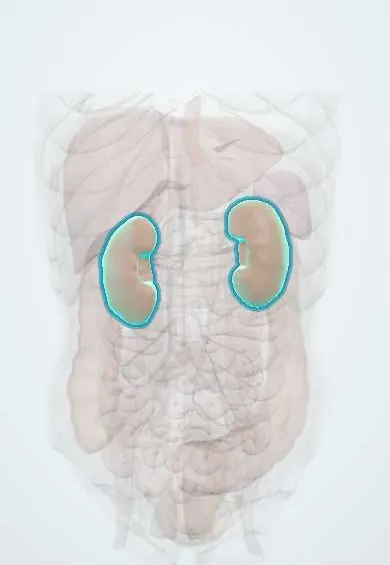
See it in 3D
Who gets it
In high-income countries post-streptococcal GN has declined while staphylococcal infection-related GN, typically in older adults with diabetes, has increased. Worldwide, viral and parasitic causes matter wherever those infections are common: hepatitis B membranous nephropathy in endemic regions, HIV-associated nephropathy mainly in people of African ancestry with advanced untreated HIV, Plasmodium malariae nephropathy in malaria zones, and schistosomal glomerulopathy in hepatosplenic S. mansoni infection (in the Americas mainly Brazil and Venezuela; cases in Colombia are imported).
Causes
- Staphylococcus aureus, including MRSA, in skin, bone, deep-seated or device infections: IgA-dominant infection-related GN
- Infective endocarditis (S. aureus, streptococci, Bartonella, Coxiella): focal, crescentic or membranoproliferative GN, sometimes with ANCA
- Infected ventriculoatrial shunt (S. epidermidis, Cutibacterium acnes): shunt nephritis
- HIV: collapsing focal segmental glomerulosclerosis (HIV-associated nephropathy); HIV can also cause immune-complex GN and thrombotic microangiopathy
- Hepatitis B: membranous nephropathy, its most common kidney manifestation; hepatitis C: cryoglobulinaemic membranoproliferative GN, less often membranous
- Plasmodium malariae (quartan malaria): chronic membranoproliferative GN with nephrotic syndrome; Schistosoma mansoni with hepatosplenic disease: mesangial or membranoproliferative GN
Risk factors
- Older age, diabetes, alcohol use and other comorbidity (staphylococcal infection-related GN)
- Injecting drug use, damaged or prosthetic heart valves (endocarditis)
- Advanced, untreated HIV infection and African ancestry with APOL1 risk variants (HIV-associated nephropathy)
- Chronic hepatitis B or C; living in or coming from areas with malaria or schistosomiasis
Pathophysiology
A persisting infection releases antigens (in S. aureus also superantigens that overstimulate T and B cells, with polyclonal IgA) → immune complexes form in the blood or in situ in the glomerulus, and complement is activated (often low C3) → glomerular inflammation: neutrophil-rich endocapillary proliferation in acute bacterial forms, membranoproliferative (double-contour) or subepithelial membranous deposits when the antigen is chronic → haematuria, proteinuria and falling GFR → removing the antigen source usually lets the inflammation settle, while delay leaves scarring. HIV takes a different route: the virus infects podocytes and tubular cells, which dedifferentiate and proliferate, the glomerular tuft collapses (collapsing FSGS) and heavy proteinuria follows.
Classification
- Bacterial, infection still active: staphylococcal IgA-dominant GN, endocarditis-associated GN, shunt nephritis
- Bacterial, infection over: post-streptococcal GN (its own page)
- Viral: HIV-associated nephropathy, hepatitis B membranous nephropathy, hepatitis C cryoglobulinaemic MPGN
- Parasitic: quartan malarial nephropathy, schistosomal glomerulopathy
Symptoms and signs
- Haematuria, proteinuria, oedema and hypertension, often with acute kidney injury
- Nephrotic syndrome in HIV-associated nephropathy, hepatitis B membranous nephropathy, quartan malaria and some schistosomal cases
- Signs of the infection itself: fever, skin or bone infection, a new heart murmur, purpura, hepatosplenomegaly, a shunt in place
- In hepatitis C cryoglobulinaemia: purpura, joint pain and weakness
Diagnosis
- Clinical
- Suspect it when nephritic or nephrotic findings appear together with an active or chronic infection. The key difference from post-streptococcal GN is timing: here the infection is usually still present, with no latent gap, and the patient is often an older adult with other illnesses.
- Tests
- Urinalysis for dysmorphic red cells and red cell casts, urine protein-creatinine ratio and creatinine; C3 and C4 (often low C3; low C3 and C4 with cryoglobulins in hepatitis C); blood cultures and a search for the source; HIV, hepatitis B surface antigen and hepatitis C serology with viral load; cryoglobulins and rheumatoid factor; malaria thick smear; stool or rectal biopsy for schistosome eggs after exposure; ANCA. Kidney biopsy defines the pattern: proliferative GN with C3-dominant or IgA-dominant deposits, membranoproliferative, membranous or collapsing FSGS.
- Imaging
- Echocardiography (transthoracic, then transoesophageal) for endocarditis; kidney ultrasound (large echogenic kidneys favour HIV-associated nephropathy, small kidneys suggest chronic damage); abdominal ultrasound for hepatosplenic schistosomiasis or splenomegaly; imaging of a shunt, bone or abscess when those infections are suspected.
Differential diagnosis
- Post-streptococcal GN: latent gap after a healed throat or skin infection, mostly children
- Primary IgA nephropathy
- C3 glomerulopathy
- ANCA-associated vasculitis and lupus nephritis
- Acute interstitial nephritis from the antibiotics used to treat the infection
- Antiretroviral tubular toxicity in people with HIV
Glomerulonephritis with an infection: which one?
| Form | Infection when the kidney fails | Complement | Biopsy pattern | Treatment focus |
|---|---|---|---|---|
| Post-streptococcal GN | Over, 1–4 weeks earlier | Low C3, recovers in weeks | Proliferative, C3 with or without IgG, subepithelial humps | Supportive care |
| Staphylococcal IgA-dominant GN | Active: skin, bone or deep infection | Low C3 in up to 60% | Proliferative with IgA-dominant deposits | Antibiotics and source control |
| Endocarditis or shunt nephritis | Active: infected valve or ventriculoatrial shunt | Often low C3 | Focal, crescentic or membranoproliferative | Antibiotics; valve surgery or shunt removal |
| HIV-associated nephropathy | Active: advanced untreated HIV | Normal | Collapsing FSGS with tubular microcysts | Antiretroviral therapy |
| Hepatitis B or C, quartan malaria, schistosomiasis | Chronic | Low C3 and C4 with hepatitis C cryoglobulins; often normal in quartan malaria | Membranous (hepatitis B); membranoproliferative (hepatitis C, malaria, schistosomes) | Antiviral or antiparasitic treatment |
Goal of treatment
Eradicate the infection or suppress the virus, support the kidney (blood pressure, proteinuria, fluid) and keep immunosuppression for selected severe cases once the infection is controlled.
Treatment
- Medical
- Treat the source: culture-guided antibiotics and drainage of abscesses; valve surgery for endocarditis when indicated; removal of an infected shunt.
- Medical
- Antiretroviral therapy for HIV-associated nephropathy, which markedly attenuates it; antivirals for hepatitis B membranous nephropathy (they increase remission of proteinuria); direct-acting antivirals for hepatitis C; antimalarial or antischistosomal treatment.
- Medical
- Supportive kidney care: ACE inhibitor or angiotensin receptor blocker for proteinuria and blood pressure, diuretics and salt restriction for oedema, drugs adjusted to kidney function.
- Medical
- Immunosuppression only in selected severe cases (for example crescentic disease or severe cryoglobulinaemic vasculitis) and only once the infection is controlled; it never replaces treating the cause.
- Procedure
- Dialysis for severe acute kidney injury; kidney biopsy to define the pattern when the cause or the severity is unclear.
- Follow-up
- Creatinine, proteinuria and complement until recovery; persistently low C3 prompts a search for complement dysregulation.
Complications
- Acute kidney injury needing dialysis
- Chronic kidney disease or kidney failure: 20–80% of patients with staphylococcal IgA-dominant GN reach kidney failure
- Complications of nephrotic syndrome (thrombosis, infection, high lipids) in the membranous and HIV forms
- Death from the underlying infection, especially endocarditis
Common traps
- Every post-infectious GN behaves like post-streptococcal GN: in staphylococcal, endocarditis and shunt nephritis the infection is still active when the kidney fails, so there is no latent gap and the treatment is to find and kill the source
- IgA deposits mean IgA nephropathy: in an older diabetic with a staphylococcal infection, IgA-dominant deposits in a neutrophil-rich proliferative GN point to infection-related GN, and steroids in place of antibiotics can be harmful
- A crescentic nephritis always needs steroids first: if the cause is endocarditis or another active infection, immunosuppression alone misses the cause; control the infection first
- A positive ANCA in a febrile patient with nephritis proves vasculitis: endocarditis can induce ANCA; take blood cultures and do an echocardiogram before immunosuppressing
- HIV-associated nephropathy is an immune-complex disease: classic HIV-associated nephropathy is a podocytopathy, with the virus inside podocytes, collapsing FSGS, normal complement and heavy proteinuria
Prognosis
It depends on age, the severity of the acute injury, pre-existing kidney damage and how fast the infection is controlled. Children with post-streptococcal GN almost always recover, but older adults with staphylococcal IgA-dominant GN often do not. In the largest series of endocarditis-associated GN about a third recovered fully, a third had persistent kidney dysfunction and about a fifth died. HIV-associated nephropathy, once a fast route to dialysis, is now uncommon and much milder with antiretroviral therapy.
Prevention
- Early treatment of staphylococcal and other bacterial infections, especially in people with diabetes
- HIV testing and early antiretroviral therapy
- Hepatitis B vaccination and treatment of hepatitis B and C
- Malaria prevention and treatment; schistosomiasis control in endemic areas
- Checking urine and creatinine in people with chronic infections
Test yourself
Think of the answer, then tap the question to see it.
How does the timing of infection differ between post-streptococcal GN and staphylococcal IgA-dominant GN?
Post-streptococcal GN follows a healed infection by 1–4 weeks. Staphylococcal IgA-dominant GN appears while the infection is still active, often in an older adult with diabetes.
Which glomerular lesion is typical of hepatitis B, hepatitis C and HIV?
Hepatitis B: membranous nephropathy. Hepatitis C: cryoglobulinaemic membranoproliferative GN. HIV: collapsing FSGS (HIV-associated nephropathy).
A febrile man who injects drugs has haematuria, rising creatinine, low C3 and a positive ANCA. What must be ruled out before immunosuppression, and how?
Infective endocarditis, which can cause GN and induce ANCA. Take blood cultures and do an echocardiogram, and treat the infection first.
Why is HIV-associated nephropathy seen mainly in people of African ancestry?
APOL1 risk variants, common in African ancestry, strongly predispose to it; the virus infects podocytes and tubular cells and causes collapsing FSGS.
Which malaria species causes a chronic nephrotic glomerulonephritis, and with what biopsy pattern?
Plasmodium malariae (quartan malaria): immune-complex membranoproliferative GN. P. falciparum mainly causes acute kidney injury from tubular necrosis.
Connections
Educational information, not medical advice. For any symptom, see a health professional.
Sources: Infection-Related Glomerulonephritis (Glomerular Diseases, 2021); Molecular Mechanisms of Injury in HIV-Associated Nephropathy (Frontiers in Medicine, 2018); Hepatitis C and kidney disease: A narrative review (Journal of Advanced Research, 2017); A Meta-Analysis of Antiviral Therapy for Hepatitis B Virus-Associated Membranous Nephropathy (PLoS One, 2016); Kidney involvement in malaria: an update (Revista do Instituto de Medicina Tropical de São Paulo, 2017); Glomerulonephritis in schistosomiasis mansoni: a time to reappraise (Revista da Sociedade Brasileira de Medicina Tropical, 2010).
Spotted a mistake?We are always improving for the community. Tell us what is wrong and our team will review it.Report a mistake
Representative model, for educational purposes only.