Obsessive-compulsive disorder (OCD) !
OCD causes unwanted, repeated thoughts (obsessions) and urges to perform rituals (compulsions) that take time and disrupt daily life.
Updated 2026-11-01
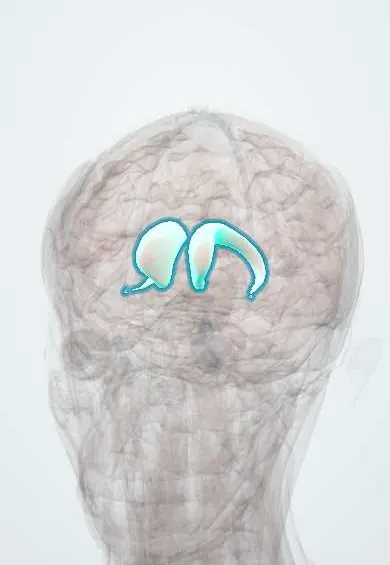
Structures involved
Tap one to see what it is and open it in 3D.
Why it happens
What it is
A chronic mental disorder defined by obsessions (intrusive, unwanted thoughts, images or urges that cause anxiety) and/or compulsions (repetitive acts or mental rituals done to reduce that anxiety). The person usually recognises them as excessive, and they take up time or cause real distress.
Who gets it
Affects roughly 1–3% of people over a lifetime worldwide, with similar figures reported in Latin America. It usually begins in adolescence or early adulthood; boys tend to start earlier. Diagnosis is often delayed for years because people hide their symptoms.
Causes
- Genetic predisposition: higher risk in first-degree relatives
- Dysfunction of the cortico-striato-thalamo-cortical circuit (orbitofrontal cortex, anterior cingulate, caudate)
- Altered serotonin (and glutamate, dopamine) signalling
- In some children, sudden onset after streptococcal infection (PANDAS, debated)
Risk factors
- Family history of OCD or tic disorders
- Childhood trauma or highly stressful life events
- Tourette syndrome or other tic disorders
- Pregnancy and the postpartum period (new onset or worsening)
Pathophysiology
Imaging studies show overactivity in a loop linking the orbitofrontal cortex, anterior cingulate gyrus, caudate nucleus and thalamus. This loop normally flags a worry and then lets it go; in OCD the 'something is wrong' signal persists, and the compulsion brings only brief relief, which reinforces it. Good response to serotonergic drugs supports a role for serotonin.
Classification
- Insight specifier: good or fair, poor, or absent insight/delusional beliefs
- Tic-related OCD
- Related disorders: body dysmorphic disorder, hoarding disorder, trichotillomania, excoriation (skin-picking) disorder
Symptoms and signs
- Contamination fears with excessive washing or cleaning
- Doubts with repeated checking (locks, stove, mistakes)
- Need for symmetry, order or exactness; arranging and counting
- Unwanted aggressive, sexual or religious thoughts, with mental rituals or reassurance seeking
- Rituals taking more than an hour a day, avoidance of triggers, and skin damage from washing
Diagnosis
- Clinical
- Clinical interview using DSM-5-TR criteria: obsessions and/or compulsions that are time-consuming (over an hour a day) or cause clinically significant distress or impairment, not explained by a substance or another disorder. Severity is often rated with the Y-BOCS scale (CY-BOCS in children).
- Tests
- No laboratory test confirms OCD. Screening for depression, suicide risk and substance use; thyroid tests or infection workup only when the picture suggests them.
- Imaging
- Not needed for diagnosis. Brain imaging is reserved for atypical late onset or neurological signs.
Differential diagnosis
- Obsessive-compulsive personality disorder (traits are ego-syntonic, no true obsessions)
- Generalised anxiety disorder (real-life worries rather than intrusive, senseless thoughts)
- Psychotic disorders with delusions
- Tic disorders and the restricted, repetitive behaviours of autism
- Depression with ruminations
Goal of treatment
Reduce the time and distress caused by obsessions and rituals, restore daily functioning, and treat coexisting depression or tics; full remission is possible but many people keep milder symptoms.
Treatment
- Conservative
- Cognitive behavioural therapy with exposure and response prevention (ERP) is first-line: gradual facing of the feared trigger without performing the ritual.
- Medical
- Selective serotonin reuptake inhibitors (SSRIs) are the first-line drugs, usually at higher doses and for longer trials than in depression; clomipramine is an alternative. Augmentation with low-dose antipsychotics in resistant cases or with tics.
- Procedure
- For severe, treatment-resistant OCD: deep transcranial magnetic stimulation and, in specialised centres, deep brain stimulation or ablative neurosurgery.
- Follow-up
- Follow-up of Y-BOCS scores, suicide risk (especially in adolescents starting SSRIs) and adverse effects.
Complications
- Major depression and suicide risk
- Loss of school, work and family functioning
- Dermatitis from excessive hand washing
- Substance use as self-treatment
Prognosis
Usually chronic with waxing and waning symptoms. Most people improve substantially with ERP and/or SSRIs; earlier onset, poor insight, hoarding and comorbidity predict a worse course.
Test yourself
Think of the answer, then tap the question to see it.
Which brain circuit is overactive in OCD?
The cortico-striato-thalamo-cortical loop: orbitofrontal cortex, anterior cingulate, caudate nucleus and thalamus.
What is the first-line psychotherapy for OCD?
Cognitive behavioural therapy with exposure and response prevention (ERP).
Which drug class is first-line for OCD, and which tricyclic is an alternative?
SSRIs, usually at higher doses than for depression; clomipramine is the tricyclic alternative.
How does OCD differ from obsessive-compulsive personality disorder?
In OCD the obsessions are ego-dystonic (unwanted, distressing); in OCPD perfectionism and rigidity are ego-syntonic and there are no true obsessions or compulsions.
Related conditions
- Personality disorders (clusters A, B and C)
- Autism spectrum disorder (ASD)
- Serotonin syndrome
- Attention-deficit/hyperactivity disorder (ADHD)
Educational information, not medical advice. For any symptom, see a health professional.
Sources: Obsessive-Compulsive Disorder (MedlinePlus, US National Library of Medicine, 2026).
Spotted a mistake?We are always improving for the community. Tell us what is wrong and our team will review it.Report a mistake
Representative model, for educational purposes only.