Thyroid storm !
Thyroid storm is a rare, life-threatening flare of an overactive thyroid, with high fever, a racing heart and confusion. It is a medical emergency.
Updated 2026-11-01
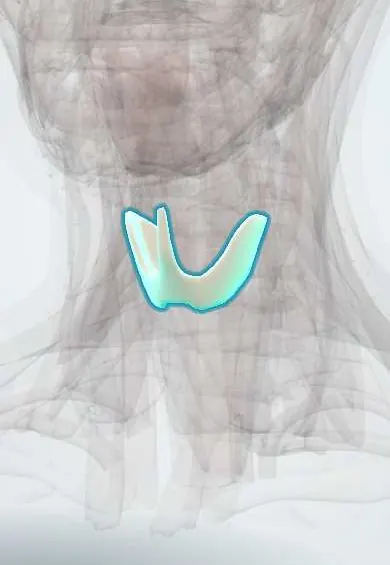
Structures involved
Tap one to see what it is and open it in 3D.
In the clinical exam
Why it happens
- Actions of thyroid hormones
- Body temperature regulation
- Thyroid hormone synthesis
- Thyroid follicles, C cells and parathyroid
What it is
An extreme, decompensated form of thyrotoxicosis in which excess thyroid hormone causes fever, cardiovascular failure and altered mental status. It is a clinical diagnosis and an endocrine emergency.
Who gets it
Uncommon, occurring in a small fraction of people admitted with thyrotoxicosis, but with a high death rate. Most cases arise in untreated or poorly controlled Graves disease, which is the commonest cause of hyperthyroidism in Colombia and Latin America.
Causes
- Underlying Graves disease most often; less often toxic multinodular goitre or toxic adenoma
- Trigger: infection, surgery or trauma, childbirth, diabetic ketoacidosis
- Stopping antithyroid drugs abruptly
- Iodine load (iodinated contrast, amiodarone) or radioiodine therapy
- Thyroid surgery in a patient who was not made euthyroid first
Risk factors
- Untreated or poorly controlled hyperthyroidism
- Poor adherence to antithyroid treatment
- Acute illness or emergency surgery
- Pregnancy and the peripartum period
Pathophysiology
A sudden stressor on top of thyrotoxicosis increases free hormone and the sensitivity of tissues to catecholamines. Metabolic rate and heat production soar, the heart is driven to tachycardia and high-output failure, and the brain is affected. The scale of the response, not the absolute hormone level, defines the storm.
Classification
- Scored with the Burch-Wartofsky point scale (temperature, CNS, GI-hepatic, heart rate, heart failure, atrial fibrillation, precipitant)
- Japan Thyroid Association criteria as an alternative
Symptoms and signs
- High fever and profuse sweating
- Marked tachycardia, often atrial fibrillation
- Agitation, delirium, psychosis, seizures or coma
- Nausea, vomiting, diarrhoea, abdominal pain and jaundice
- Goitre, tremor and eye signs of Graves disease
Diagnosis
- Clinical
- Diagnosed on clinical grounds in a patient with thyrotoxicosis plus multi-organ decompensation, supported by a high Burch-Wartofsky score. Treatment starts without waiting for laboratory confirmation.
- Tests
- Suppressed TSH with high free T4 and/or T3 (levels do not separate storm from uncomplicated thyrotoxicosis). Search for triggers: blood count, cultures, glucose, electrolytes, liver tests, ECG; TSH receptor antibodies support Graves disease.
- Imaging
- Chest X-ray and echocardiography to assess infection and cardiac function; thyroid ultrasound later to study the gland.
Differential diagnosis
- Sepsis
- Phaeochromocytoma crisis
- Malignant hyperthermia or neuroleptic malignant syndrome
- Sympathomimetic poisoning (cocaine, amphetamines)
- Heat stroke
Goal of treatment
Reduce new hormone synthesis and release, block peripheral effects, support organs in intensive care, and treat the trigger.
Treatment
- Acute
- Beta-blockers (propranolol is the classic choice) to control heart rate and adrenergic symptoms, with caution in heart failure.
- Medical
- Thionamides (propylthiouracil or methimazole) to block synthesis; iodine solution given at least an hour after the thionamide to block release; glucocorticoids to reduce T4-to-T3 conversion and cover relative adrenal insufficiency.
- Acute
- Supportive care in intensive care: fluids, active cooling and paracetamol (avoiding aspirin, which frees bound hormone), oxygen, and treatment of infection or other trigger.
- Follow-up
- Continuous cardiac monitoring, temperature, fluid balance, glucose and mental status; nursing focus on cooling, arrhythmia detection and a calm, safe environment.
- Surgical
- Definitive treatment after recovery: radioactive iodine or thyroidectomy; urgent surgery or plasma exchange if medical therapy fails.
Complications
- High-output heart failure and cardiogenic shock
- Atrial fibrillation with thromboembolism
- Acute liver failure
- Multi-organ failure and death
Prognosis
Mortality remains significant even with intensive care, mainly from heart failure and multi-organ failure. Early recognition and treatment improve survival; afterwards the hyperthyroidism needs definitive treatment.
Prevention
- Making patients euthyroid before planned surgery or radioiodine
- Adherence to antithyroid drugs and prompt treatment of infections in hyperthyroid patients
Test yourself
Think of the answer, then tap the question to see it.
Is thyroid storm diagnosed by hormone levels or clinically?
Clinically: thyrotoxicosis with fever, tachycardia, CNS and GI dysfunction; hormone levels do not separate it from simple thyrotoxicosis.
Why is iodine given only after a thionamide in thyroid storm?
Given first, iodine could serve as substrate for more hormone synthesis; the thionamide blocks synthesis before iodine blocks release.
Which antipyretic is avoided in thyroid storm and why?
Aspirin, because it displaces thyroid hormone from binding proteins and raises free hormone.
Which drug class controls the adrenergic symptoms of thyroid storm?
Beta-blockers, classically propranolol, which also reduces peripheral T4-to-T3 conversion.
Related conditions
- Graves disease (hyperthyroidism)
- Thyroid nodule
- Atrial fibrillation
- Heart failure
- Sepsis and septic shock
- Myxoedema coma
Educational information, not medical advice. For any symptom, see a health professional.
Sources: Thyroid storm (MedlinePlus Medical Encyclopedia (U.S. National Library of Medicine), 2026).
Spotted a mistake?We are always improving for the community. Tell us what is wrong and our team will review it.Report a mistake
Representative model, for educational purposes only.