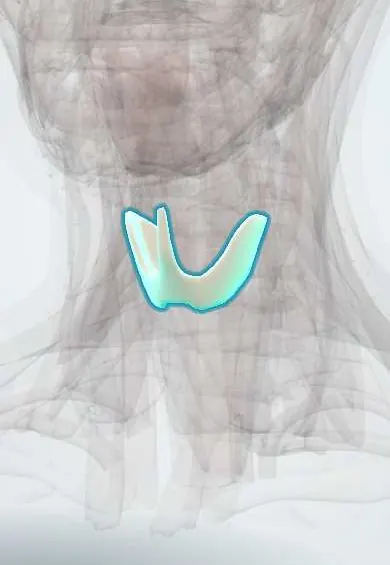
Graves disease (hyperthyroidism) !
Graves disease is an autoimmune condition that makes the thyroid overactive, causing weight loss, a fast heartbeat and sometimes bulging eyes.
Updated 2026-10-29
Structures involved
Tap one to see what it is and open it in 3D.
- Thyroid gland
- Inferior rectus
- Medial rectus
- Optic nerve
- Eyelids
- Pituitary gland
- Recurrent laryngeal nerves
- Parathyroid glands
- Cornea
In biochemistry
- Thyroid hormone synthesis: Step 5 · Thyroid peroxidase (coupling)
- Energy requirements and basal metabolic rate (BMR)
- Radioisotopes and radioimmunoassay (RIA)
- Thyroid peroxidase (TPO)
- Iodothyronine deiodinases (DIO1, DIO2, DIO3)
- Thyroxine (T4)
- Triiodothyronine (T3)
- Iodine
In immunology
- Hypersensitivity: the four types compared
- Type II hypersensitivity (antibody against cells)
- Autoantibodies: the table to know
- What antibodies do: effector functions
In histology
In the clinical exam
- Arterial pulse: rate, rhythm and amplitude
- Diagnostic facies
- Thyroid examination
- Eye exam: visual acuity, visual fields and eye movements
- Hyperthyroidism and hypothyroidism: the signs
In physiology
- Actions of thyroid hormones
- The thyroid axis: reading TSH and free T4
- Thyroid hormone transport and deiodinases
- Energy metabolism and basal metabolic rate
Why it happens
What it is
Autoimmune disease in which antibodies stimulate the TSH receptor, making the thyroid overproduce hormone and grow. It is the commonest cause of hyperthyroidism and can also affect the eyes and skin.
Who gets it
Most common in women aged roughly 20 to 50, but seen at any age. Thyroid eye disease is more frequent and more severe in smokers.
Causes
- Stimulating autoantibodies against the TSH receptor (TRAb, TSI)
- Genetic susceptibility combined with environmental triggers
Risk factors
- Female sex
- Family history of autoimmune thyroid disease
- Other autoimmune diseases
- Smoking (especially for eye disease)
- Postpartum period, stress
- High iodine load (contrast media, amiodarone)
Pathophysiology
TSH-receptor antibodies act like TSH, driving hormone synthesis and diffuse growth of the gland while TSH itself is suppressed. Excess hormone raises metabolism and sympathetic sensitivity. In the orbit, fibroblasts carrying the same receptor are activated, swelling fat and extraocular muscles and pushing the eye forward.
Symptoms and signs
- Heat intolerance, sweating, weight loss despite good appetite
- Palpitations, tachycardia, tremor, anxiety, insomnia
- Frequent stools, menstrual changes, proximal muscle weakness
- Diffuse, painless goitre, sometimes with a bruit
- Eye disease: gritty eyes, lid retraction and lid lag, proptosis, double vision
- Pretibial myxoedema (thick skin on the shins) in a few
Diagnosis
- Clinical
- Thyrotoxicosis with a diffuse goitre plus eye disease or pretibial myxoedema is enough to suspect Graves. Eye activity and severity are graded with standard scores. Thyroid storm is scored with the Burch–Wartofsky scale.
- Tests
- Suppressed TSH with raised free T4 and/or T3; TSH-receptor antibodies confirm the cause. Radioactive iodine uptake (diffuse and high) when antibodies are unclear. Blood count and liver tests before antithyroid drugs; ECG for arrhythmia.
- Imaging
- Thyroid ultrasound with Doppler shows a diffuse, hypervascular gland. Orbital CT or MRI shows enlarged extraocular muscle bellies, mostly inferior and medial recti, with the tendons spared.
Differential diagnosis
- Toxic multinodular goitre
- Toxic adenoma
- Subacute, painless or postpartum thyroiditis
- Excess thyroid hormone intake
- Anxiety disorder
- Pheochromocytoma
Goal of treatment
Control symptoms quickly, bring thyroid function to normal, protect the eyes, and choose a definitive treatment where remission does not last.
Treatment
- Medical
- Beta-blockers for palpitations, tremor and anxiety while thyroid levels are brought down.
- Medical
- Antithyroid drugs (thionamides) for 12–18 months aiming for remission; propylthiouracil is preferred in early pregnancy and thyroid storm. Agranulocytosis and liver injury are rare, serious side effects.
- Procedure
- Radioactive iodine ablation, usually leading to lifelong hypothyroidism; not used in pregnancy and may worsen active eye disease, so corticosteroid cover may be given.
- Surgical
- Total thyroidectomy for large goitres, suspicious nodules, severe eye disease or patient choice; risks include recurrent laryngeal nerve injury and hypoparathyroidism.
- Medical
- Eye disease: lubricants, stopping smoking, selenium in mild cases; intravenous corticosteroids or other immunotherapy for active moderate-to-severe disease; orbital decompression for optic nerve compression.
- Acute
- Thyroid storm: intensive care, beta-blockers, a thionamide followed later by iodine solution, corticosteroids, cooling, fluids and treating the trigger.
Drugs for this condition
Complications
- Thyroid storm
- Atrial fibrillation and high-output heart failure
- Osteoporosis
- Compressive optic neuropathy and corneal exposure
- Fetal or neonatal thyrotoxicosis (antibodies cross the placenta)
- Hypothyroidism after radioiodine or surgery
Prognosis
Most people regain normal thyroid function with treatment. After a course of antithyroid drugs roughly half relapse, so many need radioiodine or surgery. Eye disease follows its own course and may persist.
Prevention
- Not smoking (reduces the risk and severity of eye disease)
- Thyroid function checks in pregnancy and the postpartum period for women at risk
Test yourself
Think of the answer, then tap the question to see it.
What antibody causes Graves disease?
Stimulating antibodies against the TSH receptor (TRAb or TSI), which mimic TSH.
Which features are specific to Graves disease rather than other causes of hyperthyroidism?
Thyroid eye disease (proptosis, lid retraction), pretibial myxoedema and positive TSH-receptor antibodies.
Which extraocular muscles are most often enlarged in thyroid eye disease?
The inferior and medial recti, with the muscle bellies enlarged and the tendons spared.
Which antithyroid drug is preferred in the first trimester of pregnancy and in thyroid storm?
Propylthiouracil.
What serious side effect of thionamides presents with fever and sore throat?
Agranulocytosis; the drug is stopped and a blood count is checked urgently.
Related conditions
- Hypothyroidism
- Atrial fibrillation
- Heart failure
- Osteoporosis
- Phaeochromocytoma
- Thyroid nodule
- Goitre
- Gynaecomastia
Educational information, not medical advice. For any symptom, see a health professional.
Sources: Graves Disease (StatPearls (NCBI Bookshelf), 2023).
Spotted a mistake?We are always improving for the community. Tell us what is wrong and our team will review it.Report a mistake
Representative model, for educational purposes only.