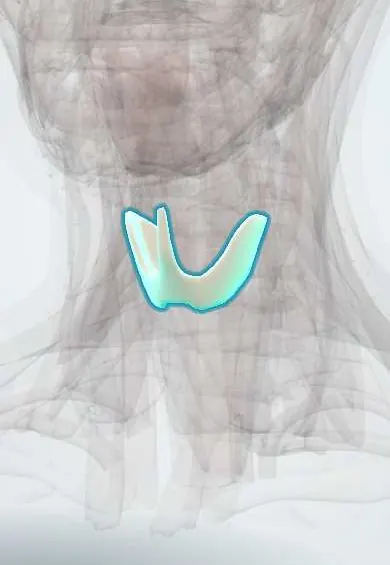
Thyroid nodule !
A thyroid nodule is a lump within the thyroid gland in the front of the neck; most are benign, and tests look for the few that are cancer.
Updated 2026-10-29
Structures involved
Tap one to see what it is and open it in 3D.
In biochemistry
In histology
In embryology
In the clinical exam
In physiology
Why it happens
- Hyperplasia: physiologic and pathologic
- Benign vs malignant tumours: the comparison table
- Frozen section: the intraoperative consultation
- Biopsy: excisional, incisional, core needle, punch and fine-needle aspiration
- Cytology: the Pap test, fine-needle aspiration and body fluids
What it is
A discrete lesion within the thyroid gland that is distinct from the surrounding tissue on palpation or imaging. Most are benign; the aim is to find the few that are cancer.
Who gets it
Very common; many are found by chance on imaging and their frequency rises with age. They are more common in women and in iodine-deficient areas.
Causes
- Colloid or adenomatous (hyperplastic) nodules
- Follicular adenomas
- Cysts
- Thyroid cancer (a minority)
- Thyroiditis
Risk factors
- Female sex and older age
- Iodine deficiency
- Childhood head and neck radiation (higher cancer risk)
- Family history of thyroid cancer or familial syndromes
Pathophysiology
Focal growth of follicular cells, driven by TSH, growth factors or acquired mutations, forms a nodule. Some become autonomous and make thyroid hormone independently of TSH (hot nodules), which are rarely malignant.
Symptoms and signs
- Often none; found on examination or imaging
- Painless neck lump that moves with swallowing
- Pressure, dysphagia or dyspnoea if large
- Symptoms of hyperthyroidism with an autonomous nodule
Diagnosis
- Clinical
- Neck examination for size, consistency, mobility and nodes.
- Tests
- TSH first; ultrasound-guided fine-needle aspiration of suspicious nodules, reported using the Bethesda system; molecular testing in indeterminate cytology.
- Imaging
- Neck ultrasound with risk stratification (systems such as TI-RADS); thyroid scintigraphy when TSH is low.
Differential diagnosis
- Thyroid cancer
- Multinodular goitre
- Thyroiditis
- Thyroglossal duct cyst
- Cervical lymph node or parathyroid adenoma
Goal of treatment
Exclude malignancy, treat hormonal over-activity or compressive symptoms, and avoid unnecessary surgery.
Treatment
- Follow-up
- Ultrasound surveillance for benign or low-risk nodules.
- Surgical
- Lobectomy or total thyroidectomy for malignant, suspicious or compressive nodules.
- Medical
- Radioactive iodine or antithyroid drugs for autonomous (toxic) nodules.
- Procedure
- Aspiration of cysts; image-guided ablation in selected benign nodules.
Complications
- Missed or delayed cancer diagnosis
- Compression of trachea or oesophagus
- Hyperthyroidism
- Recurrent laryngeal nerve injury or hypoparathyroidism after surgery
Prognosis
Excellent for benign nodules; most remain stable for years.
Test yourself
Think of the answer, then tap the question to see it.
What is the first blood test in a patient with a thyroid nodule?
TSH: a low value suggests an autonomous nodule and leads to scintigraphy.
Are hot nodules on scintigraphy usually benign or malignant?
Usually benign; cold nodules carry the higher risk of cancer.
Which system reports thyroid fine-needle aspiration cytology?
The Bethesda system.
Which ultrasound features suggest malignancy?
Hypoechogenicity, microcalcifications, irregular margins, taller-than-wide shape and extrathyroidal extension.
Related conditions
- Thyroid cancer (papillary)
- Goitre
- Graves disease (hyperthyroidism)
- Hypothyroidism
- Cervical lymphadenopathy
Educational information, not medical advice. For any symptom, see a health professional.
Sources: Thyroid Nodule (StatPearls (NCBI Bookshelf), 2023).
Spotted a mistake?We are always improving for the community. Tell us what is wrong and our team will review it.Report a mistake
Representative model, for educational purposes only.