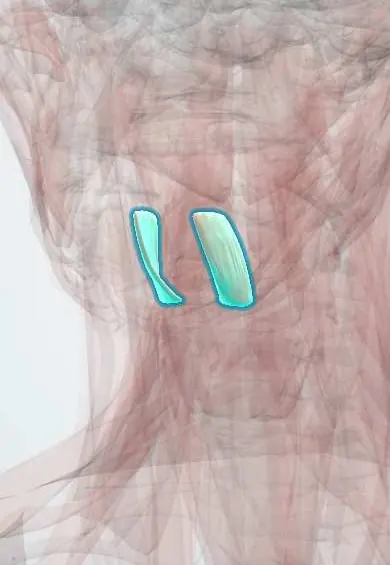
Muscular system · Head and neck
Hyoglossus !
The hyoglossus is a flat muscle running from the hyoid bone to the side of the tongue; it pulls the tongue down.
Official name: Hyoglossus muscle
Opens in the Durgical app, no sign-up needed.
What it is
A flat muscle from the hyoid to the side of the tongue.
What it does
Pulls the tongue down.
Key facts
- Origin
- Body and greater horn of the hyoid
- Insertion
- Side of the tongue
- Action
- Depresses and retracts the tongue
- Nerve
- Hypoglossal nerve (CN XII)
- Blood supply
- Lingual artery
Relations
- Superficial
- Lingual nerve with the submandibular ganglion hanging from it, the deep part of the submandibular gland and its duct, the hypoglossal nerve; the mylohyoid covers its lower front part
- Deep
- Lingual artery, genioglossus and the middle pharyngeal constrictor
- Behind
- Styloglossus, whose fibres interlace with it at the side of the tongue
How to find it
Not palpable. In submandibular gland surgery, once the mylohyoid is pulled forward, it forms the floor of the field, with the nerves and the duct lying on it.
On imaging
On axial and coronal contrast CT or MRI it is the thin, flat muscle on the side of the tongue base, above the hyoid. It divides the floor of mouth: the lingual nerve, submandibular duct and hypoglossal nerve lie lateral to it, and the lingual artery medial. This helps place a mass or a ranula. On ultrasound it is the landmark for following the submandibular duct forward to look for stones.
Clinical notes
- In submandibular gland excision the hypoglossal nerve on its surface and the lingual nerve looped under the duct are at risk; staying on the muscle keeps the lingual artery, deep to it, safe
- The lingual artery can be tied just above the greater horn of the hyoid bone by splitting the hyoglossus, for example to control bleeding from the tongue
Anatomical variants
- A small slip from the lesser horn of the hyoid, the chondroglossus, is counted as part of the hyoglossus in some texts and as a separate muscle in others
Development
Shares the occipital somite origin of the other hypoglossal-supplied tongue muscles, which migrate forward into the tongue with their nerve.
Test yourself
Think of the answer, then tap the question to see it.
Which structures lie on the outer surface of the hyoglossus, from top to bottom?
The lingual nerve, the submandibular duct and the hypoglossal nerve.
Which artery runs deep to the hyoglossus?
The lingual artery, so the hyoglossus separates the artery from the nerves.
Which three structures pass deep to the posterior border of the hyoglossus?
The glossopharyngeal nerve, the stylohyoid ligament and the lingual artery.
What are the attachments, action and nerve of the hyoglossus?
From the body and greater horn of the hyoid to the side of the tongue; it depresses and retracts the tongue; hypoglossal nerve (XII).
Educational information, not medical advice. For any symptom, see a health professional.
Its names
- Official Latin (TA2)
- musculus hyoglossus TA2 2118
- Official Spanish (DeCS)
- Músculo hiogloso
- English (TA2)
- Hyoglossus muscle
Related
Sources: Terminologia Anatomica (TA2); Anatomy, Head and Neck: Hyoglossus Muscle; Anatomy, Head and Neck, Tongue.
Spotted a mistake?We are always improving for the community. Tell us what is wrong and our team will review it.Report a mistake
Representative model, for educational purposes only.