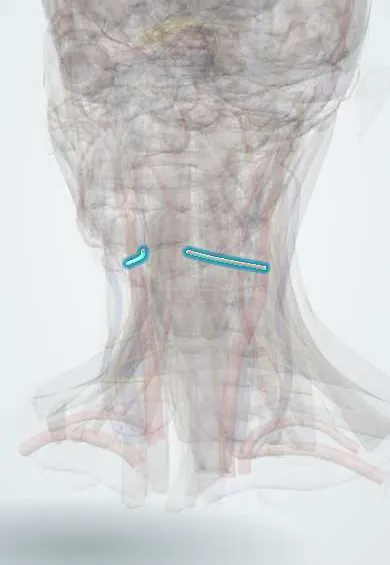
Cardiovascular system · Head and neck
Lingual artery !
The lingual artery, a branch of the external carotid, is the main blood supply of the tongue and the floor of the mouth.
Opens in the Durgical app, no sign-up needed.
What it is
An external carotid branch to the tongue.
What it does
Feeds the tongue and the floor of the mouth.
Key facts
- Origin
- External carotid at the greater horn of the hyoid
- Branches
- Suprahyoid, dorsal lingual, sublingual, deep lingual
- Supplies
- Tongue, floor of the mouth
Relations
- Course
- Leaves the front of the external carotid opposite the tip of the greater horn of the hyoid, often loops upward (crossed by the hypoglossal nerve), runs forward above the greater horn deep to the hyoglossus, then turns up and forward under the tongue as the deep lingual artery to the tip
- Superficial
- Hyoglossus, which separates it from the hypoglossal nerve, the lingual nerve and the submandibular duct
- Deep
- Middle constrictor of the pharynx, then the genioglossus
How to find it
It cannot be felt. Under the tongue the bluish deep lingual veins show on each side of the frenulum, with the artery deeper. In surgery it is found by opening the hyoglossus just above the greater horn of the hyoid bone, below the hypoglossal nerve.
On imaging
Colour Doppler or CT angiography shows it as the second front branch of the external carotid, looping up at the greater horn of the hyoid before running deep to the hyoglossus. CT angiography, or catheter angiography for embolisation, is used for tongue bleeding. In tongue cancer, MRI shows how close the tumour comes to the lingual neurovascular bundle.
Clinical notes
- Heavy bleeding from the tongue (trauma, tumour, surgery of the tongue base) can be controlled by ligation or embolisation of this artery
- Drilling through the inner cortex of the mandible for a dental implant can tear the sublingual artery; the floor-of-mouth haematoma pushes the tongue up and can block the airway
- Resection at the base of the tongue, including transoral robotic surgery, identifies and clips the lingual artery and its dorsal branches beforehand, because bleeding there after surgery can threaten the airway
- Classic ligation site: Pirogov's triangle above the hyoid (hypoglossal nerve above, intermediate tendon of the digastric below, free border of the mylohyoid in front); the hyoglossus forming its floor is split to reach the artery
Anatomical variants
- It commonly arises with the facial artery as a linguofacial trunk, less often with the superior thyroid artery as a thyrolingual trunk
Memory aid
Hyoglossus rule: the nerves and the duct cross it on the outside; the lingual artery hides underneath.
Test yourself
Think of the answer, then tap the question to see it.
Which muscle separates the lingual artery from the hypoglossal nerve, lingual nerve and submandibular duct?
The hyoglossus: the artery runs deep to it, the nerves and duct cross its outer surface.
Why does a midline incision of the tongue bleed less than a cut through its side?
Few branches of the lingual artery cross the tongue's midline septum.
Why can a dental implant drilled through the inner mandible threaten the airway?
It can tear the sublingual artery; the floor-of-mouth haematoma pushes the tongue up and can block the airway.
Educational information, not medical advice. For any symptom, see a health professional.
Its names
- Official Latin (TA2)
- arteria lingualis TA2 4383
- Official Spanish (DeCS)
- Arteria lingual
- English (TA2)
- Lingual artery
Related
Sources: Terminologia Anatomica (TA2); Anatomy, Head and Neck, Lingual Artery; Tratado de anatomía humana (9.ª ed.), tomo II, Libro IV, sección 2 Arterias, caps. I-III (sistema de la arteria pulmonar; aorta y ramas del cayado hasta la carótida interna).
Spotted a mistake?We are always improving for the community. Tell us what is wrong and our team will review it.Report a mistake
Representative model, for educational purposes only.