Cardiovascular system · Pelvis
Inferior vesical and prostatic arteries !
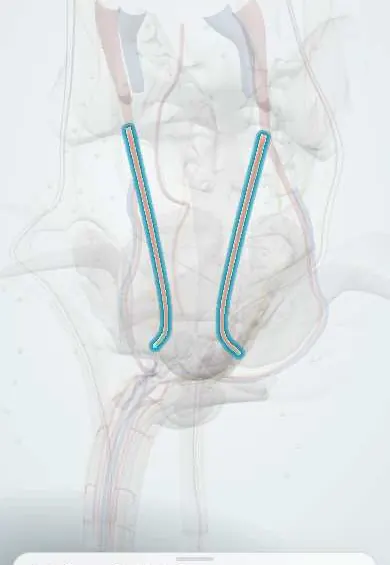
The inferior vesical and prostatic arteries are branches of the internal iliac artery that supply the bladder base, the prostate and the seminal vesicles.
Official name: Inferior vesical artery; prostatic branches
Opens in the Durgical app, no sign-up needed.
What it is
A branch of the internal iliac artery to the base of the bladder; in the male it gives the prostatic arteries and often branches to the ductus deferens and seminal vesicles.
What it does
Supplies the base of the bladder, the prostate, the seminal vesicles and the lower ureter.
Key facts
- Origin
- Anterior division of the internal iliac artery, often with the middle rectal artery; male counterpart of the vaginal artery
- Branches
- Prostatic arteries (urethral and capsular groups); branches to the seminal vesicles, the lower ureter and often the artery to the ductus deferens
- Supplies
- Bladder base and neck, prostate, seminal vesicles, lower ureter; blocked in prostatic artery embolization for BPH; the prostatic pedicles of radical prostatectomy
Relations
- Course
- From the anterior division of the internal iliac artery it runs forward and medially below the peritoneum, over the levator ani, to the base of the bladder and the prostate
- Medial
- Bladder base, seminal vesicles and prostate
- Above
- Superior vesical artery supplying the upper bladder; the ureter and ductus deferens near the bladder base
On imaging
CT angiography, or cone-beam CT during catheter angiography, maps its origin and prostatic branches before embolization.
Common problems
- Narrowing (atherosclerosis) can reduce blood flow to the penis and cause erectile dysfunction, or buttock pain on walking.
Treatment
- Its prostatic branches are blocked in prostatic artery embolisation for BPH, and are controlled (the 'prostatic pedicles') in a radical prostatectomy.
Clinical notes
- Bleeding after TURP comes mainly from prostatic branches at the bladder neck
- Prostatic bleeding after surgery or biopsy that does not settle with conservative care can be stopped by selective embolization of its prostatic branches
Anatomical variants
- Origin varies: from the anterior division, a common trunk with the middle rectal artery, or from the internal pudendal or obturator artery; the prostate may also be fed by other pelvic branches
Related conditions
Test yourself
Think of the answer, then tap the question to see it.
Which procedure for BPH targets the prostatic branches of the inferior vesical artery?
Prostatic artery embolisation; its variable origin needs careful mapping to avoid embolising the bladder, rectum or penis.
What are the lateral prostatic pedicles in radical prostatectomy?
The inferior vesical (prostatic) arteries with the prostatic veins, divided close to the gland in nerve-sparing surgery.
Where does bleeding after TURP mainly come from?
Prostatic branches of the inferior vesical artery at the bladder neck.
Educational information, not medical advice. For any symptom, see a health professional.
Its names
- Official Latin (TA2)
- arteria vesicalis inferior; rami prostatici
- Official Spanish (DeCS)
- Arteria vesical inferior; ramas prostáticas
- English (TA2)
- Inferior vesical artery; prostatic branches
- Also called
- prostatic arteries
Related
Sources: Anatomy, Abdomen and Pelvis: Internal Iliac Arteries.
Spotted a mistake?We are always improving for the community. Tell us what is wrong and our team will review it.Report a mistake
Representative model, for educational purposes only.