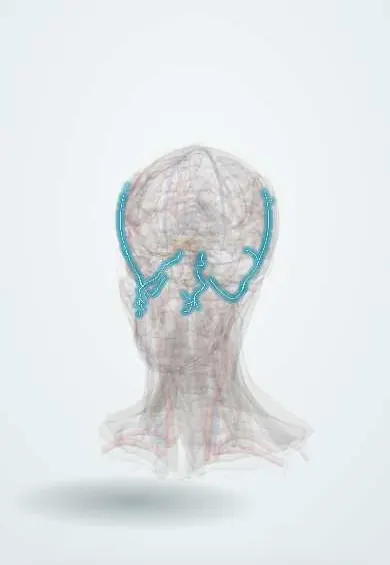
Nervous system · Head and neck
V2 maxillary !
The maxillary nerve (V2), the middle branch of the trigeminal nerve, gives feeling to the cheek, upper lip, upper teeth and palate.
Official name: Maxillary nerve
Opens in the Durgical app, no sign-up needed.
What it is
The middle trigeminal branch, to the cheek and upper jaw.
What it does
Feeling of the cheek, upper lip, upper teeth and palate.
Key facts
- Roots
- V2; foramen rotundum -> pterygopalatine fossa -> infraorbital foramen
- Moves
- None
- Feeling from
- Cheek, lower eyelid, upper lip, upper teeth, palate, maxillary sinus; branches: meningeal, zygomatic, ganglionic (pterygopalatine: nasopalatine, palatine, nasal, pharyngeal), superior alveolar (posterior, middle, anterior), infraorbital
Relations
- Course
- From the trigeminal ganglion along the lateral wall of the cavernous sinus (some texts: just below it), through the foramen rotundum into the pterygopalatine fossa, then forward through the inferior orbital fissure into the orbital floor, along the infraorbital groove and canal, and out of the infraorbital foramen as the infraorbital nerve
- Below
- In the orbital floor, the maxillary sinus, separated from the infraorbital canal by a thin plate of bone
- Superficial
- On the face, the levator labii superioris, which covers the infraorbital foramen and the emerging nerve
How to find it
The infraorbital foramen lies about a finger's breadth below the middle of the lower orbital margin, on roughly the same vertical line as the supraorbital notch and the mental foramen.
Examination
- Light touch and pinprick on the cheek and upper lip compared with the other side; numbness after facial trauma points to an infraorbital nerve injury in an orbital floor or zygomatic fracture
On imaging
Coronal CT of the facial bones shows the infraorbital canal and the orbital floor in blowout fractures; MRI follows the nerve back through the foramen rotundum when tumour spread along the nerve is suspected.
Clinical notes
- Infraorbital nerve block at the infraorbital foramen, through the mouth or the skin, numbs the lower eyelid, cheek, side of the nose and upper lip for repairs
- Zygomaticomaxillary complex and Le Fort fractures often cross the infraorbital foramen, leaving numbness of the cheek
- Maxillary sinusitis is often felt as an ache in the upper back teeth
Anatomical variants
- Accessory infraorbital foramina are found in some skulls, usually small and above or to the side of the main one; branches leaving through them can escape a block aimed at the main foramen
Related conditions
Test yourself
Think of the answer, then tap the question to see it.
Which branch of the V2 maxillary nerve is at risk in orbital floor (blowout) fractures, and what results?
The infraorbital nerve: numb cheek, side of the nose, upper lip and upper teeth on that side.
Through which foramen does the V2 maxillary nerve leave the skull, and which fossa does it enter?
The foramen rotundum, into the pterygopalatine fossa, where the pterygopalatine ganglion hangs from it.
Why can maxillary sinusitis feel like upper molar pain?
The superior alveolar nerves (V2 maxillary) run in the walls of the maxillary sinus, so the pain is shared.
Educational information, not medical advice. For any symptom, see a health professional.
Its names
- Official Latin (TA2)
- nervus maxillaris TA2 6216
- Official Spanish (DeCS)
- Nervio Maxilar DeCS D008442
- English (TA2)
- Maxillary nerve
- Also called
- V2 · cranial nerve V2 · maxillary division of trigeminal nerve
Related
Sources: Terminologia Anatomica (TA2); DeCS; Anatomy, Head and Neck, Maxillary Nerve.
Spotted a mistake?We are always improving for the community. Tell us what is wrong and our team will review it.Report a mistake
Representative model, for educational purposes only.