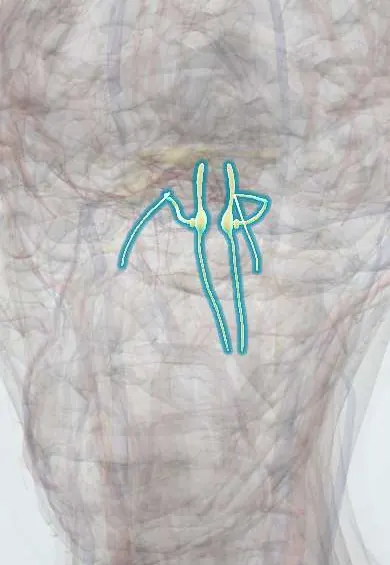
Trigeminal neuralgia !
Trigeminal neuralgia causes sudden, brief, electric-shock pains on one side of the face, often set off by a light touch, chewing or talking.
Updated 2026-10-29
Structures involved
Tap one to see what it is and open it in 3D.
- Trigeminal nerve (V)
- Trigeminal ganglion
- V2 maxillary
- V3 mandibular
- V1 ophthalmic
- Pons
- Cerebellar arteries
- Foramen ovale
- Foramen rotundum
- Basilar artery
In embryology
- Pharyngeal arches: nerve, muscles, skeleton and artery (the table)
- First pharyngeal arch (mandibular arch) and the trigeminal nerve
In physiology
Why it happens
What it is
A chronic pain disorder with sudden, brief, electric shock-like attacks of pain in one or more divisions of the trigeminal nerve, usually on one side of the face and triggered by light touch.
Who gets it
Usually begins after age 50 and is more common in women. In younger patients, especially with bilateral or atypical features, multiple sclerosis or another secondary cause is more likely.
Causes
- Classical: compression of the trigeminal nerve root near the pons by a blood vessel, usually the superior cerebellar artery
- Secondary: multiple sclerosis plaque, tumour of the cerebellopontine angle (e.g. vestibular schwannoma, meningioma)
- Idiopathic: no cause found
Risk factors
- Age over 50
- Female sex
- Multiple sclerosis
- Hypertension (association)
Pathophysiology
Pulsatile vascular compression at the root entry zone, where central myelin meets peripheral myelin, causes focal demyelination. Damaged fibres generate ectopic impulses and abnormal cross-talk (ephaptic transmission) between touch and pain fibres, so light touch can set off paroxysmal pain.
Classification
- Classical (neurovascular compression with root changes)
- Secondary (identifiable disease such as multiple sclerosis or tumour)
- Idiopathic
- Purely paroxysmal or with concomitant continuous pain
Symptoms and signs
- Brief (a fraction of a second to 2 minutes) electric, stabbing pain
- Usually unilateral, most often in the maxillary or mandibular divisions
- Triggered by light touch, chewing, talking, brushing teeth, shaving or wind
- Pain-free periods between attacks and remissions for weeks or months
- Normal neurological examination in classical forms
Diagnosis
- Clinical
- Based on typical paroxysmal pain in a trigeminal distribution with trigger features (International Classification of Headache Disorders criteria). A neurological deficit suggests a secondary cause.
- Tests
- No routine laboratory tests. Baseline blood count, sodium and liver function before and during certain antiseizure drugs. Trigeminal reflex testing in specialised centres.
- Imaging
- MRI of the brain with dedicated sequences of the cerebellopontine angle to look for vascular compression, multiple sclerosis plaques or tumours.
Differential diagnosis
- Dental pain (caries, cracked tooth, pulpitis)
- Temporomandibular disorder
- Post-herpetic neuralgia
- Glossopharyngeal neuralgia
- Short-lasting unilateral neuralgiform headache attacks (SUNCT/SUNA)
- Persistent idiopathic facial pain
Goal of treatment
Control the attacks with the fewest side effects and offer surgery to suitable patients when drugs fail or are poorly tolerated.
Treatment
- Medical
- Sodium channel-blocking antiseizure drugs (carbamazepine class) are first line; other antiseizure drugs or muscle relaxants are added or substituted if needed.
- Surgical
- Microvascular decompression of the trigeminal root for classical neuralgia in fit patients; it offers the longest pain relief.
- Procedure
- Percutaneous procedures on the trigeminal ganglion (radiofrequency, glycerol or balloon compression) or stereotactic radiosurgery, often for older patients.
- Acute
- Severe attacks that stop eating or drinking may need hospital admission for hydration and intravenous treatment.
Drugs for this condition
Complications
- Weight loss and dehydration from avoiding eating
- Depression and reduced quality of life
- Drug adverse effects: drowsiness, ataxia, hyponatraemia, rash
- Facial numbness or corneal anaesthesia after procedures
Prognosis
Often a relapsing-remitting course. Most patients respond to drugs at first, but many later need surgery; microvascular decompression gives long-lasting relief in many cases.
Test yourself
Think of the answer, then tap the question to see it.
Which trigeminal divisions are most often affected in trigeminal neuralgia?
The maxillary (V2) and mandibular (V3) divisions.
What is the most common cause of classical trigeminal neuralgia?
Compression of the trigeminal root near the pons by an artery, usually the superior cerebellar artery.
Which drug class is first line for trigeminal neuralgia?
Sodium channel-blocking antiseizure drugs of the carbamazepine class.
Which findings suggest secondary trigeminal neuralgia?
Facial sensory loss, reduced corneal reflex, bilateral pain, young onset or other cranial nerve deficits.
Which surgery treats the cause of classical trigeminal neuralgia?
Microvascular decompression, which separates the vessel from the trigeminal root.
Related conditions
- Multiple sclerosis
- Herpes zoster (shingles)
- Temporomandibular disorder
- Dental caries
- Vestibular schwannoma (acoustic neuroma)
- Giant cell arteritis
Educational information, not medical advice. For any symptom, see a health professional.
Sources: Trigeminal Neuralgia (StatPearls (NCBI Bookshelf), 2024).
Spotted a mistake?We are always improving for the community. Tell us what is wrong and our team will review it.Report a mistake
Representative model, for educational purposes only.