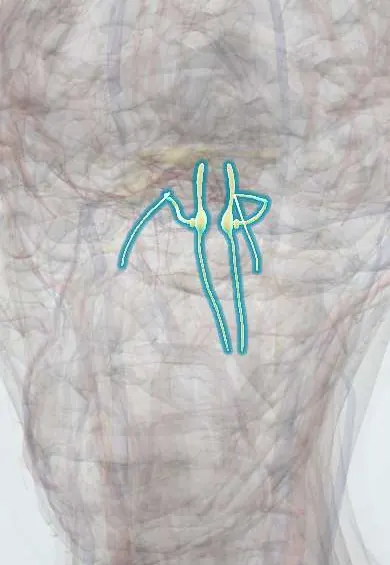
Nervous system · Head and neck
Trigeminal nerve (V) !
The trigeminal nerve (cranial nerve V) gives feeling to the face, eyes, nose, mouth and teeth and powers the chewing muscles.
Official name: Trigeminal nerve
Opens in the Durgical app, no sign-up needed.
What it is
The large nerve from the pons that splits into three branches (V1, V2, V3).
What it does
Feeling of the face, eye, nose, mouth and teeth; powers the chewing muscles.
Key facts
- Roots
- Motor nucleus and sensory nuclei (pons, mesencephalic to spinal); trigeminal ganglion; V1 superior orbital fissure, V2 foramen rotundum, V3 foramen ovale
- Moves
- Muscles of mastication, mylohyoid, anterior digastric, tensor tympani, tensor veli palatini (V3)
- Feeling from
- Face, cornea, nasal and oral mucosa, teeth, anterior two thirds of the tongue (general), dura
Relations
- Course
- Leaves the side of the pons as a large sensory root and a small motor root, crosses to the petrous apex and enters Meckel's cave, where the trigeminal ganglion gives off the three divisions; the V1 ophthalmic and V2 maxillary nerves run in the lateral wall of the cavernous sinus, while the V3 mandibular nerve drops straight through the foramen ovale
- Above
- Near the root entry zone, the superior cerebellar artery, the vessel most often found pressing on the root in trigeminal neuralgia
- Medial
- The cavernous sinus and the internal carotid artery, medial to the ganglion and its first two divisions
How to find it
Sensation is compared side to side on the forehead (V1), the cheek (V2) and the chin (V3). Motor power is felt in the masseter and temporalis while the person clenches the teeth.
Examination
- Facial sensation: light touch and pinprick on forehead, cheek and chin; loss in one division points to a branch, loss in all three to the ganglion or the root
- Corneal reflex: touching the cornea with a wisp of cotton makes both eyes blink; afferent V1 (nasociliary), efferent facial nerve (VII)
- Jaw jerk: a tap on the chin with the mouth slightly open; a brisk jerk suggests an upper motor neuron lesion above the pons
- Motor: clenching (bulk of masseter and temporalis) and opening against resistance; the jaw deviates toward a weak side
On imaging
Thin-slice MRI through the cisternal segment looks for a vessel touching the root (neurovascular contact) and for tumours or multiple sclerosis plaques at the root entry zone.
Common problems
- Trigeminal neuralgia: brief electric-shock pains in the face triggered by touch, chewing or wind.
- Shingles in the V1 area can damage the eye.
How it is diagnosed
Typical history; MRI to look for a vessel pressing on the nerve.
Treatment
- Anti-seizure medicines (such as carbamazepine).
- Microvascular decompression or procedures through the foramen ovale when medicines fail.
- Antivirals early for shingles.
Clinical notes
- Trigeminal neuralgia in a young adult, or on both sides, raises the question of multiple sclerosis
- Procedures for neuralgia that does not respond to treatment act on the root or the ganglion: microvascular decompression, percutaneous ganglion procedures and radiosurgery
- Lateral medullary syndrome damages the spinal trigeminal nucleus: loss of pain and temperature on the same side of the face and the opposite side of the body
- Cavernous sinus disease can numb the V1 and V2 areas but spares V3, which does not pass through the sinus
Memory aid
Exits of the divisions, top to bottom: "Standing Room Only": Superior orbital fissure (V1), Rotundum (V2), Ovale (V3).
Related conditions
Test yourself
Think of the answer, then tap the question to see it.
What is trigeminal neuralgia and what usually causes it?
Brief, electric shooting pains in the V2 or V3 area triggered by touch, chewing, talking or a breeze; often a vessel (superior cerebellar artery) pressing on the root.
Through which foramina do the three divisions of the trigeminal nerve (V) leave the skull?
V1 the superior orbital fissure, V2 the foramen rotundum, V3 the foramen ovale.
Which way does the jaw deviate on opening in a trigeminal motor lesion, and why?
Toward the weak side, pushed by the healthy lateral pterygoid; only V3 carries motor fibres.
What are the afferent and efferent limbs of the corneal reflex?
Afferent: V1 of the trigeminal nerve (nasociliary). Efferent: the facial nerve (VII), closing both eyes.
Why does numbness over the angle of the jaw not fit a trigeminal nerve lesion?
That skin is supplied by the great auricular nerve (C2–C3), not the trigeminal nerve.
Educational information, not medical advice. For any symptom, see a health professional.
Its names
- Official Latin (TA2)
- nervus trigeminus TA2 6192
- Official Spanish (DeCS)
- Nervio Trigémino DeCS D014276
- English (TA2)
- Trigeminal nerve
- Also called
- cranial nerve V · Gasserian ganglion
Sources: Terminologia Anatomica (TA2); DeCS; Neuroanatomy, Cranial Nerve 5 (Trigeminal).
Spotted a mistake?We are always improving for the community. Tell us what is wrong and our team will review it.Report a mistake
Representative model, for educational purposes only.