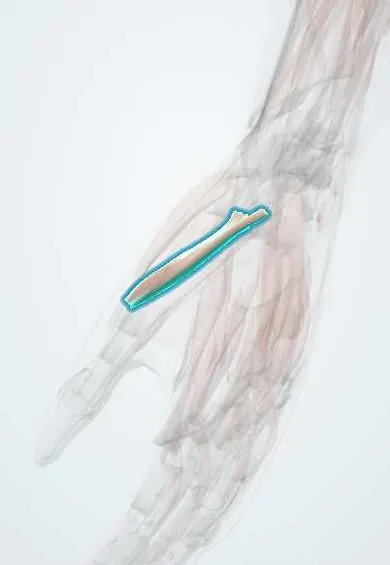
Opponens pollicis !
The opponens pollicis is a deep thumb-pad muscle; it rolls the thumb across the palm to meet the fingers, a movement called opposition.
Opens in the Durgical app, no sign-up needed.
What it is
A deep thumb-pad muscle along the thumb metacarpal.
What it does
Rolls the thumb across the palm to meet the fingers (opposition).
Key facts
- Origin
- Flexor retinaculum, tubercle of the trapezium
- Insertion
- Lateral border of the 1st metacarpal
- Action
- Opposes the thumb (rotates it to face the fingers)
- Nerve
- Recurrent branch of the median nerve (C8–T1)
- Blood supply
- Superficial palmar branch of the radial artery
Relations
- Superficial
- Abductor pollicis brevis (APB) and part of the flexor pollicis brevis (FPB)
- Deep
- The 1st metacarpal and the capsule of the thumb CMC joint
- Medial
- Deep head of FPB and the adductor pollicis
How to find it
Being deep, it is felt through APB: touching the thumb pad to the little-finger pad, nails parallel, makes the thenar eminence harden along the thumb metacarpal.
Examination
- Opposition test: the thumb pad is brought to the little-finger pad with the nails parallel; contact only with the side of the thumb, without rotation, indicates a median nerve or recurrent motor branch lesion
On imaging
Lies deep to abductor pollicis brevis along the thumb metacarpal; ultrasound and MRI show it as the deep thenar layer. Rarely the target itself: imaging looks for median nerve compression at the wrist, and MRI may show thenar denervation (oedema, then fatty atrophy). Thumb-base radiographs assess trapeziometacarpal arthritis, which limits the same motion.
Clinical notes
- Ape hand follows a median nerve lesion, most clearly when high (with long flexor loss too); the extensors pull the thumb back in line with the fingers
- Opponensplasty restores opposition when the recurrent motor branch or median nerve does not recover
Anatomical variants
- Sometimes supplied by the ulnar nerve, through a palmar link between the deep branch of the ulnar nerve and the recurrent motor branch (Riche–Cannieu anastomosis), which can preserve opposition after a median injury
Development
Thenar muscles are among the parts most affected in congenital thumb hypoplasia: beyond the mildest grades, opponens pollicis and abductor pollicis brevis are small or missing, so an opposition transfer is part of the repair. The thumb comes to lie laterally because the upper limb turns outward by about 90° in week 7.
Related conditions
Test yourself
Think of the answer, then tap the question to see it.
Which thenar muscle inserts on the metacarpal, and what movement does it supply?
The opponens pollicis, along the whole lateral border of the 1st metacarpal; it supplies the rotation of opposition.
What is an ape hand?
Thenar wasting with the thumb lying back in line with the fingers, unable to rotate to face them; it follows a median nerve lesion.
How is opposition tested, and what does a positive result mean?
Thumb pad to little-finger pad with the nails parallel; contact only with the side of the thumb indicates a median nerve or recurrent motor branch lesion.
Educational information, not medical advice. For any symptom, see a health professional.
Its names
- Official Latin (TA2)
- musculus opponens pollicis TA2 2525
- Official Spanish (DeCS)
- Músculo oponente del pulgar
- English (TA2)
- Opponens pollicis
Related
Sources: Terminologia Anatomica (TA2); Anatomy, Shoulder and Upper Limb, Hand Opponens Pollicis Muscle; 8.5 Development of the Appendicular Skeleton (OpenStax (Rice University), 2022) · adapted, CC BY 4.0.
Spotted a mistake?We are always improving for the community. Tell us what is wrong and our team will review it.Report a mistake
Representative model, for educational purposes only.