Joints and ligaments · Lower limb
Sacrotuberous ligament !
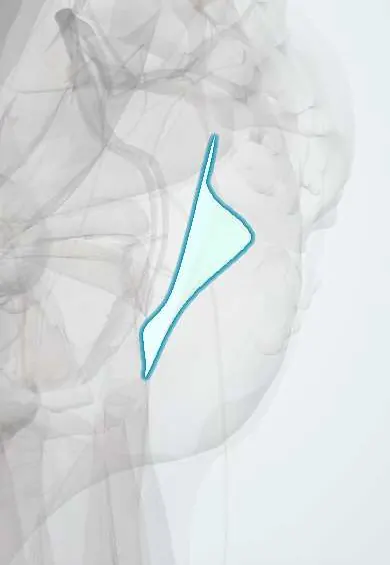
The sacrotuberous ligament is a long band from the sacrum to the sitting bone (ischial tuberosity); it steadies the pelvis.
Opens in the Durgical app, no sign-up needed.
What it is
A long, strong band from the sacrum and coccyx to the ischial tuberosity (sitting bone).
What it does
Keeps the lower sacrum from tipping and helps steady the pelvis. Part of the hamstring origin blends with it.
Key facts
- Attaches
- Posterior iliac spines, lateral sacrum and coccyx to ischial tuberosity
- Function
- Resists nutation (upward tilt of lower sacrum); with sacrospinous turns sciatic notches into foramina
- Tight in
- Sacral nutation
Relations
- Superficial
- Gluteus maximus, which partly arises from it
- Deep
- Sacrospinous ligament, with the pudendal nerve and internal pudendal vessels crossing between the two near the ischial spine
- Below
- Ischial tuberosity and the long head of biceps femoris; its falciform process curves forward along the ischial ramus
How to find it
Deep in the lower buttock: firm pressure between the ischial tuberosity and the side of the lower sacrum and coccyx meets a taut band through gluteus maximus.
On imaging
Radiographs do not show it unless it calcifies, seen as a linear density from the sacrum to the ischial tuberosity. MRI shows it as a thick dark band blending with the hamstring origin at the tuberosity; this junction is checked in hamstring avulsions. In suspected pudendal entrapment, CT or ultrasound is used mainly to guide an injection between it and the sacrospinous ligament.
Clinical notes
- Surgical decompression of pudendal nerve entrapment may divide this ligament
- Torn in unstable pelvic ring injuries (rotationally or vertically unstable)
- Lies close to the pudendal canal (Alcock canal), which runs along the side wall of the ischioanal fossa
Anatomical variants
- Its lower fibres often run straight on into the tendon of the long head of biceps femoris; some texts regard the ligament as the cut-off upper end of that tendon
Related conditions
Test yourself
Think of the answer, then tap the question to see it.
Where does the sacrotuberous ligament attach?
From the posterior iliac spines, lateral sacrum and coccyx to the ischial tuberosity.
Between which two ligaments can the pudendal nerve be trapped, causing pudendal neuralgia?
Between the sacrotuberous and sacrospinous ligaments, near the ischial spine.
What do the sacrotuberous and sacrospinous ligaments do to the sciatic notches?
They turn the greater and lesser sciatic notches into foramina; the sacrotuberous ligament also resists sacral nutation.
Educational information, not medical advice. For any symptom, see a health professional.
Its names
- Official Latin (TA2)
- ligamentum sacrotuberale TA2 1850
- Official Spanish (DeCS)
- Ligamento sacrotuberoso
- English (TA2)
- Sacrotuberous ligament
- Also called
- sacrotuberal ligament · ligamentum sacrotuberosum
Related
Sources: Terminologia Anatomica (TA2); Anatomy, Bony Pelvis and Lower Limb: Pelvic Joints; Anatomy, Abdomen and Pelvis: Ligaments; Anatomy of the Human Body (20th ed.): Articulations of the Pelvis (Lea & Febiger (Gray's Anatomy, 1918), 1918) · adapted, Public domain.
Spotted a mistake?We are always improving for the community. Tell us what is wrong and our team will review it.Report a mistake
Representative model, for educational purposes only.