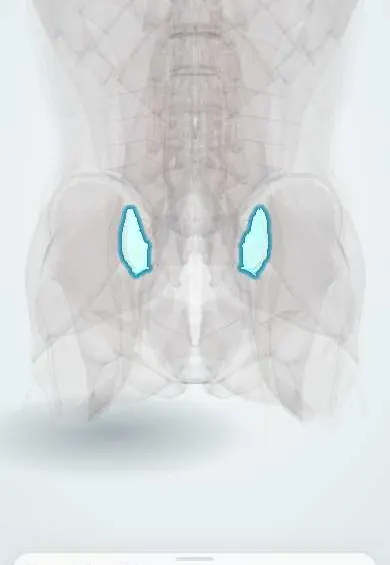
Sacroiliac joint pain !
Sacroiliac joint pain comes from the joint between the sacrum and pelvis; it is felt in the low back and buttock and is often overlooked.
Updated 2026-10-29
Structures involved
Tap one to see what it is and open it in 3D.
- SI joint surfaces
- Sacroiliac ligaments
- Sacrum
- Hip bone
- Iliolumbar ligament
- Sacrotuberous ligament
- Piriformis
- Gluteus maximus
- Thoracolumbar fascia
- L5 vertebra
What it is
Pain arising from the sacroiliac joint or its ligaments, felt in the low back and buttock below the level of L5. It is a common, often overlooked cause of low back pain.
Who gets it
Thought to cause a meaningful share of chronic low back pain; estimates vary widely. It is common in pregnancy and after lumbar fusion.
Causes
- Abnormal joint loading or movement (hypermobility or hypomobility)
- Trauma: a fall on the buttock, a car crash or a sudden misstep
- Pregnancy and childbirth (hormonal ligament laxity and weight change)
- Inflammatory sacroiliitis (spondyloarthritis) or infection
- Degenerative arthritis of the joint
Risk factors
- Previous lumbar fusion, especially down to the sacrum
- Pregnancy
- Leg length difference or abnormal gait
- Running and sports with repeated single-leg loading
- Obesity
Pathophysiology
The sacroiliac joint is a strong, nearly rigid joint that transfers load from the spine to the pelvis and has a rich nerve supply, mainly from the dorsal rami of L5 to S3. Sprain of the ligaments, capsular inflammation or degenerative change irritates these nerves, giving buttock pain that can spread to the thigh.
Symptoms and signs
- One-sided pain in the buttock and low back below L5, often near the posterior superior iliac spine
- Fortin finger sign: the patient points to an area just below and inside the posterior superior iliac spine
- Pain spreading to the groin or back of the thigh, usually not below the knee
- Pain when sitting on the affected side, climbing stairs, standing on one leg or turning in bed
Diagnosis
- Clinical
- Pain provocation tests: distraction, compression, thigh thrust, Gaenslen test and sacral thrust; FABER (Patrick) test is also used. Three or more positive tests, with lumbar and hip causes excluded, support the diagnosis.
- Tests
- CRP, ESR and HLA-B27 if an inflammatory cause is suspected. An image-guided diagnostic injection of local anaesthetic into the joint that relieves the pain is considered the reference standard.
- Imaging
- X-rays and CT may be normal or show arthritis. MRI is useful to look for sacroiliitis, stress fractures, infection or lumbar causes.
Differential diagnosis
- Lumbar disc herniation with radiculopathy
- Facet joint pain
- Hip osteoarthritis
- Ankylosing spondylitis (inflammatory sacroiliitis)
- Piriformis syndrome
- Sacral stress fracture
Goal of treatment
Reduce pain, restore function and stable pelvic loading, and treat any underlying inflammatory or infectious cause.
Treatment
- Conservative
- Activity modification, education and, in some patients, a sacroiliac belt, especially in pregnancy.
- Medical
- Simple analgesics and NSAIDs.
- Rehabilitation
- Physiotherapy for core, gluteal and hip strength, posture and gait; manual therapy is sometimes used.
- Procedure
- Image-guided intra-articular corticosteroid injection; radiofrequency ablation of the lateral branch nerves for persistent pain.
- Surgical
- Sacroiliac joint fusion, usually minimally invasive, for carefully selected patients with confirmed joint pain who fail other treatment.
Complications
- Chronic low back pain and disability
- Overlap with lumbar and hip pain that makes diagnosis harder
Prognosis
Many patients improve with conservative care; pregnancy-related pain usually settles after delivery. Persistent cases may need procedures, with variable long-term results.
Test yourself
Think of the answer, then tap the question to see it.
Where is sacroiliac joint pain typically felt?
In the buttock and low back below L5, often near the posterior superior iliac spine, sometimes spreading to the thigh.
Which tests are used to provoke sacroiliac joint pain?
Distraction, compression, thigh thrust, Gaenslen test and sacral thrust; FABER is also used.
How many positive provocation tests are commonly taken to support sacroiliac joint pain?
Three or more of the standard tests, after lumbar and hip causes are excluded.
What is considered the reference standard to confirm sacroiliac joint pain?
Relief of pain after an image-guided injection of local anaesthetic into the joint.
Which surgery increases the risk of sacroiliac joint pain later?
Lumbar fusion, especially when it extends to the sacrum.
Related conditions
- Mechanical low back pain
- Ankylosing spondylitis
- Lumbar Disc Herniation
- Sciatica (Lumbar Radiculopathy)
- Hip Osteoarthritis
- Piriformis syndrome
Educational information, not medical advice. For any symptom, see a health professional.
Sources: Sacroiliac Joint Pain (StatPearls (NCBI Bookshelf), 2023).
Spotted a mistake?We are always improving for the community. Tell us what is wrong and our team will review it.Report a mistake
Representative model, for educational purposes only.