Cardiovascular system · Head and neck
Transverse sinus !
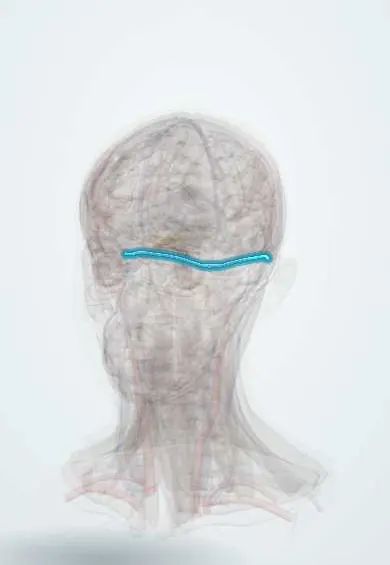
The transverse sinus is a vein channel that curves along the inside of the back of the skull, carrying brain blood toward the neck veins.
Opens in the Durgical app, no sign-up needed.
What it is
A sinus along the back edge of the tentorium on each side.
What it does
Carries blood from the confluence toward the sigmoid sinus.
Key facts
- Drains
- Confluence of sinuses
- Into
- Sigmoid sinus
Relations
- Course
- From the confluence of sinuses it curves laterally and forward in the attached edge of the tentorium, then leaves it at the petrous temporal bone, receives the superior petrosal sinus and becomes the sigmoid sinus
- Above
- Occipital lobe, above the tentorium
- Below
- Cerebellar hemisphere, below the tentorium
How to find it
Surface marking: a line from the external occipital protuberance curving laterally, slightly convex upward, to the back of the mastoid process; the asterion roughly marks where it turns into the sigmoid sinus, a landmark for posterior fossa approaches.
On imaging
On MR or CT venography a filling defect or absent flow suggests thrombosis; a thin but smooth sinus is more often hypoplasia, and arachnoid granulations can make small rounded filling defects that are normal.
Clinical notes
- Dural arteriovenous fistulas often involve the junction of the transverse sinus and sigmoid sinus and may cause pulsatile tinnitus
- Thrombosis here can cause only headache and raised pressure, much like idiopathic intracranial hypertension, so venography is part of the work-up of that condition
- In selected people with idiopathic intracranial hypertension and a narrowed transverse sinus, a stent placed in the sinus can lower the pressure
Anatomical variants
- Usually asymmetric: the right is most often dominant, and the left may be small or hypoplastic, which can mimic thrombosis
Development
It arises as a new channel over the developing inner ear capsule, because ear growth closes part of the primary head vein; blood from the front of the head is rerouted into it, which helps explain how often the two sides differ.
Related conditions
Test yourself
Think of the answer, then tap the question to see it.
Where does the transverse sinus run?
In the attached outer margin of the tentorium cerebelli, in a groove on the occipital bone, from the confluence of sinuses to the petrous temporal bone, where it becomes the sigmoid sinus.
Which vein makes a temporal lobe venous infarct possible when the transverse sinus thromboses?
The inferior anastomotic vein (of Labbé), which drains the temporal lobe into the transverse sinus.
Why can a small left transverse sinus be mistaken for thrombosis on venography?
The transverse sinuses are usually asymmetric: the right is most often dominant and the left may be hypoplastic; a thin but smooth sinus is more often hypoplasia.
Which venous sinus finding is common in idiopathic intracranial hypertension?
Narrowing of both transverse sinuses.
Educational information, not medical advice. For any symptom, see a health professional.
Its names
- Official Latin (TA2)
- sinus transversus TA2 4849
- Official Spanish (DeCS)
- Senos Transversos DeCS D054064
- English (TA2)
- Transverse sinus
- Also called
- lateral sinus
Related
Sources: Terminologia Anatomica (TA2); DeCS; Neuroanatomy, Dural Venous Sinuses; Anatomy of the Human Body (20th ed.): Development of the Vascular System (Lea & Febiger (Gray's Anatomy, 1918), 1918) · adapted, Public domain.
Spotted a mistake?We are always improving for the community. Tell us what is wrong and our team will review it.Report a mistake
Representative model, for educational purposes only.