Conditions · Obstetrics and gynecology
Breech and other malpresentations !
When the baby is not head-down at the end of pregnancy, most often bottom-first. Doctors may try to turn the baby or plan a caesarean birth.
Updated 2026-11-01
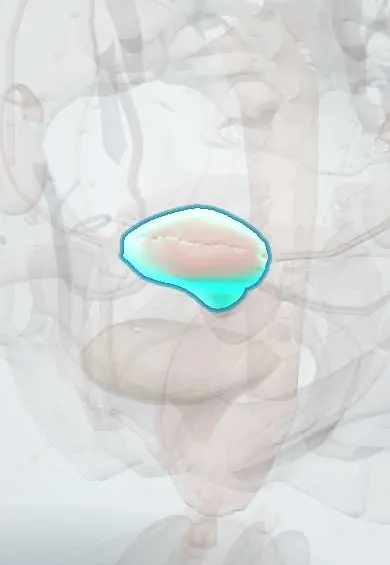
Structures involved
Tap one to see what it is and open it in 3D.
What it is
Breech presentation means the fetal buttocks or feet lie over the pelvic inlet instead of the head. Other malpresentations include transverse or oblique lie (shoulder presentation) and face or brow presentation. Breech is common in mid-pregnancy and most fetuses turn spontaneously, so it becomes clinically relevant from about 36 weeks.
Who gets it
About 3 to 4 percent of term pregnancies are breech, and a much higher share of preterm births. Caesarean section is the usual mode of delivery for term breech in Colombia and Latin America, which contributes to the region's high caesarean rates.
Causes
- Prematurity (the fetus has not yet turned)
- Uterine anomalies (septate or bicornuate uterus) and fibroids
- Placenta praevia or a cornual placenta
- Polyhydramnios or oligohydramnios
- Multiple pregnancy
- Fetal anomalies (hydrocephalus, anencephaly, neuromuscular disease) and short cord
Risk factors
- Preterm gestation
- Previous breech presentation
- First pregnancy or, for transverse lie, high parity with a lax uterus
- Contracted pelvis
- Abnormal amniotic fluid volume
Pathophysiology
Near term, most fetuses settle head-down because the larger breech and legs fit best in the roomy uterine fundus. Anything that changes the shape of the cavity, crowds it, gives too much room, or limits fetal movement interferes with this adaptation. In a breech birth the body is delivered first through a cervix that may not be fully dilated for the larger head, so the after-coming head can become trapped while the cord is compressed. The irregular breech also fills the lower segment poorly, which favours cord prolapse when the membranes rupture.
Classification
- Frank breech: hips flexed, knees extended (most common)
- Complete breech: hips and knees flexed
- Footling or incomplete breech: one or both feet presenting (highest risk of cord prolapse)
- Transverse or oblique lie (shoulder presentation)
- Face and brow presentations (deflexed head)
Symptoms and signs
- Often none; found on examination or ultrasound
- Hard round fetal head felt under the ribs at the fundus
- Fetal heart heard above the umbilicus
- Kicks felt low in the pelvis
Diagnosis
- Clinical
- Leopold manoeuvres find the head at the fundus; on vaginal examination the presenting part is soft and irregular (buttocks, anus, sacrum or feet) rather than the hard skull with sutures.
- Tests
- Usual pre-delivery tests and blood group with antibody screen (anti-D prophylaxis is needed in Rh-negative women undergoing external version).
- Imaging
- Ultrasound confirms presentation and type of breech, flexion of the head, estimated fetal weight, placental site, fluid volume and fetal anomalies.
Differential diagnosis
- Cephalic presentation misjudged on palpation
- Transverse or oblique lie
- Face presentation (can be mistaken for breech on vaginal examination)
Goal of treatment
Increase the chance of a cephalic birth and, if the fetus stays breech, choose the safest mode of delivery for mother and baby.
Treatment
- Procedure
- External cephalic version offered from about 36 to 37 weeks if there are no contraindications, with tocolysis to relax the uterus and fetal heart monitoring before and after.
- Surgical
- Planned caesarean section, usually at or after 39 weeks, for persistent breech at term and for transverse lie.
- Procedure
- Assisted vaginal breech birth only in selected cases (frank or complete breech, adequate pelvis, normal-sized fetus, flexed head, skilled attendant), and for the second twin in some settings.
- Follow-up
- Instruct the woman to come at once if membranes rupture or labour begins; on rupture, check for cord prolapse and monitor the fetal heart rate.
Complications
- Umbilical cord prolapse
- Entrapment of the after-coming head and birth asphyxia
- Birth injuries (brachial plexus, fractures)
- Developmental dysplasia of the hip in the newborn
- Maternal risks of caesarean section and of version (abruption, fetal distress)
Prognosis
Most breech fetuses turn before term, and external version succeeds in about half of attempts. Planned caesarean birth for persistent term breech gives low neonatal risk; breech babies should be screened for hip dysplasia.
Prevention
- Offering external cephalic version at term
- Ultrasound confirmation of presentation at 36 weeks
Test yourself
Think of the answer, then tap the question to see it.
What is the most common type of breech presentation?
Frank breech (hips flexed, knees extended).
When is external cephalic version usually offered?
From about 36 to 37 weeks, before labour.
Which type of breech carries the highest risk of cord prolapse?
Footling (incomplete) breech.
Which newborn screening is important after breech presentation?
Screening for developmental dysplasia of the hip.
How is a persistent transverse lie at term delivered?
By caesarean section.
Related conditions
- Umbilical cord prolapse
- Preterm labour and birth
- Multiple pregnancy and twin–twin transfusion syndrome
- Amniotic fluid disorders (polyhydramnios, oligohydramnios)
- Placenta praevia
- Uterine fibroids (leiomyomas)
- Müllerian anomalies (MRKH, septate uterus, imperforate hymen)
- Developmental dysplasia of the hip
- Labour dystocia (arrest of labour, cephalopelvic disproportion)
- Intrapartum fetal compromise (non-reassuring fetal status)
- Neonatal birth injuries (caput, cephalohaematoma, clavicle fracture)
- Premature rupture of membranes (PROM and PPROM)
Educational information, not medical advice. For any symptom, see a health professional.
Sources: Breech birth (MedlinePlus (U.S. National Library of Medicine), 2024).
Spotted a mistake?We are always improving for the community. Tell us what is wrong and our team will review it.Report a mistake
Representative model, for educational purposes only.