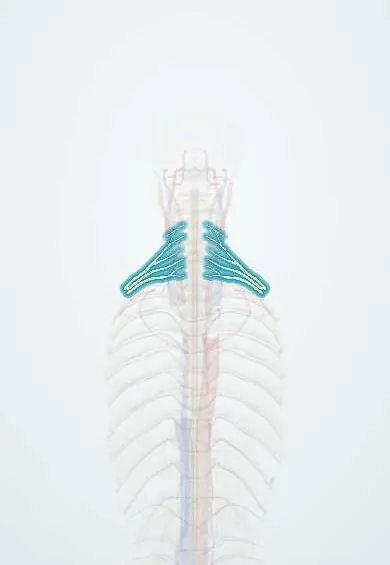
Brachial plexus roots !
The brachial plexus roots are the C5 to T1 nerve roots joining between the scalene muscles to form the nerve network of the arm.
Official name: Brachial plexus
Opens in the Durgical app, no sign-up needed.
What it is
The C5 to T1 nerve roots joining into trunks between the scalene muscles, on their way to the arm.
What it does
Form the nerve network for the shoulder, arm and hand. See the upper-limb model for the rest.
Key facts
- Roots
- Ventral rami of C5–T1 (varies: prefixed with C4, postfixed with T2); emerge between anterior and middle scalenes
- Moves
- Root branches: dorsal scapular nerve (C5: rhomboids, levator scapulae), long thoracic nerve (C5–C7: serratus anterior); plexus: all upper limb muscles
- Feeling from
- Upper limb dermatomes C5–T1 via the terminal branches
Relations
- Course
- The ventral rami leave the foramina behind the vertebral artery, emerge between the anterior and middle scalenes, join into upper (C5–C6), middle (C7) and lower (C8–T1) trunks in the posterior triangle and pass over the first rib behind the clavicle with the subclavian artery
- In front
- The anterior scalene with the phrenic nerve on its front; the subclavian artery lies in front of the lower trunk on the first rib
- Behind
- The middle scalene
- Below
- The first rib and the dome of the pleura; T1 rises over the neck of the first rib to reach the plexus
- Superficial
- Platysma, supraclavicular nerves, external jugular vein and the inferior belly of omohyoid; the transverse cervical artery crosses the trunks
How to find it
The interscalene groove is found by sliding a finger off the back edge of the sternocleidomastoid at the level of the cricoid cartilage (C6) onto the scalenes. On ultrasound the roots and trunks look like a vertical row of round dark dots ('traffic light') between the two muscles.
Examination
- Tinel sign over the supraclavicular plexus: tingling down the arm, used to follow regeneration or locate a neuroma
- Roos (elevated arm stress) test: opening and closing the hands with the arms raised reproduces the symptoms in thoracic outlet syndrome
On imaging
MRI or CT myelography shows pseudomeningoceles (CSF pouches) at the foramina after root avulsion; MRI neurography shows the plexus beyond. A chest radiograph checks for a raised hemidiaphragm and for a cervical rib.
Clinical notes
- Neurogenic thoracic outlet syndrome: the lower trunk (C8–T1) is stretched over a cervical rib or fibrous band, causing ulnar-side numbness and thenar wasting (Gilliatt-Sumner hand)
- Pancoast tumour at the lung apex invades the lower trunk and the stellate ganglion: shoulder and inner-arm pain, hand weakness and Horner syndrome
- Motorcycle accidents that force the head and shoulder apart are the classic cause of adult supraclavicular injury; nerve transfers (e.g. spinal accessory to suprascapular) help when roots are avulsed
- Neuralgic amyotrophy (Parsonage-Turner syndrome): sudden severe shoulder pain followed by patchy weakness, often in upper trunk muscles
Anatomical variants
- Cervical rib or a fibrous band from C7, in under 1 in 100 people, can lift and kink the lower trunk
- A root or trunk (most often C5 or C6) may pass through the anterior scalene instead of behind it
Memory aid
Roots, trunks, divisions, cords, branches: "Randy Travis Drinks Cold Beer".
Related conditions
Test yourself
Think of the answer, then tap the question to see it.
Which ventral rami form the brachial plexus, and between which muscles do they emerge?
C5–T1, emerging between the anterior and middle scalenes.
Which trunks do the brachial plexus roots form?
Upper trunk C5–C6, middle trunk C7 and lower trunk C8–T1.
What is the posture in Erb palsy, and which roots are injured?
C5–C6: arm adducted, internally rotated, elbow straight (waiter's tip).
Which signs suggest a preganglionic root avulsion of the brachial plexus?
Horner syndrome, winged scapula, rhomboid weakness, a raised hemidiaphragm and normal sensory potentials in a numb arm.
What does a Pancoast tumour at the lung apex cause by invading the lower trunk and stellate ganglion?
Shoulder and inner-arm pain, hand weakness and Horner syndrome.
Educational information, not medical advice. For any symptom, see a health professional.
Its names
- Official Latin (TA2)
- plexus brachialis TA2 6395
- Official Spanish (DeCS)
- Plexo braquial DeCS D001917
- English (TA2)
- Brachial plexus
Related
Sources: Terminologia Anatomica (TA2); DeCS; Anatomy, Head and Neck: Cervical Nerves; Anatomy, Shoulder and Upper Limb, Brachial Plexus.
Spotted a mistake?We are always improving for the community. Tell us what is wrong and our team will review it.Report a mistake
Representative model, for educational purposes only.