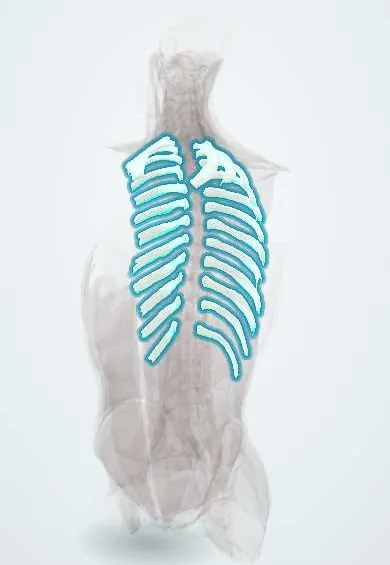
Ribs (back part) !
The back ends of the twelve pairs of ribs join the thoracic vertebrae; this cage makes the mid-back much stiffer than the neck or lower back.
Official name: Ribs
Opens in the Durgical app, no sign-up needed.
What it is
The back ends of the twelve pairs of ribs, where each rib joins the side of a thoracic vertebra.
What it does
Hold the thoracic spine like a cage, which makes the mid-back much stiffer than the neck or lower back.
Key facts
- Joints with
- Head: bodies of same and higher vertebra plus the disc (joint of head of rib); tubercle: transverse process of same vertebra (costotransverse joint, ribs 1–10)
- Landmarks
- Head with two facets and crest (single facet on ribs 1, 10–12); neck; tubercle; angle; costal groove for intercostal vein, artery and nerve
Relations
- Medial
- Costovertebral and costotransverse joints held by the radiate, intra-articular and costotransverse ligaments (rib-to-spine ligaments)
- Deep
- Endothoracic fascia, parietal pleura and lung; the sympathetic trunk lies on the rib heads
- Below
- Costal groove with the posterior intercostal arteries, the intercostal vein and the intercostal nerves, between the internal and innermost intercostal muscles
- Superficial
- Erector spinae (iliocostalis on the angles), levatores costarum and serratus posterior; the scapula and its muscles cover ribs 2–7
How to find it
In front, ribs are counted from the second costal cartilage beside the sternal angle. Behind, the angles of the ribs are felt just lateral to the erector spinae; the twelfth rib is followed inward from the flank and may be too short to feel.
Examination
- Rib compression (spring) test: squeezing the chest front to back or side to side, away from the sore spot, causes pain at the site of a rib fracture; pain only under direct pressure fits a bruise better
- Hooking maneuver: the fingers are curled under the lower costal margin and pulled forward; reproducing the pain, sometimes with a click, suggests slipping rib syndrome of the loose false ribs (8–10)
On imaging
A chest X-ray misses many rib fractures; CT shows them and the pleural and lung injury beneath. Notching of the lower edges of middle ribs (about 3–9) is a classic sign of coarctation of the aorta, from enlarged intercostal collateral arteries.
Clinical notes
- Posterior rib fractures in infants, near the joints with the spine, are a classic marker of non-accidental injury from squeezing of the chest
- Older adults with several rib fractures are at high risk of pneumonia because pain stops deep breathing; intercostal, paravertebral and erector spinae blocks act on the nerves along the ribs
- Cervical rib on C7 narrows the thoracic outlet above the first rib (thoracic outlet syndrome)
Anatomical variants
- Cervical rib on C7 (commonly quoted 0.5–1%) or a lumbar rib on L1
- Bifid (forked) rib, usually at its front end, most often the third or fourth
- The rib cage is on average smaller in women, with more steeply sloping ribs
Development
Ribs grow from the costal processes of the thoracic vertebrae; in the neck and lower back these elements stay small, within the transverse processes, and occasionally grow into cervical or lumbar ribs.
Memory aid
VAN from top to bottom in the costal groove: Vein, Artery, Nerve.
Related conditions
Test yourself
Think of the answer, then tap the question to see it.
In what order do the intercostal vessels and nerve run in the costal groove of each rib?
Vein, artery, nerve (VAN) from top to bottom, so needles and drains pass just above the upper border of the rib below.
What is a flail chest, and what is its sign?
Two or more adjacent ribs each broken in two or more places; the segment sinks in on inspiration (paradoxical movement), usually over a lung contusion.
What do posterior rib fractures near the joints with the spine suggest in an infant?
Non-accidental injury, from squeezing of the chest.
What does notching of the lower edges of the middle ribs (about 3–9) on X-ray suggest?
Coarctation of the aorta, from enlarged intercostal collateral arteries.
Educational information, not medical advice. For any symptom, see a health professional.
Its names
- Official Latin (TA2)
- costae TA2 1105
- Official Spanish (DeCS)
- Costillas DeCS D012272
- English (TA2)
- Ribs
- Also called
- ribs 1-12 · ossa costalia
Related
Sources: Terminologia Anatomica (TA2); DeCS; Anatomy, Thorax, Ribs.
Spotted a mistake?We are always improving for the community. Tell us what is wrong and our team will review it.Report a mistake
Representative model, for educational purposes only.