
Duane retraction syndrome
A congenital miswiring of the nerves to the eye muscles: one eye cannot turn fully, and the eye sinks back and the lid narrows when it turns in.
What it is
A congenital cranial dysinnervation disorder: the abducens nerve is absent or underdeveloped and the lateral rectus is supplied by oculomotor branches. Abduction, adduction or both are limited, and the globe retracts with lid fissure narrowing on adduction. A compensatory head turn usually prevents amblyopia.
Who gets it
The most common congenital cranial dysinnervation disorder; more often in girls and in the left eye; usually one eye.
Causes
- Developmental absence of the abducens nucleus or nerve with aberrant oculomotor innervation
- Sometimes genetic or part of syndromes
Risk factors
- Family history (familial forms)
- Associated syndromes
Pathophysiology
Fibres meant for the medial rectus also supply the lateral rectus. On attempted adduction both muscles contract together, pulling the eye backwards (retraction) and narrowing the lid fissure; abduction is weak because the lateral rectus lacks its own nerve.
Classification
- Type 1: limited abduction (most common)
- Type 2: limited adduction
- Type 3: limited abduction and adduction
Symptoms and signs
- Eye that does not turn out (or in) fully
- Narrowing of the lid opening when looking in
- Face turn to keep both eyes straight
- Up- or down-shoots of the eye on adduction
Diagnosis
- Clinical
- Limited horizontal movement with globe retraction and lid fissure narrowing on adduction, present since birth; old photographs help.
- Tests
- Orthoptic assessment and refraction; hearing and systemic check for associated syndromes.
- Imaging
- MRI can show absence of the abducens nerve, though not needed for typical cases.
Differential diagnosis
- Sixth nerve palsy
- Infantile esotropia
- Möbius syndrome
- Restrictive strabismus
Child with limited abduction
| Feature | Duane syndrome type 1 | Sixth nerve palsy | Infantile esotropia | Möbius syndrome |
|---|---|---|---|---|
| Onset | Congenital, non-progressive | Usually acquired | In the first months of life | Congenital |
| Retraction and fissure narrowing on adduction | Yes | No | No | No |
| Eye position looking ahead | Often straight or a small inward turn | Inward turn, worse for distance | Large constant inward turn | Inward turn |
| Other signs | Up- or down-shoots on adduction, compensatory head turn | Double vision; look for raised intracranial pressure or other neurological signs | Cross-fixation, latent nystagmus | Weakness of both sides of the face |
Goal of treatment
Allow comfortable binocular vision without a marked head turn and treat any amblyopia.
Treatment
- Conservative
- Glasses and amblyopia treatment when needed.
- Surgical
- Strabismus surgery for a significant head turn, deviation in primary position or marked retraction and up- or down-shoots.
- Follow-up
- Observation in most children, who have good binocular vision with a small head turn.
Complications
- Abnormal head posture
- Amblyopia (uncommon)
- Cosmetic concern from retraction
Common traps
- Limited abduction since infancy means a congenital sixth nerve palsy: in Duane the globe retracts and the lid fissure narrows on adduction, and the eye is often nearly straight looking ahead; a sixth nerve palsy has neither retraction nor narrowing
- Surgery will restore full eye movement: the innervation cannot be rewired; surgery aims to remove the head turn, the deviation or marked retraction, not to restore range
- A child with a limited eye movement will become amblyopic: most children with Duane keep good vision because a head turn preserves single binocular vision
- A new abduction deficit in an adult may be late-presenting Duane: Duane is present from birth and does not progress, so an acquired limitation is worked up as a sixth nerve palsy; old photographs help
- The narrowed lid fissure on adduction is a ptosis: it is a mechanical narrowing because the globe is pulled back as both horizontal muscles contract together
Prognosis
Non-progressive; most patients have good vision and function; surgery improves head posture but does not restore full movement.
Test yourself
Think of the answer, then tap the question to see it.
A 5-year-old girl cannot abduct her left eye; when she looks right, the left eye sinks back and its lid fissure narrows. Diagnosis?
Duane retraction syndrome type 1: limited abduction plus globe retraction and fissure narrowing on adduction.
Why does the globe retract on adduction in Duane syndrome?
The lateral rectus is supplied by oculomotor fibres meant for the medial rectus, so both muscles contract at once and pull the eye backwards.
Why do most children with Duane syndrome keep good vision?
They adopt a head turn that keeps both eyes aligned where they look, so binocular vision develops and amblyopia is uncommon.
When is surgery offered in Duane syndrome?
For a marked head turn, a deviation looking straight ahead, or disfiguring retraction and up- or down-shoots; it improves posture, not range of movement.
Connections
Educational information, not medical advice. For any symptom, see a health professional.
Sources: Duane Retraction Syndrome (EyeWiki, American Academy of Ophthalmology, 2026).
Spotted a mistake?We are always improving for the community. Tell us what is wrong and our team will review it.Report a mistake
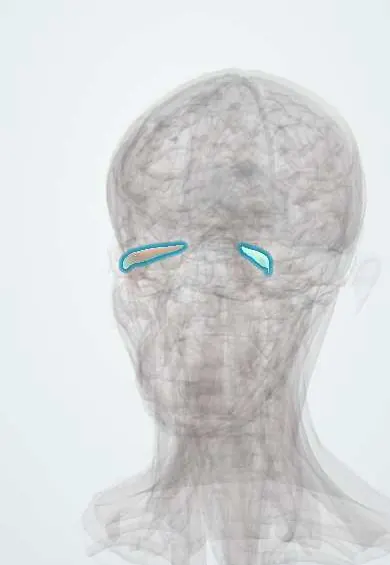
Representative model, for educational purposes only.