
Abducens (sixth) nerve palsy
The eye cannot turn outward, causing horizontal double vision. In older adults it is often vascular; with headache or papilloedema, raised pressure.
What it is
Weakness of the lateral rectus muscle from damage to the sixth cranial nerve. The affected eye cannot abduct, producing horizontal double vision that worsens looking towards the affected side and at distance. Because the nerve has a long course inside the skull, it is often affected by raised intracranial pressure, where it is a false localising sign.
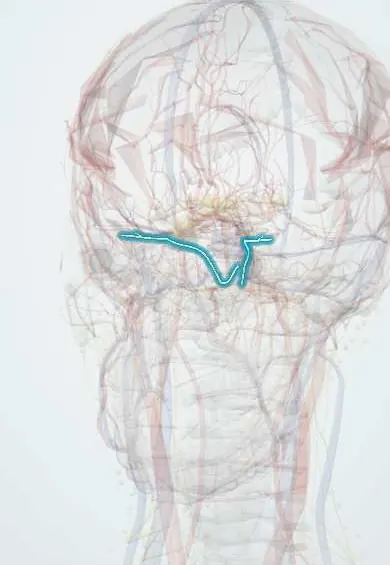
See it in 3D
Who gets it
The most common isolated ocular motor nerve palsy; in adults over 50 often microvascular, in children often after viral illness or from tumours.
Causes
- Microvascular ischaemia (diabetes, hypertension)
- Raised intracranial pressure
- Tumours of the brainstem, skull base or cavernous sinus
- Trauma
- Multiple sclerosis
- Petrous apex infection after otitis media in children
Risk factors
- Diabetes and hypertension
- Head trauma
- Conditions raising intracranial pressure
Pathophysiology
The nerve runs a long path from the pons over the petrous apex and through the cavernous sinus; stretching from raised pressure, ischaemia of its blood supply, compression or inflammation stop it conducting, so the lateral rectus is weak.
Symptoms and signs
- Horizontal double vision, worse at distance and looking towards the affected side
- Eye turned inward (esotropia)
- Head turned towards the affected side to keep single vision
Diagnosis
- Clinical
- Limited abduction of one eye with an esotropia greater at distance; fundus exam for papilloedema and a full neurological exam.
- Tests
- Glucose and blood pressure; ESR and CRP over 50; lumbar puncture after imaging if raised pressure is suspected.
- Imaging
- MRI of the brain when the patient is young, there are other signs, papilloedema or no recovery.
Differential diagnosis
- Myasthenia gravis
- Thyroid eye disease (restriction of the medial rectus)
- Orbital medial wall fracture
- Decompensated esophoria
- Duane syndrome (congenital)
Goal of treatment
Find and treat the cause and relieve double vision.
Treatment
- Medical
- Control of vascular risk factors in microvascular palsy, which usually recovers within months.
- Conservative
- Patching one eye or prisms to relieve double vision.
- Surgical
- Strabismus surgery or botulinum toxin for persistent deviation.
Complications
- Persistent double vision
- Amblyopia in young children
Prognosis
Microvascular palsies usually recover within about three months; the outlook of other causes depends on the cause.
Test yourself
Think of the answer, then tap the question to see it.
Which muscle is weak in sixth nerve palsy?
The lateral rectus, so the eye cannot turn outward.
Why is sixth nerve palsy a false localising sign?
Because raised intracranial pressure stretches the nerve along its long course, regardless of the lesion's site.
When is MRI needed?
In young patients, with other neurological signs, papilloedema, or no recovery after about three months.
In ophthalmology
Connections
Educational information, not medical advice. For any symptom, see a health professional.
Sources: Abducens Nerve Palsy (StatPearls Publishing (NCBI Bookshelf), 2023).
Spotted a mistake?We are always improving for the community. Tell us what is wrong and our team will review it.Report a mistake
Representative model, for educational purposes only.