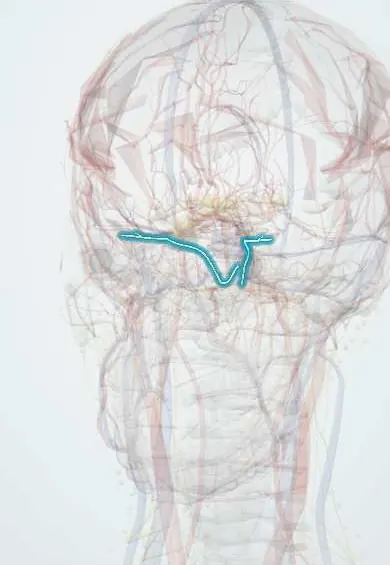
Nervous system · Head and neck
Abducens nerve (VI) !
The abducens nerve (cranial nerve VI) turns the eye outward; raised pressure inside the skull often affects it first, causing double vision.
Official name: Abducens nerve
Opens in the Durgical app, no sign-up needed.
What it is
A thin nerve with a long path up the skull base to the lateral rectus.
What it does
Turns the eye outward; often the first nerve affected by raised pressure in the skull.
Key facts
- Roots
- Abducens nucleus (pons, under the facial colliculus); long path through the cavernous sinus; superior orbital fissure
- Moves
- Lateral rectus
- Feeling from
- None
Relations
- Course
- Exits at the junction of the pons and the medulla oblongata, climbs the clivus, pierces the dura, bends over the petrous apex under the petrosphenoidal ligament (Dorello's canal), crosses the cavernous sinus and enters the orbit through the superior orbital fissure, inside the common tendinous ring, to reach the lateral rectus
- Medial
- In the cavernous sinus, the internal carotid artery with its sympathetic plexus
- Lateral
- In the cavernous sinus, the lateral wall carrying the oculomotor nerve (III), the trochlear nerve (IV), V1 and V2
How to find it
It cannot be felt; it is assessed by having the person follow a target to each side, where the affected eye stops short of the outer corner. On MRI it is followed from the pontomedullary junction up the clivus to Dorello's canal.
Examination
- Lateral gaze: incomplete abduction of the affected eye, which may rest turned in (esotropia)
- Cover test: the inward deviation is greater at distance and on gaze toward the affected side
- Fundoscopy: papilloedema alongside a sixth nerve palsy points to raised intracranial pressure as the cause
On imaging
High-resolution heavily T2-weighted MRI shows it rising from the pontomedullary junction along the clivus to Dorello's canal. In a palsy, contrast MRI checks the pons, clivus, petrous apex and cavernous sinus; signs of raised pressure (flattened backs of the globes, wide optic nerve sheaths, empty sella) explain a false localising palsy. CT shows skull base fractures.
Clinical notes
- Gradenigo syndrome: middle ear infection spreading to the petrous apex gives a VI palsy, deep facial pain (V) and ear discharge
- A lumbar puncture or low intracranial pressure can also stretch it, giving a palsy that usually recovers
- In adults an isolated palsy is often microvascular (diabetes, hypertension); in children a tumour of the pons or raised pressure is considered first
Development
Duane retraction syndrome is a congenital miswiring: the abducens nucleus or nerve fails to develop and oculomotor branches reach the lateral rectus, so the eye cannot turn out well and pulls back into the orbit, narrowing the lids, when it turns in.
Memory aid
"The abducens abducts": its only muscle is the lateral rectus (LR6).
Related conditions
Test yourself
Think of the answer, then tap the question to see it.
What is the deficit in an abducens nerve (VI) palsy?
The eye cannot turn out; horizontal double vision worse looking toward the affected side and at distance.
Why is an abducens nerve palsy called a false localising sign?
Raised intracranial pressure stretches its long path over the petrous apex, so the lesion need not be near the nerve.
Why is the abducens nerve often the first nerve hit by cavernous sinus disease?
It runs free inside the sinus beside the internal carotid artery, not in the lateral wall.
What is Gradenigo syndrome?
Middle ear infection spreading to the petrous apex: abducens nerve (VI) palsy, deep facial pain (V) and ear discharge.
Educational information, not medical advice. For any symptom, see a health professional.
Its names
- Official Latin (TA2)
- nervus abducens TA2 6283
- Official Spanish (DeCS)
- Nervio Abducens DeCS D000010
- English (TA2)
- Abducens nerve
- Also called
- cranial nerve VI · abducent nerve
Related
Sources: Terminologia Anatomica (TA2); DeCS; Neuroanatomy, Cranial Nerve 6 (Abducens).
Spotted a mistake?We are always improving for the community. Tell us what is wrong and our team will review it.Report a mistake
Representative model, for educational purposes only.