Conditions · Metabolism (biochemistry)
Huntington disease !
An inherited brain disease causing involuntary movements, mood changes and dementia, due to a CAG repeat in the HTT gene.
Updated 2026-11-01
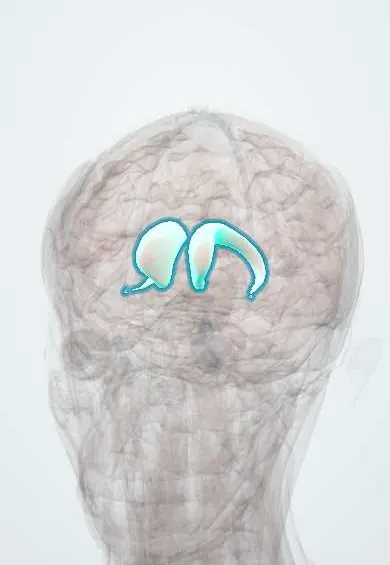
Structures involved
Tap one to see what it is and open it in 3D.
In biochemistry
In physiology
Why it happens
- Nonclassic inheritance: repeat expansions, mitochondrial genes, imprinting, mosaicism
- Autophagy
- Endoplasmic reticulum stress and the unfolded protein response
- Mendelian inheritance: autosomal dominant, recessive and X-linked
What it is
An autosomal dominant neurodegenerative disease caused by expansion of the HTT CAG repeat (36 or more), which produces a huntingtin with a long, toxic polyglutamine tract.
Who gets it
It affects about 3 to 7 in 100,000 people of European ancestry; it is less common in people of Japanese, Chinese or African origin. In Latin America the Lake Maracaibo cluster (Venezuela) is famous: studying it led to the gene. Large families have been described in Colombia's Caribbean region.
Causes
- Expansion of the CAG repeat in exon 1 of HTT (chromosome 4p16.3)
- Autosomal dominant inheritance; each child has a 50% risk
- Expansions grow mainly when passed through the father (juvenile form)
Risk factors
- An affected parent
- CAG number: 36–39 incomplete penetrance; 40 or more, full penetrance
Pathophysiology
The long polyglutamine makes huntingtin misfold, form nuclear aggregates and disturb transcription, axonal transport, mitochondrial function and release of neurotrophic factors (BDNF). The first neurons to die are the GABAergic medium spiny neurons of the striatum (caudate and putamen) that form the indirect pathway: the brake on the thalamus is lost and excess movements appear (chorea). The frontal cortex is affected later, with behavioural disorders and dementia.
Classification
- Adult form (typical onset between 30 and 50)
- Juvenile form (Westphal, > 60 CAG): rigidity, seizures, onset before 20
- Reduced-penetrance range (36–39 CAG)
Symptoms and signs
- Chorea: brief, irregular involuntary movements
- Clumsiness, gait disturbance, dysarthria and dysphagia
- Depression, irritability, apathy, impulsive behaviour
- Trouble planning and organising; later dementia
- Weight loss
Diagnosis
- Clinical
- A progressive movement disorder with psychiatric and cognitive symptoms in a person with a family history.
- Tests
- Genetic testing of the HTT CAG repeat number (by PCR); predictive testing in people without symptoms requires counselling.
- Imaging
- MRI shows caudate atrophy with 'boxcar' dilated lateral ventricles; mostly useful to rule out other causes.
Treatment
- Medical
- Medicines for chorea (VMAT2 inhibitors such as tetrabenazine, or antipsychotics), case by case.
- Medical
- Treatment of depression, irritability and psychosis; monitoring of suicide risk.
- Rehabilitation
- Physiotherapy, occupational and speech therapy; swallowing assessment.
- Conservative
- Nutritional support (high calorie needs) and palliative care in late stages.
- Follow-up
- Genetic counselling before and after predictive testing in at-risk relatives.
Drugs for this condition
Complications
- Aspiration pneumonia
- Falls and fractures
- Malnutrition
- Suicide
- Total dependence in late stages
Prognosis
It progresses without cure; median survival is 15 to 20 years after symptoms start.
Prevention
- Genetic counselling; prenatal or preimplantation diagnosis if the family wishes
Test yourself
Think of the answer, then tap the question to see it.
Which repeat expands in Huntington disease, and how is it inherited?
The CAG repeat of the HTT gene (36 or more copies); autosomal dominant inheritance.
Which neurons are lost first, and why does that cause chorea?
The GABAergic spiny neurons of the indirect-pathway striatum; their loss releases the thalamus and movements become excessive.
Why is the juvenile form usually inherited from the father?
The CAG repeat is more unstable in spermatogenesis and expands more through the paternal line (anticipation).
Which MRI finding is typical?
Atrophy of the caudate head with enlarged frontal horns of the lateral ventricles.
Related conditions
Educational information, not medical advice. For any symptom, see a health professional.
Sources: Huntington's disease: MedlinePlus Genetics (MedlinePlus, US National Library of Medicine, 2026); HTT gene: MedlinePlus Genetics (MedlinePlus, US National Library of Medicine, 2026); Textbook of Biochemistry for Medical Students, 6th ed. (Jaypee Brothers Medical Publishers (Vasudevan DM, Sreekumari S, Vaidyanathan K), 2011).
Spotted a mistake?We are always improving for the community. Tell us what is wrong and our team will review it.Report a mistake
Representative model, for educational purposes only.