Nervous system · Head and neck
Substantia nigra !
The substantia nigra is a dark band of cells in the midbrain that makes dopamine for movement control; its loss causes Parkinson disease.
Opens in the Durgical app, no sign-up needed.
What it is
A dark band of cells in the midbrain.
What it does
Makes dopamine for the basal ganglia; its loss causes Parkinson disease.
Key facts
- Where
- Midbrain, between the cerebral peduncle and the tegmentum
- Blood supply
- PCA branches
- Function
- Dopamine to the striatum (lost in Parkinson disease)
Relations
- In front
- Crus of the cerebral peduncle with the corticospinal and corticobulbar fibres
- Behind
- Midbrain tegmentum with the red nucleus
- Medial
- Interpeduncular fossa with the emerging oculomotor nerve; the ventral tegmental area (reward dopamine) lies just medial
- Above
- It extends up into the subthalamus, next to the subthalamic nucleus
How to find it
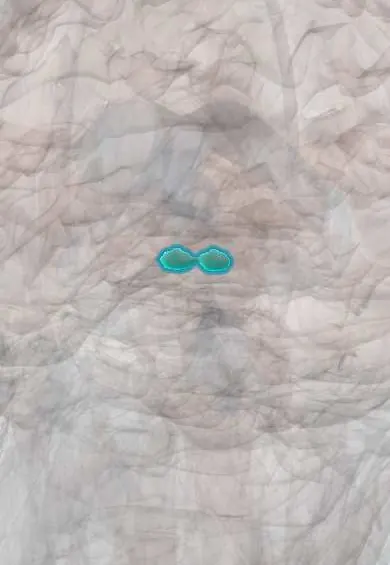
On an axial cut of the upper midbrain it is the dark band between the cerebral peduncle (crus) in front and the tegmentum, with the red nucleus, behind. Its pigment makes it visible to the naked eye in a sliced brainstem; in Parkinson disease it looks pale.
Examination
- Resting tremor that eases on movement and returns on holding a posture
- Rigidity felt on passive wrist rotation, with a ratchet-like give (cogwheeling) when tremor adds to it
- Repeated finger or foot tapping that slows and shrinks (decrement) shows bradykinesia
- Pull test: the examiner tugs the shoulders back from behind; several steps backward or a fall shows postural instability
On imaging
Standard MRI is usually normal. On high-resolution susceptibility imaging the normal bright dorsal nigra ('swallow tail') is lost in Parkinson disease. Dopamine transporter SPECT shows reduced striatal uptake, supporting but not making the diagnosis.
Common problems
- Parkinson disease: its dopamine cells are lost, causing tremor, stiffness, slowness and balance problems.
How it is diagnosed
Clinical exam by a neurologist; special scans in doubtful cases.
Treatment
- Medicines that replace dopamine.
- Deep brain stimulation in selected patients.
- Physical therapy and exercise.
Clinical notes
- Deep brain stimulation of the subthalamic nucleus or internal globus pallidus helps selected patients with advanced Parkinson disease
- The toxin MPTP, a contaminant of illicit drugs, destroys the pars compacta and caused sudden parkinsonism in young people
Memory aid
Parkinson signs: TRAP (Tremor, Rigidity, Akinesia/bradykinesia, Postural instability).
Related conditions
- Parkinson disease
- Dementia with Lewy bodies
- Restless legs syndrome
- Progressive supranuclear palsy
- REM sleep behaviour disorder (RBD)
- Neuroleptic malignant syndrome
- Antipsychotic-induced movement disorders (dystonia, akathisia, parkinsonism, tardive dyskinesia)
Test yourself
Think of the answer, then tap the question to see it.
What are the two parts of the substantia nigra?
Pars compacta: pigmented dopamine neurons projecting to the striatum; pars reticulata: inhibitory output, like the internal globus pallidus.
What are the cardinal signs of Parkinson disease?
Resting «pill-rolling» tremor, rigidity (lead-pipe or cogwheel), bradykinesia and later postural instability.
What does the substantia nigra show at autopsy in Parkinson disease?
It is pale, and surviving neurons contain Lewy bodies (alpha-synuclein).
Which drugs can cause parkinsonism?
Drugs that block dopamine receptors, such as antipsychotics and some antiemetics (metoclopramide).
Educational information, not medical advice. For any symptom, see a health professional.
Its names
- Official Latin (TA2)
- substantia nigra TA2 5881
- Official Spanish (DeCS)
- Sustancia Negra DeCS D013378
- English (TA2)
- Substantia nigra
- Also called
- nucleus niger
Related
Sources: Terminologia Anatomica (TA2); DeCS; Neuroanatomy, Substantia Nigra.
Spotted a mistake?We are always improving for the community. Tell us what is wrong and our team will review it.Report a mistake
Representative model, for educational purposes only.