Insulinoma !
A usually benign pancreatic tumour that makes too much insulin, causing repeated episodes of low blood sugar, often while fasting.
Updated 2026-11-01
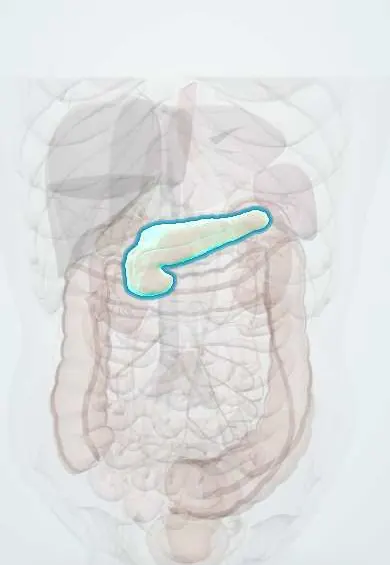
Structures involved
Tap one to see what it is and open it in 3D.
Why it happens
- Hereditary cancer syndromes: the table to know
- Islets and insulin: secretion and actions
- The physiological response to hypoglycemia
- Islets of Langerhans: α, β, δ cells
What it is
A neuroendocrine tumour of the pancreatic islet beta cells that secretes insulin without regulation and causes recurrent hypoglycaemia. It is the most common functioning pancreatic neuroendocrine tumour; about nine in ten are benign, solitary and small.
Who gets it
Rare, with an incidence of a few cases per million people per year, most often diagnosed between the fourth and sixth decades and slightly more in women. Up to about 10% are malignant and a small proportion occur within multiple endocrine neoplasia type 1 (MEN1), where they tend to be multiple.
Causes
- Clonal proliferation of pancreatic beta cells, mostly sporadic
- Hereditary forms within MEN1 syndrome (with parathyroid and pituitary tumours)
Risk factors
- Multiple endocrine neoplasia type 1 (MEN1) or a family history of it
- Middle age
Pathophysiology
Normally insulin secretion falls when glucose drops. Tumour cells keep releasing insulin regardless of glucose, so during fasting or exercise the liver stops producing glucose and tissues keep taking it up, causing hypoglycaemia. Low glucose triggers adrenergic symptoms first and then neuroglycopenic symptoms when the brain is starved of fuel. C-peptide is released with endogenous insulin, which distinguishes it from injected insulin.
Classification
- Benign (most) or malignant (with metastases, usually to liver or lymph nodes)
- Sporadic (solitary) or MEN1-associated (often multiple)
Symptoms and signs
- Episodes of hypoglycaemia, typically when fasting or after exercise
- Adrenergic symptoms: sweating, tremor, palpitations, anxiety, hunger
- Neuroglycopenic symptoms: confusion, abnormal behaviour, blurred or double vision, slurred speech
- Seizures or loss of consciousness in severe episodes
- Weight gain from frequent eating to avoid symptoms
- Whipple triad: symptoms of hypoglycaemia, low plasma glucose at the time, and relief when glucose is raised
Diagnosis
- Clinical
- Document the Whipple triad. In a person without diabetes, recurrent fasting hypoglycaemia needs work-up; ask about access to insulin or sulfonylureas, and look for features of MEN1.
- Tests
- Supervised prolonged fast (up to 72 hours) is the reference test: during documented hypoglycaemia, insulin, C-peptide and proinsulin are inappropriately high, beta-hydroxybutyrate is low, and a sulfonylurea screen is negative. Low C-peptide with high insulin points instead to injected insulin. Calcium, PTH and prolactin if MEN1 is suspected.
- Imaging
- Localisation only after biochemical confirmation: contrast CT or MRI of the pancreas, endoscopic ultrasound (very sensitive for small tumours), and functional imaging such as GLP-1 receptor or somatostatin-receptor scans; intraoperative ultrasound helps the surgeon.
Differential diagnosis
- Exogenous insulin or sulfonylurea use (factitious or accidental)
- Non-insulinoma pancreatogenous hypoglycaemia or post-bariatric hypoglycaemia
- Adrenal insufficiency or hypopituitarism
- Liver failure, sepsis or starvation
- Non-islet cell tumour hypoglycaemia (IGF-2 secreting tumours)
- Epilepsy or psychiatric disorder (misdiagnoses)
Goal of treatment
Cure by removing the tumour while preserving as much pancreas as possible, and prevent hypoglycaemia before surgery or when the tumour cannot be removed.
Treatment
- Surgical
- Surgical removal is curative in most cases: enucleation for small superficial tumours, or distal or central pancreatectomy depending on location; pancreatoduodenectomy (Whipple procedure) for some tumours of the head or multiple tumours.
- Acute
- Hypoglycaemic episodes are treated with oral glucose if the person is alert, or intravenous dextrose (or glucagon) if consciousness is impaired.
- Medical
- When surgery is delayed or not possible: frequent small meals, diazoxide to reduce insulin release, and somatostatin analogues in selected tumours.
- Medical
- Malignant or metastatic disease: liver resection or embolisation, ablation, targeted therapy (such as mTOR inhibitors), chemotherapy or peptide receptor radionuclide therapy.
- Follow-up
- Nursing priorities: frequent capillary glucose checks, especially during the supervised fast and around surgery; seizure precautions; watch for post-operative hyperglycaemia, pancreatic fistula and pancreatitis.
Complications
- Brain injury from severe or prolonged hypoglycaemia
- Injuries or accidents during episodes
- Metastases to the liver or lymph nodes in malignant tumours
- After surgery: pancreatic fistula, pancreatitis and, after extensive resection, diabetes
Prognosis
For benign, solitary tumours that are completely removed, cure is the rule and long-term survival is normal. Malignant insulinomas have a worse outlook, and MEN1-associated tumours may recur.
Test yourself
Think of the answer, then tap the question to see it.
What is the Whipple triad?
Symptoms of hypoglycaemia, a documented low plasma glucose at the same time, and relief of symptoms when glucose is raised.
Which test is the reference standard for diagnosing insulinoma?
A supervised prolonged fast (up to 72 hours) measuring glucose, insulin, C-peptide, proinsulin and beta-hydroxybutyrate during hypoglycaemia.
How does C-peptide distinguish insulinoma from surreptitious insulin injection?
C-peptide is high in insulinoma (endogenous insulin) but suppressed when hypoglycaemia is caused by injected insulin.
Which hereditary syndrome is associated with insulinoma?
Multiple endocrine neoplasia type 1 (MEN1), with parathyroid, pituitary and pancreatic tumours.
What is the treatment of choice for a solitary benign insulinoma?
Surgical removal, often by enucleation, which is usually curative.
Related conditions
Educational information, not medical advice. For any symptom, see a health professional.
Sources: Insulinoma: MedlinePlus Medical Encyclopedia (MedlinePlus (U.S. National Library of Medicine), 2024); Treating Pancreatic Neuroendocrine Tumors (Islet Cell Tumors) (National Cancer Institute, 2026).
Spotted a mistake?We are always improving for the community. Tell us what is wrong and our team will review it.Report a mistake
Representative model, for educational purposes only.